The Rise of Quantum Artificial Intelligence: Elon Musk’s Vision for the Future
Table of Contents
Introduction
Quantum artificial intelligence sits at the intersection of quantum computing and AI research. Interest has grown because quantum systems could eventually support selected machine learning, optimization, and scientific simulation tasks, but current evidence does not support claims of a universal intelligence engine or guaranteed financial returns.
The Elon Musk AI vision has shaped public debate about automation, safety, autonomous systems, and human-machine interaction. However, the quantum computing future is being built mainly through work by research laboratories, universities, and technology companies. This guide explains what quantum AI means, where Musk actually fits, which applications are being tested, and how to avoid misleading “QuantumAI” investment claims.
What it means
Quantum artificial intelligence is research that explores whether quantum computers and quantum algorithms can improve specific AI or machine learning tasks. It is real as a scientific field, but it is not yet a general-purpose technology that makes every AI system faster or smarter.
Elon Musk has influenced public discussion about advanced AI, but there is no verified evidence that he leads or endorses a commercial QuantumAI trading platform. Readers should separate quantum machine learning research from celebrity marketing, speculative predictions, and investment scams.
What Quantum Artificial Intelligence Really Means
Artificial intelligence is a broad category of computer systems that can recognize patterns, generate content, classify information, make predictions, or support decisions. Familiar consumer tools such as Siri and Google Assistant helped introduce conversational AI to everyday users, although those products rely on classical computing rather than quantum processors.
Quantum computing uses quantum mechanical properties to process information. Instead of classical bits that represent either 0 or 1, quantum computers use qubits. A qubit can exist in a combination of states until it is measured, while entanglement and interference can help certain algorithms manipulate probability in ways that classical systems cannot directly copy.
Quantum artificial intelligence combines these areas by asking a focused question: can quantum hardware or quantum algorithms improve a useful part of a machine learning workflow? The answer may eventually be yes for selected problems, but the field is still experimental.
The practical term researchers use most often is quantum machine learning. It covers methods such as quantum kernels, variational quantum circuits, quantum neural networks, optimization routines, and hybrid systems that divide work between classical and quantum computers.
How the Quantum Computing Future Could Affect AI Research
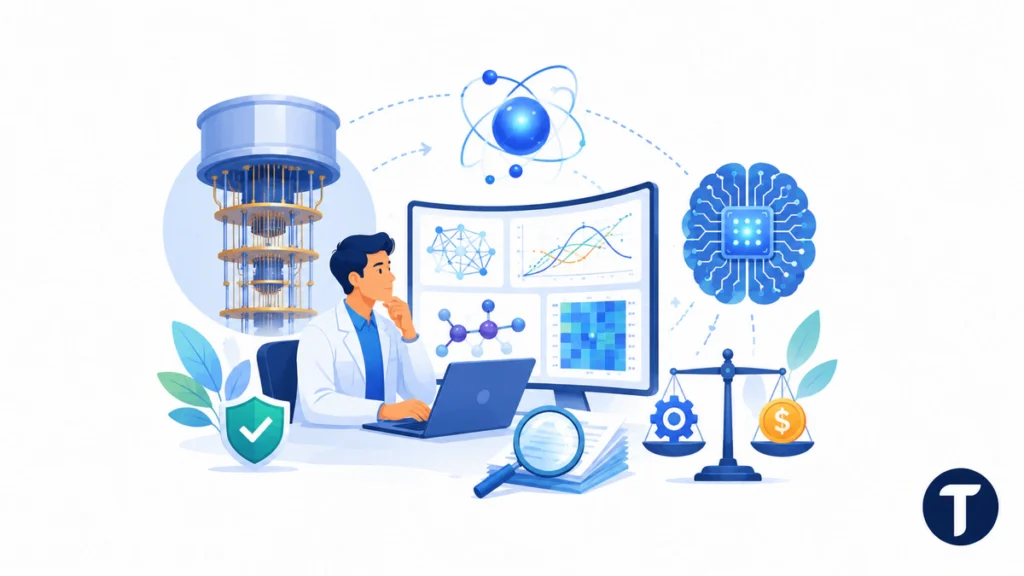
Quantum computers are not simply faster versions of ordinary computers. They may offer advantages for particular mathematical structures, sampling problems, simulations, or optimization tasks. That means the strongest future use cases will probably be narrow and technically defined rather than a universal replacement for classical AI.
Google’s Quantum AI lab is developing quantum hardware, software, and error-correction methods with the long-term goal of useful large-scale quantum computing. Its work shows that the field is advancing, but it also shows why reliable quantum computation requires much more than attaching the word “quantum” to an AI product.
Evidence must remain central. A 2025 systematic review of quantum machine learning for digital health examined thousands of studies and found no consistent performance trend showing empirical quantum utility over classical methods in that field. It shows that researchers still need better hardware, stronger benchmarks, realistic operating conditions, and fair comparisons.
This distinction matters because theoretical speedups, laboratory demonstrations, simulations, and commercial products are not the same thing. A useful quantum artificial intelligence system must solve a real problem better enough to justify its cost, complexity, data requirements, and operational risk.
What the Elon Musk AI Vision Actually Means
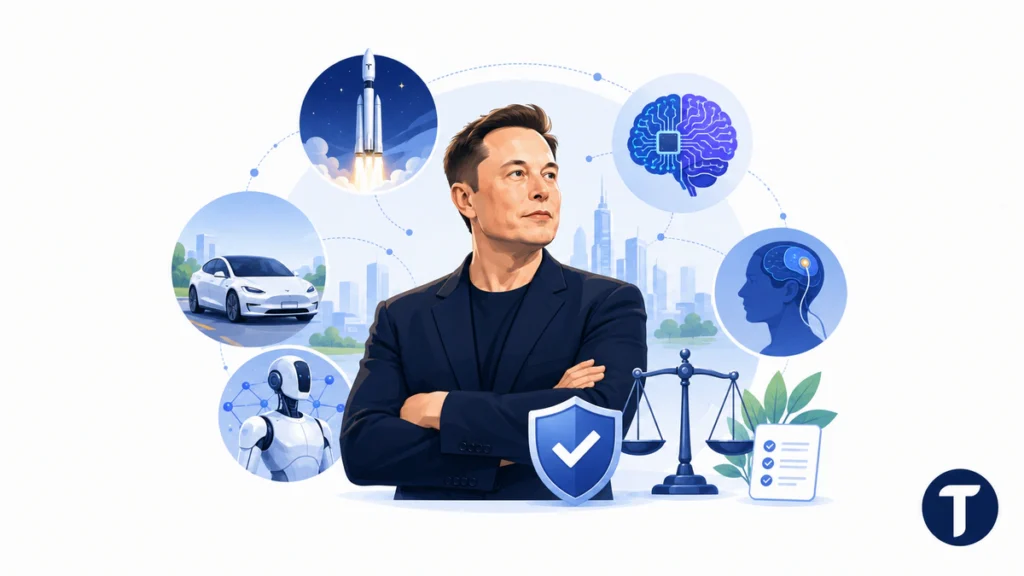
Elon Musk is closely associated with ambitious technology projects involving electric vehicles, space systems, autonomous driving, artificial intelligence, and brain-computer interfaces. His public comments have also helped make AI safety and advanced machine intelligence mainstream topics.
That influence does not establish a verified quantum computing program. There is no clear public evidence that Musk leads a dedicated quantum artificial intelligence company, has launched an official QuantumAI trading system, or has endorsed platforms that promise automated profits under that name.
The most accurate interpretation of the Elon Musk AI vision is broader. Musk has repeatedly promoted rapid technological development while warning that powerful AI systems require oversight and safety controls. Those concerns are relevant to quantum AI because stronger computing capabilities could create new benefits and new governance questions. In that sense, the Elon Musk AI vision is a discussion about capability, control, and long-term risk rather than proof of a specific quantum product.
However, readers should not turn a broad technology philosophy into a specific endorsement. A video, advertisement, social media post, or news-style page that uses Musk’s image is not proof of a commercial relationship. Verification requires an announcement from an official company channel, a regulatory filing, credible reporting, or technical documentation that identifies the people and organizations involved.
Quantum Artificial Intelligence Claims: Research Versus Marketing
| Claim | What the Evidence Supports | Practical Status |
|---|---|---|
| Quantum AI can improve every machine learning task | Quantum methods may help selected problems with suitable mathematical structure | Unsupported as a universal claim |
| Quantum computers test every answer at once | Superposition supports different computational behavior, but measurement and algorithm design still limit what can be extracted | Misleading simplification |
| Elon Musk runs a QuantumAI trading platform | No verified official connection has been established | Treat as an unverified marketing claim |
| Quantum AI already guarantees better medical diagnosis | Research is active, but strong evidence of consistent real-world advantage remains limited | Experimental |
| Quantum computing may support optimization and simulation | These are major research areas with plausible long-term value | Promising but problem-specific |
| A celebrity endorsement proves an investment is safe | Images, testimonials, and deepfakes can be fabricated or used without authorization | High scam risk |
The table highlights the central problem: the phrase quantum artificial intelligence is used for both legitimate research and vague marketing. Readers must identify which meaning applies before trusting a claim.
Real-World Applications Researchers Are Exploring
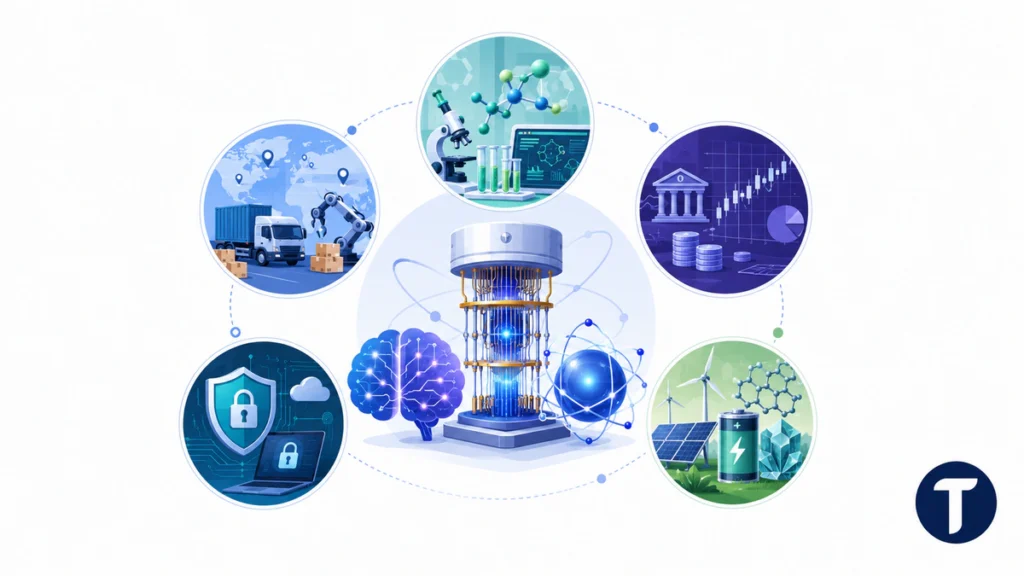
Drug Discovery and Molecular Research
Quantum systems may eventually help simulate molecules, chemical reactions, and material properties that are difficult to model accurately with classical methods. AI can help identify patterns, prioritize candidate compounds, or interpret experimental data.
The important distinction is that quantum simulation and quantum machine learning are related but not identical. A research project may use classical AI to analyze data from a quantum experiment, use a quantum algorithm inside a hybrid workflow, or study whether a quantum model can improve prediction.
Optimization and Logistics
Transportation networks, manufacturing schedules, supply chains, energy systems, and workforce planning can involve enormous numbers of possible combinations. Quantum optimization methods are being studied as potential tools for selected versions of these problems.
Businesses should not assume that a quantum method will automatically beat established optimization software. The test must include runtime, solution quality, hardware access, data preparation, repeatability, and comparison with strong classical alternatives.
Finance and Risk Analysis
Banks and researchers are exploring quantum approaches to portfolio optimization, fraud analysis, risk calculations, and scenario modeling. These areas attract attention because financial problems can involve uncertainty, large datasets, and difficult optimization.
Research activity does not justify a consumer platform promising guaranteed returns. A website that asks for a quick deposit while offering vague “quantum-powered” profits does not meet the documentation and oversight expected from a legitimate financial service.
Cybersecurity
Quantum computing could affect cybersecurity in two different ways. Large fault-tolerant quantum computers may eventually threaten some widely used public-key cryptography, while quantum-resistant cryptographic standards are being developed to prepare for that possibility.
AI may also help monitor networks, classify threats, or support security operations. Combining quantum computing and AI in cybersecurity remains a research topic, not a reason to replace proven security controls today.
Climate, Energy, and Materials
Researchers are studying whether quantum computation can support material discovery, energy optimization, battery chemistry, and complex physical simulations. AI can help analyze results or guide experiments.
These applications may become important because better materials and more efficient processes can affect energy storage, manufacturing, and climate technology. Progress will depend on error-corrected hardware, useful algorithms, and evidence that the quantum approach performs better than practical classical methods.
What Limits Quantum Artificial Intelligence Today
Quantum artificial intelligence faces several technical and commercial limits.
First, quantum hardware is noisy. Qubits are fragile, and unwanted interactions can create errors before a calculation is complete. Error mitigation can improve some experiments, but large-scale reliable computing will require stronger error correction.
Second, current systems have limited usable scale. A processor may contain many physical qubits while still lacking enough stable logical qubits for a valuable production workload.
Third, classical data must often be encoded into a quantum state. If loading or transforming the data takes too much time, the theoretical advantage can disappear.
Fourth, benchmarking is difficult. Small experiments may compare a quantum model with a weak classical baseline, use ideal simulations, or ignore hardware costs. A credible result must use competitive classical methods and disclose the conditions clearly.
Finally, quantum talent, hardware access, software development, and experimentation can be expensive. Most organizations will gain more immediate value from better classical AI, clean data, secure infrastructure, and well-designed workflows.
What Is QuantumAI, and Is It Trustworthy?

“QuantumAI” is not one universally recognized product or company. The name may refer to research groups, software experiments, educational content, or unrelated commercial platforms. Some online advertisements use it to promote automated trading, cryptocurrency, or investment services.
Treat any platform cautiously when it claims Elon Musk support, guaranteed profit, almost no risk, secret algorithms, or unusually fast returns. The Federal Trade Commission’s investment scam guidance warns that scammers may use celebrity testimonials, promises of large profits, pressure to act quickly, and limited documentation.
Before sending money, check the legal company name, physical location, regulatory status, ownership, fees, withdrawal rules, privacy policy, and independent complaint history. Search the relevant financial regulator’s database rather than trusting a badge displayed on the platform itself.
Do not assume that a polished dashboard proves real trading activity. Scam sites can display fabricated balances and gains, then demand more money for taxes, verification, account upgrades, or withdrawal fees.
How to Evaluate a Quantum Artificial Intelligence Claim
Use a simple evidence checklist before believing a headline, buying a product, or approving a pilot:
- Identify the exact problem. What task is the system supposed to improve?
- Ask what is quantum. Does it use real quantum hardware, a simulator, a quantum-inspired classical method, or only marketing language?
- Check the evidence. Look for peer-reviewed research, reproducible benchmarks, technical documentation, or credible independent testing.
- Find the classical baseline. A quantum result matters only when compared fairly with strong classical alternatives.
- Review the operating conditions. Was the result produced on ideal simulation, noisy hardware, or a production environment?
- Verify the organization. Confirm the company, researchers, partners, and official announcements.
- Reject guaranteed returns. No legitimate technology removes investment risk.
- Protect your data. Do not provide identity documents, payment details, or account access until the service has passed due diligence.
A credible provider should welcome detailed questions. Evasive answers, urgency, secret methods, and celebrity imagery are warning signs.
How Individuals Can Learn About Quantum Artificial Intelligence
Start with the foundations. Learn basic linear algebra, probability, Python, machine learning concepts, and introductory quantum mechanics. You do not need advanced physics to begin understanding qubits, gates, circuits, measurement, and simple algorithms.
Use reputable learning environments rather than investment promotions. IBM Quantum, Google Quantum AI, university courses, and open-source frameworks can help learners run small circuits, use simulators, and understand the limitations of current hardware.
Next, build a small project. Compare a classical model with a simple quantum or hybrid method on a manageable dataset. Record the data preparation, model size, runtime, accuracy, hardware conditions, and limitations.
Research conferences, university groups, professional communities, and open-source projects provide better signals than anonymous accounts promising exclusive investment access.
How Businesses Should Prepare
Most businesses do not need to purchase quantum AI software today. They need a monitoring and evaluation process that prepares them for the quantum computing future without forcing premature investment.
Assign someone to track credible research, vendor roadmaps, standards, security implications, and relevant industry experiments. Define the business problems that might justify deeper investigation, such as molecular simulation, difficult optimization, or specialized scientific computing.
Organizations evaluating experimental AI should also use TechBonna’s guide to building an AI governance framework for organizational transformation. That moves the reader from awareness to action by establishing decision owners, evidence requirements, pilot controls, risk reviews, and clear approval gates.
A pilot should begin only when the organization can state the problem, select a baseline, protect the data, measure the result, and stop the project if the evidence is weak. Technology strategy should follow operational value, not fear of missing out.
Things people ask
Is Quantum Artificial Intelligence Real?
Yes. Quantum artificial intelligence is a real research area that connects quantum computing with machine learning and AI-related tasks. It is not yet a general-purpose commercial technology that outperforms classical AI across ordinary business uses.
Is Elon Musk Leading Quantum AI?
There is no verified public evidence that Elon Musk leads a dedicated quantum AI program or endorses commercial QuantumAI trading platforms. His influence is mainly connected to broader AI development, safety debates, autonomy, and human-machine interaction.
Can Quantum AI Replace Classical AI?
Not broadly. Classical AI will remain the practical choice for most current applications because the hardware, software, data pipelines, talent, and deployment tools are mature. Quantum approaches may eventually complement classical systems for selected problems.
Can Quantum AI Guarantee Investment Profits?
No. No AI, quantum computer, trading bot, or investment platform can guarantee profits without risk. Claims of guaranteed returns, celebrity backing, secret algorithms, or urgent deposits are major warning signs.
What Should People Watch Next?
For the quantum computing future, watch progress in logical qubits, error correction, hardware reliability, quantum algorithms, data encoding, independent benchmarks, and useful demonstrations under realistic conditions. Also watch whether results survive comparison with improving classical methods.
The takeaway
Quantum artificial intelligence deserves attention because it may eventually support important advances in machine learning, optimization, simulation, and scientific discovery. The field also deserves restraint because current hardware and evidence remain far behind the most dramatic marketing claims.
The most responsible view combines curiosity with verification. The Elon Musk AI vision can help explain why advanced technology attracts public interest, but it should not be treated as proof of a specific product or endorsement. A credible quantum computing future will be built through research, engineering, transparent testing, and responsible governance, not celebrity images or guaranteed-profit promises.