Why AI Transformation Needs an AI Governance Framework in 2026
Table of Contents
AI transformation is moving from pilot projects into daily business systems. That makes an AI governance framework, enterprise AI risk management, and responsible AI policy just as important as models, data, and cloud infrastructure.
For day-to-day AI reliability, governance should also cover the errors teams see in production tools. A practical example is documenting what to do when the DeepSeek server is busy error appears, because that separates service outages from local access, browser, network, and API issues.
The challenge is simple: when an AI system influences hiring, pricing, lending, support, fraud detection, or clinical review, it changes who makes decisions. Strong AI governance keeps that power clear, monitored, and accountable.
In 2026, this matters more because AI is no longer limited to isolated experiments. More teams are using generative AI, predictive models, vendor tools, and automated workflows in live business processes. Governance gives those systems rules before scale turns small mistakes into company-wide risk.
In brief
AI transformation needs an AI governance framework because AI changes how decisions are made across the business. Governance defines who approves AI use, who owns risk, how models are monitored, and what happens when an automated decision creates harm.
In 2026, effective AI governance is not only a compliance task. It is the operating model that helps companies manage AI risk, protect customers, meet rules such as the EU AI Act, and scale responsible AI without losing control.
The rule the article names is worth reading in its own terms rather than through a vendor summary. The European Commission’s own summary of the AI Act sets out its risk tiers, and that structure is the practical reason governance has to classify use cases before it can assign controls.
| Question | Short Answer |
|---|---|
| What Is the Core Problem? | Unclear decision rights around AI systems. |
| Who Should Own It? | Executive leadership, risk, legal, security, product, and data teams together. |
| What Should Be Governed? | Data, models, vendors, AI use cases, monitoring, and escalation. |
| What Is the Goal? | Trustworthy AI that supports business results without creating unmanaged liability. |
Why AI Governance Matters Before Scale
Many companies treat AI development like a software rollout. They fund a tool, assign a team, and expect the business case to appear after launch.
That approach breaks down when AI deployment touches real decisions. A chatbot can give the wrong answer. A fraud model can block a legitimate customer. A pricing model can create unfair outcomes. A recruiting tool can repeat bias hidden in past data.
AI governance matters because scale multiplies both value and mistakes. A weak manual process may affect 20 records. A weak model can affect thousands before anyone notices.
For example, a company using AI for credit approvals should define who owns the model, what data can be used, how rejected customers can appeal, how bias is tested, and when the system must be paused. Without those rules, the business may not notice harm until customers, regulators, or auditors find it first.
How Delivery Teams Fit into AI Governance
AI transformation often needs more than one internal team. Companies may need cloud engineers, data specialists, security reviewers, compliance support, and software teams that understand enterprise AI.
AI governance also matters when work is distributed across vendors, offshore teams, or outside delivery partners. Some organizations expand capacity with external partners, including Colombia IT companies, when they need extra help with data engineering, cloud platforms, or compliance-focused software delivery. The delivery location is not the main issue. The governance structure is.
Every partner should work within the same responsible AI policy. That means clear access rules, documented model changes, security requirements, vendor oversight, and named owners for each AI system.
| Governance Area | What It Controls | Why It Matters |
|---|---|---|
| Decision Rights | Who can approve, pause, or change AI use. | Prevents authority from drifting across teams. |
| Data Governance | Data quality, access, retention, and transfer rules. | Bad data creates bad model outcomes. |
| Model Governance | Validation, testing, monitoring, and retirement. | Keeps AI models aligned with real-world performance. |
| Risk Escalation | Who acts when harm, drift, or bias appears. | Turns incidents into managed responses. |
What Makes AI Governance Different from IT Governance
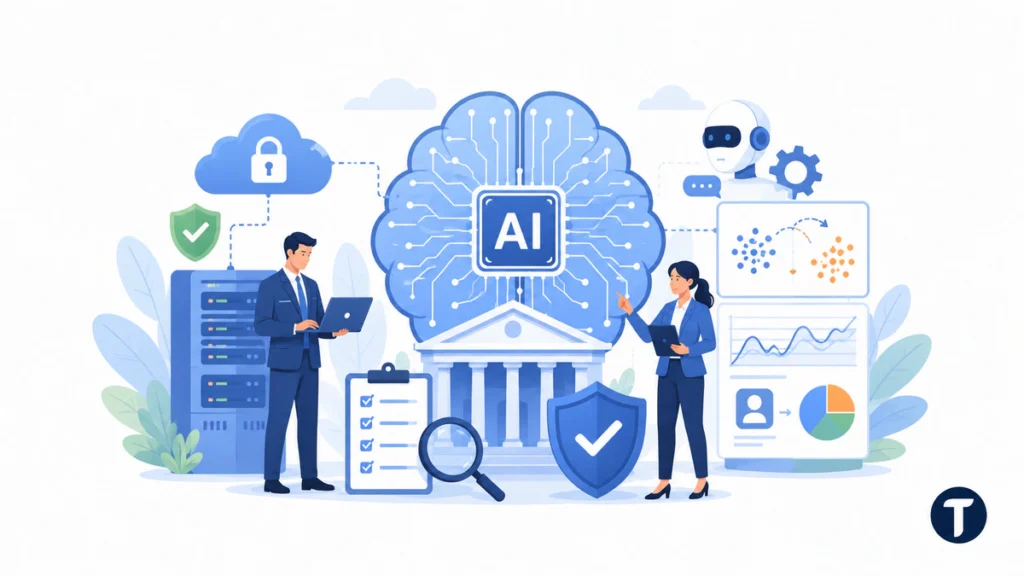
Traditional IT governance focuses on systems, access, uptime, cybersecurity, procurement, and change control. Those controls still matter, but they are not enough for evolving AI.
An AI system may behave differently as inputs change. AI models can drift, learn patterns that no longer fit the market, or produce outputs that are hard for users to explain. Generative AI adds another layer because employees can use public tools before the company has approved them.
This is why the NIST Generative AI Profile for the AI RMF is useful. It frames trustworthy AI around governance, mapping, measurement, and management, not only technical performance. The NIST AI RMF gives companies a practical way to connect AI risk assessment with daily oversight.
Why 2026 Changes the Governance Conversation
The AI governance conversation is sharper in 2026 because regulation, customer expectations, and enterprise adoption are moving at the same time. The EU AI Act becomes a practical concern for companies that build, buy, or deploy AI systems connected to regulated markets or high-impact decisions.
That does not mean every company needs the same compliance program. It means leaders need a clear way to classify AI use cases, document high-risk systems, review vendor tools, preserve audit trails, and prove that human oversight exists where it matters.
For teams using AI in hiring, lending, healthcare, education, fraud detection, pricing, or customer eligibility, governance is no longer optional paperwork. It is part of the product, risk, legal, data, and security operating model.
The Main Governance Gaps That Block AI Transformation
AI initiatives usually stall for one of five reasons. The technology may work, but the organization cannot answer basic ownership questions.
- No clear owner: Product, legal, IT, and data science all assume another team owns the risk.
- Weak board reporting: Leaders hear about AI wins, but not model failures, rejected use cases, or unresolved risks.
- Inconsistent data rules: Business units define data quality, consent, retention, and access in different ways.
- No monitoring plan: The model launches, but no one tracks drift, bias, accuracy, or customer harm over time.
- Principles without enforcement: AI ethics statements exist, but teams lack metrics, approvals, and consequences.
Effective AI governance turns broad AI principles into practical AI practices. It tells teams what to document, when to review, and when to stop.
Key Components of an Effective AI Governance Framework
A strong governance framework should be simple enough to use and strong enough to survive pressure. It should not live only in a policy file.
| Pillar | Practical Question | Example Control |
|---|---|---|
| Use Case Review | Is this low, medium, or high-risk AI? | Risk tiering before build or purchase. |
| Data and Privacy | Can this data be used for this purpose? | Access controls, consent checks, and retention rules. |
| Model Lifecycle | How will we test, monitor, and retire the model? | Validation records and retraining thresholds. |
| Human Oversight | When must a person review the output? | Human-in-the-loop review for high-risk AI systems. |
| Audit Trail | Can we explain what happened later? | Logs, documentation, and decision records. |
Standards can help here. ISO 42001 gives organizations a management system approach for AI management, while the OECD AI Principles help define responsible AI use at a policy level. The EU AI Act adds legal duties for certain high-risk AI categories.
Board-Level Questions for AI Governance
A practical AI governance framework should help leaders answer direct questions before an AI system goes live:
- Which AI systems affect customers, employees, pricing, eligibility, safety, or legal rights?
- Who can approve, pause, change, or retire each system?
- What data is used, and who approved that use?
- How often is model performance reviewed?
- What happens when the system creates harm, drift, bias, or inaccurate output?
- Which vendor tools use AI, and what access do they have to company data?
These questions turn responsible AI from a statement into a repeatable control system.
How AI Governance Links to Business Results
Governance is sometimes treated as the department that says no. In good companies, it does the opposite. It lets teams move faster because the rules are known before the project starts.
A clear framework for AI helps teams approve safer use cases, reject weak ones earlier, and focus investment on systems that can survive legal, security, and customer review. It also supports better forecasting from historical operational data because teams know which data is trusted, who owns the model, and how performance will be checked.
Strong oversight can also support business goals such as Reduced manual work, faster reporting, better customer service, and more consistent decisions. The point is not to slow AI down. The point is to make sure useful AI can keep running.
How to Implement AI Governance
You do not need a 200-page policy to start. You need a clear governance model that teams can follow.
First 30 days:
- Define AI risk appetite and responsible AI principles.
- Inventory current AI use, including shadow AI and vendor tools.
- Identify systems that affect customers, employees, pricing, eligibility, or safety.
Next 60 days:
- Classify AI use cases by business impact and regulatory exposure.
- Assign owners for data, model performance, security, compliance, and outcomes.
- Create approval gates for high-risk AI systems and sensitive data use.
Next 90 days:
- Document testing, AI impact assessments, monitoring, and escalation paths.
- Set review cycles for drift, bias, accuracy, privacy, and vendor risk.
- Review the governance model regularly as laws, tools, and risks change.
The best practices are the ones people can actually follow. If the process is too slow, employees will route around it. If it is too vague, risk will hide inside everyday workflows.
Governance Standards and Operating Model
Key AI governance frameworks help teams move from opinion to repeatable control.
| Framework | Best Use | What It Helps With |
|---|---|---|
| NIST AI RMF | Risk language and oversight | Governance, mapping, measurement, and management. |
| ISO 42001 | AI management system | Roles, policies, controls, and continuous improvement. |
| EU AI Act | Legal compliance | High-risk classification, documentation, and oversight. |
| OECD AI Principles | Responsible AI policy | Trustworthy, human-centered AI principles. |
The operating model should document AI ownership, monitor AI performance, and govern AI workloads across the AI lifecycle. It should also align AI investments with existing governance, robust data governance, ethical AI review, responsible AI practices, and a clear standard for AI development and deployment.
This is where responsible AI governance becomes practical. Teams can develop AI with a shared understanding of AI risk, document AI decisions, protect trust in AI, and update the approach to AI as tools, rules, and business needs change.
The takeaway
AI transformation is not only about choosing better tools. It is about deciding how much authority an AI system should have, who is responsible for that authority, and how the company will prove that its decisions are fair, secure, and explainable.
In 2026, the companies that win with AI will not be the ones that deploy every model first. They will be the ones with an AI governance framework that connects enterprise AI risk management, responsible AI policy, and daily AI governance into one working system.
Marketing teams also need feedback loops after policy is written. TechBonna’s guide to AI search monitoring tools and AI visibility tracking explains how prompts, citations, and answer snapshots can show whether public source material supports clear brand positioning.