Why Is AI Moving From Our Phones to Wearable Devices
Table of Contents
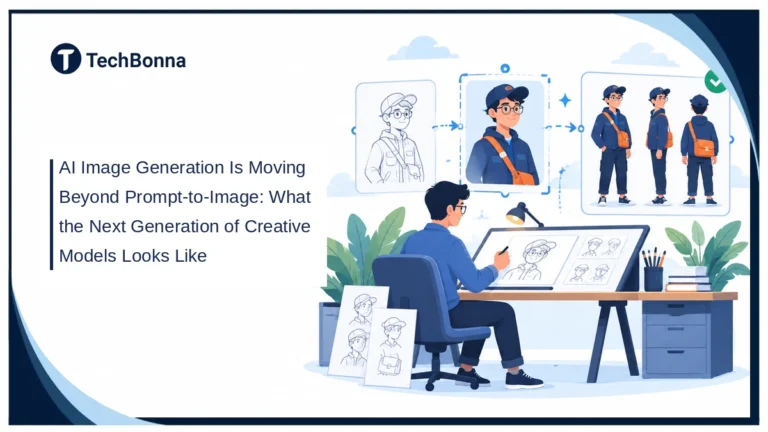
Wearable AI is changing how people use technology because phones are no longer the easiest device for every moment. Smart glasses can capture what you see, while voice assistants can answer questions, set reminders, and guide simple tasks without forcing you back to a screen.
This does not mean phones are finished. It means wearable devices are becoming the quicker layer for daily help, especially when you are walking, commuting, exercising, cooking, traveling, or working with your hands.
The short explanation
AI is moving from phones to wearable devices because people want faster, hands-free, and more natural access to digital help. Wearables such as smart watches, earbuds, rings, and smart glasses make AI easier to use in the exact moment someone needs it, without unlocking a phone or opening another app.
Phones still matter for detailed work, typing, shopping, editing, and long browsing sessions. Wearable AI works best for short interactions, including voice commands, alerts, reminders, audio, quick search, translation, navigation, and first-person capture.
Why Wearable AI Is Moving Beyond The Phone Screen
The smartphone became the center of digital life because it put the internet, apps, cameras, messages, payments, and maps in one pocket. That power is not going away, but it also creates friction. A small task can turn into a screen session with notifications, scrolling, and app switching.
Pew Research Center reports that about nine-in-ten U.S. adults own a smartphone, which shows how deeply phone-based computing is built into everyday life. That same dependence explains why lighter, faster interfaces are becoming more useful.
Wearable AI reduces the number of steps between a need and an answer. Instead of unlocking a phone, opening an app, typing a prompt, and reading a screen, a person can ask a question through earbuds, glance at a watch, or use smart eyewear for quick context.
The core shift is convenience: AI becomes more useful when it is available at the speed of the moment.
How Smart Glasses Make AI Feel More Natural
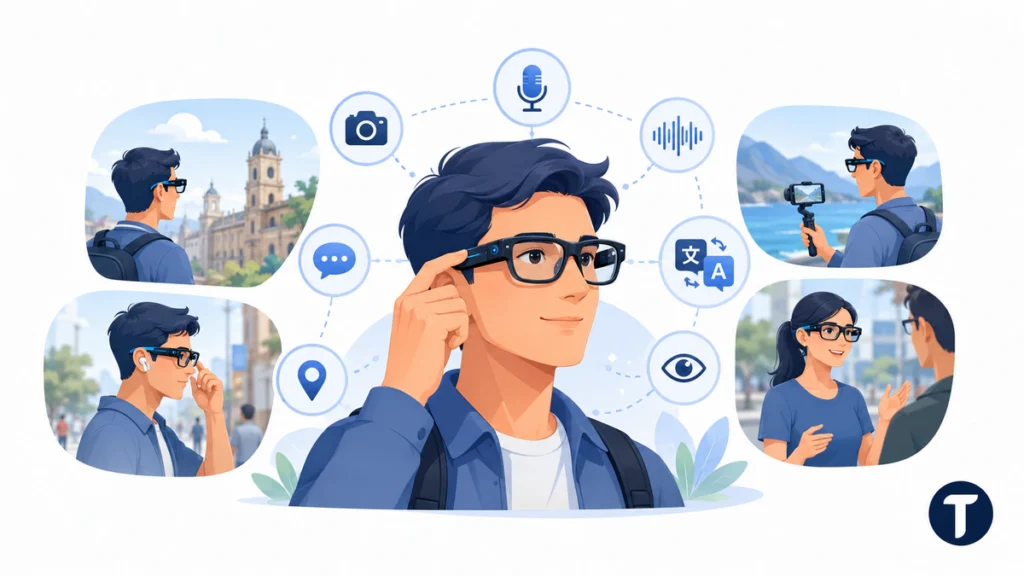
Smart glasses are one of the clearest signs that AI is moving into accessories people already understand. Eyewear sits at eye level, so it can support voice, audio, camera capture, translation, navigation, and visual context without asking the user to hold a device.
This is where AI-powered glasses from Ray-Ban show the wider direction of the market. The important point is not only that the glasses include smart features. It is that those features live in something people may already wear while walking, traveling, filming, listening, or talking.
Smart glasses also fit the way people naturally experience the world. A phone camera captures what you point at after you take it out. Glasses can capture a first-person view more quickly, which matters for short videos, notes, travel moments, and future AI tools that respond to what the user is seeing.
IDC forecasts that display-less smart glasses shipments will grow from about 13.6 million units in 2026 to 27.3 million by 2030. That does not make smart eyewear mainstream overnight, but it shows that the category is moving from experiment to serious consumer device.
Voice Assistants Are Becoming The Main Wearable Interface
Typing works well when you are sitting still. It is less useful when you are carrying shopping bags, driving, cooking, exercising, fixing something, or walking through a busy place. That is why voice assistants matter so much for wearable AI.
Voice turns AI into a conversation instead of a menu. You do not need to remember where a feature lives, which app has the right button, or how to phrase a search query for a tiny screen. You can ask for a reminder, message summary, translation, quick fact, calendar update, or audio command in plain language.
This is also why earbuds and watches are important. They may not feel as futuristic as glasses, but they are already normal accessories. When AI runs through them well, the assistant becomes available without pulling attention away from the physical world.
The Stanford HAI 2025 AI Index tracks how quickly AI capability and adoption are moving across daily tools and business systems. Wearables fit that larger pattern because they bring AI closer to ordinary routines instead of leaving it inside a separate app.
Wearable AI Vs Phone AI: What Each Device Does Best
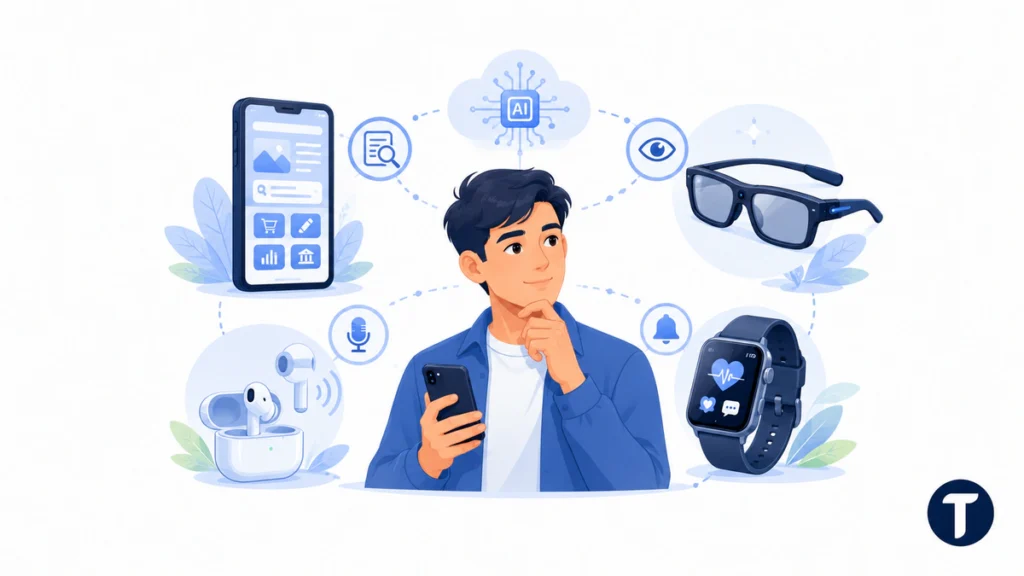
The best way to understand this shift is not to ask which device wins. Phones and wearables solve different problems. A phone is still the better device for long reading, editing, browsing, forms, payments, research, and tasks that need a larger screen.
Wearable AI works best when the task is brief, contextual, or hands-free. It can handle the small moments that make people reach for a phone many times a day.
| Device Type | Best For | Why It Matters |
|---|---|---|
| Phone AI | Writing, research, shopping, editing, visual browsing, and app-based workflows | The larger screen and keyboard support deeper work. |
| Smart Glasses | First-person capture, audio help, translation, navigation, and visual context | They keep the user’s hands free and stay close to the line of sight. |
| Watch AI | Alerts, health prompts, reminders, timers, quick replies, and glanceable updates | The wrist is fast for simple decisions and short status checks. |
| Earbud AI | Voice commands, message summaries, calls, directions, and language support | Audio gives users help without requiring a screen. |
The future is not phone AI versus wearable AI. It is a connected system where each device handles the part of the task it is best suited for.
Why Smaller AI Interactions Matter
Many people judge AI by large tasks, such as writing a report, planning a project, editing photos, or analyzing data. Those jobs are important, but daily usefulness often comes from smaller interactions repeated many times.
A wearable can help when you need to remember a thought, hear a message, ask for a quick conversion, translate a phrase, capture a moment, check a direction, or control audio. Each task may take only a few seconds, yet the saved effort adds up because the user does not have to break attention and stare at a phone.
This is where wearable AI can reduce screen dependence. It can keep useful technology close while making it less likely that every small action becomes another scroll session.
For TechBonna readers comparing broader AI tools, the same logic applies to software decisions too. The strongest tools do not only add features. They remove steps from the user’s day and make the right action easier to take.
Wearable devices are only one example of practical AI adoption. TechBonna also explains how smart payment routing uses AI to boost approval rates in digital payment systems.
What Needs To Improve Before Wearable AI Feels Mainstream
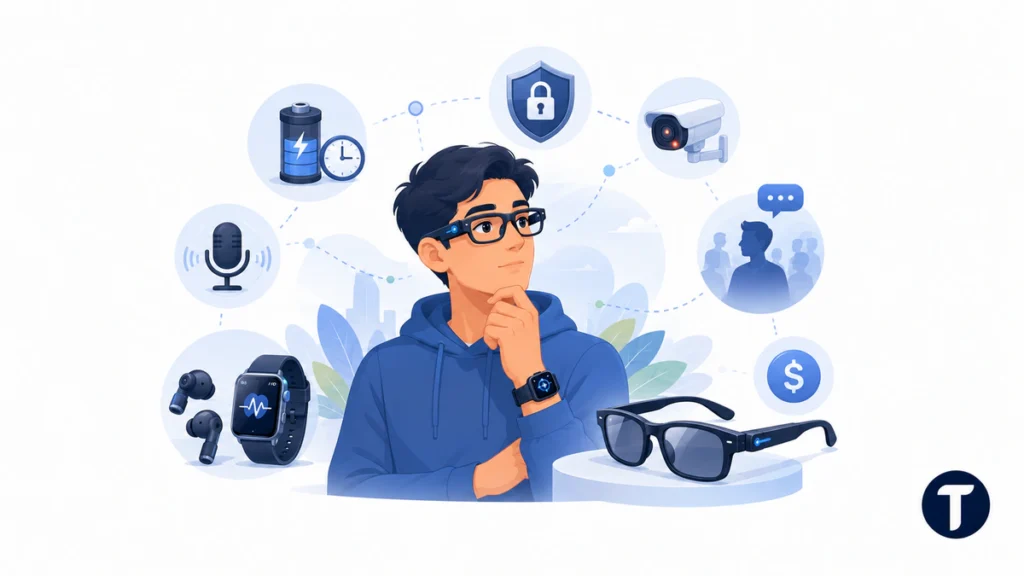
Wearable AI still has limits. Battery life, privacy, comfort, cost, camera concerns, always-listening worries, data security, and social acceptance all affect adoption. A device can be clever and still fail if people feel awkward wearing it or unsure about when it is recording.
Accuracy also matters. If a voice assistant misunderstands a command, gives a weak answer, or interrupts at the wrong time, users will go back to their phones. The wearable experience has to feel quick, reliable, and respectful of attention.
Design is another barrier. Wearables must be useful without becoming distracting. A watch should not overload the wrist with notifications. Glasses should not make every moment feel like a recording session. Earbuds should not make private tasks feel exposed in public.
The winning wearable devices will be the ones that make AI feel quieter, faster, and more practical, not louder or more intrusive.
How Businesses Should Think About Wearable AI
Businesses should watch this shift because it changes how users may search, buy, communicate, and ask for help. If more interactions happen through voice and glanceable screens, content needs to answer questions clearly and directly.
This is especially important for support pages, local search, product comparisons, how-to content, and short explainers. Wearable users are not likely to read long blocks of text on a tiny screen. They need concise answers first, with deeper detail available when they move to a phone or laptop.
Brands should also think about context. A customer using wearable AI may be walking, cooking, driving, shopping, or traveling. The answer needs to be useful in motion. That favors clean structure, clear headings, natural language, and content that can be read aloud by an assistant.
How Wearable Technology Changes The AI Device Form Factor
A useful AI wearable needs more than a small chip and a microphone. It needs sensor data, an AI model that can understand context, real-time audio, clear privacy controls, and a form factor people can wear without thinking about it all day.
This is why the next wave includes more than glasses. Smartwatches, a smart ring, an AI pin, a pendant, a wristband, and earbuds can all become different paths into wearable technology. Each AI device collects different signals, from movement and health monitoring to audio notes and location cues.
Artificial intelligence is moving toward these mobile devices because AI technology works best when it can use AI at the point of need. Machine learning can summarize a transcript, improve health data alerts, support early detection of health issues, and make the response feel seamless instead of delayed.
That health data carries obligations the device maker cannot wave away. In the US, the FTC’s Health Breach Notification Rule reaches health apps and connected devices, not only medical providers, so a wearable collecting identifiable health information sits inside a notification regime from the day it ships.
AI wearables also show why AI hardware is becoming a real tech trend. Apple Vision Pro, AR glasses, and an AI-powered wearable may serve different users, but they all point to the same idea: wearable AI devices are redefining how people interact with technology.
The future of AI will depend on trust as much as features. If AI models become more powerful while tech companies make wearables easier to control, wearable AI could transform communication without making the user feel watched, distracted, or overloaded.
Related questions
Will Wearable AI Replace Smartphones?
No. Wearable AI will not replace smartphones in the near term. Phones are still better for detailed work, visual browsing, typing, editing, payments, and full app experiences. Wearables handle faster, simpler, hands-free moments.
Why Are Smart Glasses Important For AI?
Smart glasses are important because they sit close to the user’s eyes and ears. That creates a natural place for voice help, audio responses, first-person capture, translation, navigation, and future visual AI support.
Are Voice Assistants The Main Reason AI Is Moving To Wearables?
Voice assistants are one of the main reasons. Wearables often have small or no screens, so voice gives users a simple way to ask questions, control features, and receive help without typing.
What Are The Biggest Risks Of Wearable AI?
The biggest risks include privacy, recording concerns, data security, battery life, weak accuracy, distraction, and social discomfort. Wearable devices need clear controls and trustworthy design before they feel normal for more people.
What this means in practice
AI is moving from phones to wearable devices because people want help that is faster, lighter, and closer to the moment. Phones remain essential, but they are not always the best interface for quick answers, hands-free capture, reminders, navigation, or audio support.
Wearable AI, smart glasses, and voice assistants point toward a more flexible future where technology follows the user across devices instead of forcing every small task through one screen. The most useful AI will not live in one gadget. It will appear through the device that fits the moment best.