AI Cybersecurity Certification Courses: 11 Powerful Skills for Safer Teams
Table of Contents
AI cybersecurity certification courses have become more important as attackers use AI to find weaknesses, test defenses, and abuse vulnerable systems faster. Security teams now need practical training that connects artificial intelligence with cybersecurity skills, operational risk, and real-world response.
The best programs do more than explain AI tools. They teach professionals how to identify AI risks, test AI systems, protect sensitive data, and respond when automation creates new security exposure.
Quick Answer
AI cybersecurity certification courses help security professionals understand, test, and protect systems that use artificial intelligence. They usually cover risks involving machine learning models, large language models, prompts, data pipelines, cloud services, and automated workflows.
A strong AI cybersecurity certification course should teach practical skills such as AI threat modeling, data protection, adversarial testing, secure AI development, governance, monitoring, incident response, and clear reporting. The goal is not just to earn a credential, but to help teams recognize AI-related risk and respond safely in real environments. In practical terms, AI cybersecurity certification helps teams turn AI risk into safer decisions.
Threat modelling is easier to teach against a concrete list. The MITRE ATLAS matrix organises tactics and techniques used against AI systems the same way ATT&CK does for enterprise networks, which gives a training exercise real adversary behaviour to work from instead of invented scenarios.
Why AI Cybersecurity Certification Courses Matter Now
AI is no longer a side topic for security teams. It now appears in customer support tools, developer workflows, fraud detection, endpoint security, data analysis, and internal automation.
That creates a simple problem. If an organization uses AI systems but its team only understands traditional information security, blind spots grow quickly.
The main value of AI cybersecurity certification courses is that they translate new AI risk into practical security work. They help cybersecurity analysts, security engineers, and security leaders understand what changes when software starts learning from data, generating outputs, and making recommendations at speed.
NIST has also recognized this shift through its NICE Framework work. Its updated AI Security Competency Area focuses on the knowledge and skills needed to understand the intersection of artificial intelligence, cybersecurity, and workforce readiness. You can review that workforce context in NIST’s update on NICE Framework Components v2.1.0.
That source matters because it frames AI security as a workforce issue, not just a software issue. AI cybersecurity certification courses are most useful when they help teams build repeatable judgment around that change.
The 11 Skills AI Cybersecurity Certification Courses Should Teach
Strong AI security certification courses should help learners build practical skills they can use in real security work. Look for training that covers:
- AI security fundamentals
- AI threat modeling
- Data protection and privacy
- Model risk and reliability limits
- Prompt injection and adversarial testing
- Secure AI application development
- Cloud and infrastructure security
- AI supply chain and third-party tool review
- Governance and policy translation
- Monitoring, detection, and incident response
- Hands-on reporting for technical and business audiences
These skills matter because AI security is not one task. It combines application security, data protection, infrastructure review, risk management, testing, and clear communication. Good AI cybersecurity certification courses connect these areas instead of treating AI as a single tool problem.
Core AI Security Fundamentals
Every good AI cybersecurity certification starts with fundamentals. Before you can secure AI, you need to understand what makes AI technologies different from standard applications.
This includes how machine learning models are trained, how prompts influence outputs, how data moves through pipelines, and how AI applications connect to business systems. It also includes the limits of AI models. They can be useful and still be wrong, biased, manipulated, or over-trusted.
AI security fundamentals give you the vocabulary to spot risk before it becomes a breach. Without this base, security professionals may treat AI as a black box and miss obvious failure points.
Useful foundation topics include:
- How artificial intelligence systems use training data and model outputs
- How generative AI differs from traditional automation
- How prompts, plugins, agents, and APIs expand the attack surface
- How AI systems create privacy, integrity, and availability risks
- How human review reduces unsafe reliance on automated answers
AI security certification courses that skip these basics may leave learners with tool knowledge but weak judgment.
Threat Modeling for Modern AI Systems
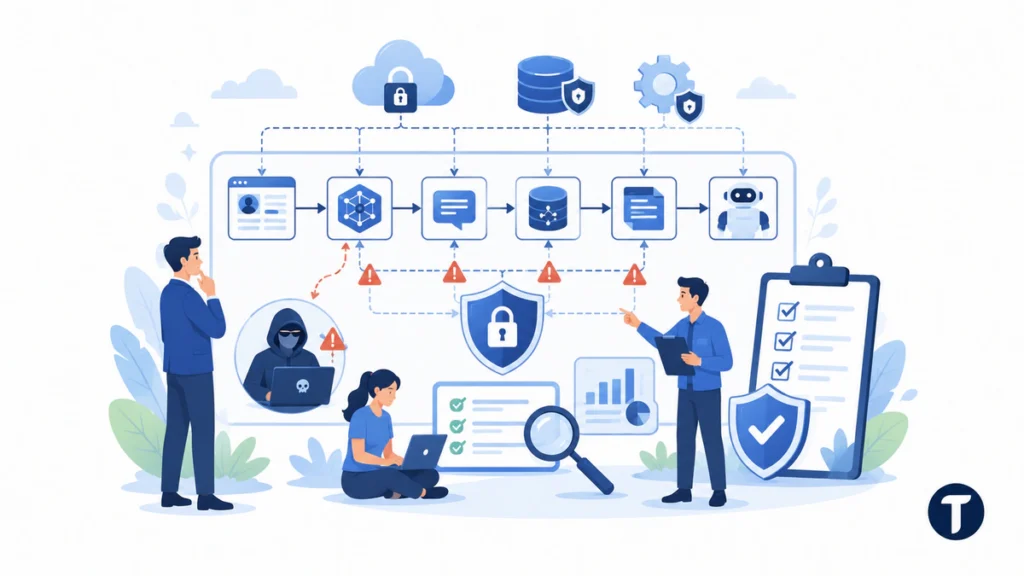
Threat modeling is one of the most important security skills in this field. AI cybersecurity certification courses should teach learners to map more than a model. Learners may need to review a user interface, API gateway, prompt layer, vector database, retrieval system, cloud service, logging tool, and downstream business workflow.
Each part can fail in a different way. A model may leak sensitive data. A retrieval system may expose the wrong document. An AI agent may take an action without enough approval. A cloud permission may let attackers reach data that should be isolated.
Good AI security training teaches you to map the full system, not just test the chatbot.
A practical threat model asks:
- What data enters the AI system?
- Where is that data stored, retrieved, or embedded?
- Who can influence the model’s input or context?
- What actions can the AI system trigger?
- What controls prevent unsafe output, data exposure, or privilege misuse?
- How would an attacker test those controls?
This is where AI and cybersecurity meet day to day. The skill is not just knowing attack names. It is learning how to reason through trust boundaries, data flows, and business impact.
Data Protection and Privacy Skills
AI systems rely on data, so data protection becomes central. AI cybersecurity certification courses should teach how sensitive information moves through training sets, prompts, logs, embeddings, analytics tools, and third-party services.
Security teams need to know when data can be used safely, when it needs masking, and when it should never enter an AI workflow at all. This is especially important for regulated data, customer records, intellectual property, source code, and internal security findings.
A secure AI program starts by controlling what the system is allowed to know.
Strong courses usually cover:
- Data classification for AI use cases
- Prompt and response logging risks
- Embedding and vector database exposure
- Data leakage through model output
- Access control for retrieval-augmented generation systems
- Retention rules for AI-generated records
For teams handling sensitive data, AI security certification courses should make privacy controls practical, not theoretical.
Adversarial Testing and AI Red Teaming
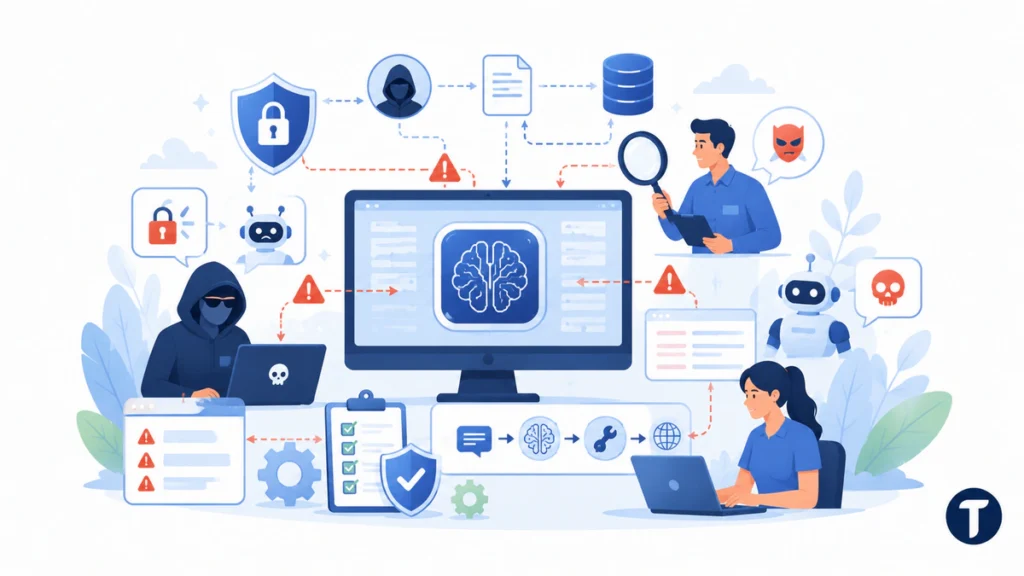
AI red teaming is where training becomes hands-on. Instead of only reviewing policies, learners test whether AI systems behave safely under pressure.
This may include prompt injection, jailbreak attempts, data extraction, model manipulation, unsafe tool use, indirect prompt attacks, and attempts to make AI agents act outside approved boundaries. The goal is not to break systems for sport. The goal is to find risk before attackers do.
A course is easier to judge when you know the vocabulary it should be teaching. NIST’s adversarial machine learning taxonomy names the attack classes and their mitigations for both predictive and generative systems, so you can check whether a syllabus covers the field or only the two attacks that demo well.
For example, advanced programs such as OffSec’s hands-on AI cybersecurity course show how this field is moving toward practical labs, red team exercises, and realistic AI-enabled environments rather than purely theoretical lessons.
For a vendor-neutral reference, OWASP’s LLM and Generative AI security guidance is also useful because it maps common risks such as prompt injection, sensitive information disclosure, supply chain exposure, data poisoning, excessive agency, and insecure output handling.
Hands-on testing is important because AI risks often appear only when real users, messy data, and connected tools interact. This is why practical AI cybersecurity certification courses should include realistic testing and reporting tasks.
Secure AI Development and Application Security
AI security is also an application security problem. Many AI products are still web apps, APIs, cloud workloads, and data services. They need secure design, authentication, authorization, logging, dependency management, and testing.
The difference is that AI adds new layers. Developers may need guardrails for prompts, output filters, model access controls, plugin restrictions, evaluation tests, and human approval steps for risky actions.
The best AI security certification courses connect secure development practices with AI-specific controls.
Important skills include:
- Designing safe AI workflows before deployment
- Testing AI applications for injection and data leakage
- Securing APIs that connect AI tools to business systems
- Protecting model configuration and secrets
- Reviewing third-party AI tools before adoption
- Building approval gates for high-risk AI actions
For developers and AppSec teams, AI cybersecurity certification should make secure design part of the normal build process.
Cloud, Infrastructure, and Model Operations
Modern AI systems often run across cloud platforms, managed model providers, internal data stores, CI/CD pipelines, and monitoring tools. That means cloud security and model operations are part of AI security.
AI cybersecurity certification courses should explain how AI infrastructure is deployed, updated, logged, and monitored. They should also cover identity and access management, network segmentation, storage security, secret handling, and deployment review.
Third-party models, plugins, packages, and managed AI providers also create supply chain questions. Security teams need to know what is being used, what data it can access, and how it is maintained.
AI security fails when teams secure the model but ignore the infrastructure around it.
Common infrastructure skills include:
- Checking least-privilege access for AI services
- Securing cloud storage used by training or retrieval systems
- Monitoring model endpoints for abuse
- Protecting CI/CD pipelines that ship AI applications
- Separating development, testing, and production data
- Auditing logs without exposing sensitive prompts or outputs
Governance, Risk Management, and Policy Translation
Technical testing is not enough. Security professionals also need to translate findings into governance and risk management. Leaders need to know which AI use cases are acceptable, which need extra controls, and which should wait.
AI cybersecurity certification courses should teach how to create practical policy, not paperwork that nobody reads. Useful governance work includes approved tool lists, data use rules, vendor review checklists, model documentation, incident paths, and user training.
Governance turns AI security from individual heroics into a repeatable business process.
Good reporting is part of this skill. Security teams need to explain what was found, why it matters, who owns the fix, and what risk remains after controls are added. AI security certification courses should also teach learners how to communicate those findings to both technical and business audiences.
Monitoring, Detection, and Incident Response
AI systems need ongoing monitoring after launch. A safe model today can become risky tomorrow if the data changes, attackers find a new bypass, or a connected tool gains new permissions.
Security operations teams need signals that show when AI is being misused. These may include unusual prompt patterns, repeated policy bypass attempts, high-volume queries, sensitive data in outputs, strange agent actions, or abnormal API use.
AI incident response depends on knowing what normal AI behavior looks like before something goes wrong.
Good AI cybersecurity certification courses help teams prepare for questions such as:
- How do we investigate a suspected prompt injection incident?
- Which logs show what the user, model, and connected tool did?
- How do we contain an AI agent that took an unsafe action?
- When should we suspend a model, disable a plugin, or rotate credentials?
- How do we explain AI-related impact to legal, compliance, and leadership?
For security teams that want to connect AI response training with investigation evidence, packet capture can show the network traffic behind suspicious activity before analysts decide what to contain.
How to Choose the Right AI Security Certification Course
Not every AI cybersecurity certification is equally useful. Some courses focus on high-level awareness. Others focus on engineering, red teaming, governance, or security operations. The right choice depends on your role and goals.
A SOC analyst may need monitoring and incident response practice. An application security engineer may need deeper testing, secure design, and cloud integration work. A security leader may need more focus on governance, vendor risk, and reporting.
Choose the course that matches the work you need to perform, not the badge that sounds most impressive.
Use this checklist before enrolling:
- Check the hands-on component. Look for labs, practical tasks, reports, or exams based on real-world scenarios.
- Review the syllabus. It should cover AI systems, machine learning basics, data protection, adversarial testing, and secure deployment.
- Match the level to your role. The best fit depends on whether you work in SOC, application security, cloud security, governance, or red teaming.
- Check the source credibility. Prefer providers with clear security expertise, transparent learning outcomes, and current material.
- Look for reporting practice. The ability to explain AI risk is as important as finding it.
- Confirm update frequency. AI techniques change quickly, so old courseware can lose value fast.
When comparing AI security certification courses, avoid choosing only by brand name. The stronger option is the course that matches your daily responsibilities. For buyers, AI cybersecurity certification courses are strongest when they show what learners can actually do.
Final Thoughts
AI will not remove the need for cybersecurity professionals, but it will change the skills they need. Security teams now need to understand how AI systems use data, generate outputs, connect to business tools, and create new risks.
When comparing AI cybersecurity certification courses, prioritize practical training over badge value alone. The strongest programs teach real testing, secure design, monitoring, governance, incident response, and clear reporting so teams can manage AI risk with confidence.
The best AI cybersecurity certification should leave learners with practical judgment, not just terminology. That is what separates useful training from a simple awareness course.