Direct Mail for Real Estate: 7 Proven Branding Strategies That Build Trust
Table of Contents
Direct mail for real estate helps agents and brokers build trust before a seller is ready to make a decision. A mailed postcard can make your name feel local, steady, and easy to remember.
Used consistently, real estate direct mail turns neighborhood visibility into brand memory. The strongest direct mail marketing campaigns pair a clear position with useful local information, repeated delivery, and a simple next step.
In brief
Direct mail for real estate is a marketing strategy that uses postcards, letters, brochures, and other mailed pieces to keep an agent or broker visible in a target market.
The best real estate direct mail campaigns use a clear mailing list, one brand promise, helpful local content, consistent delivery, and a trackable call to action.
Why Direct Mail Still Works for Real Estate Branding
Real estate branding is not only a logo, color, headshot, or slogan. It is the feeling a homeowner gets when your name appears again with helpful local information.
Direct mail gives that brand a physical place in the home. A postcard can sit on a counter, land in a mailbox, or stay in a stack of bills until the owner has time to read it.
The National Association of REALTORS says direct mail can create a hometown feel when real estate professionals choose the right neighborhood and stay consistent. Its direct mail guide for real estate agents also notes that repeat contact builds memory and trust over time.
I like that lesson because it keeps the strategy grounded. Direct mail works best as a long-term local presence, not as a one-off trick.
A mailed real estate marketing message should make the reader think, “I know this person, and they understand this area.” That is stronger than a cold digital ad because the brand appears in a quieter space.
That is why direct mail for real estate should feel useful before it ever asks for a listing appointment. Direct mail for real estate also gives agents a repeatable offline signal they can connect to digital follow-up.
1. Choose the Right Direct Mail Campaign Position
A strong direct mail for real estate campaign begins with one narrow promise. You cannot be the luxury listing expert, first-time buyer guide, downsizing advisor, investor contact, and neighborhood historian on one small mailer.
Choose the right position before you choose a template, offer, or headline. That focus keeps real estate direct mail from feeling like a generic ad.
Useful brand positions include:
- The neighborhood listing specialist
- The calm downsizing guide
- The data-first market update agent
- The relocation contact for one school district
- The premium home valuation expert
- The residential and commercial real estate advisor for a local niche
Your position should answer one question fast: why should this homeowner remember you?
A real estate mailer with one promise feels more confident than a crowded mail piece. It also makes your design, message, and call to action easier to repeat.
2. Build a Recognizable Real Estate Mailer System
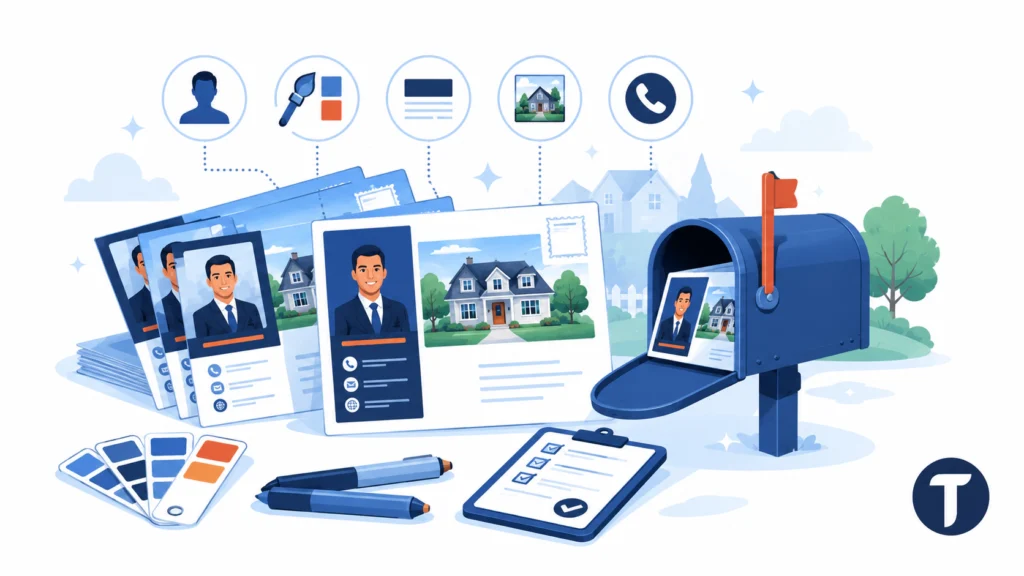
A mailed direct mail for real estate postcard campaign works best when people can spot your brand before they read every word. Use the same face, colors, logo placement, headline style, and contact block on each mailer.
That does not mean every postcard should look identical. It means each mailed piece should feel like it came from the same trusted real estate business.
Direct mail marketing also needs visual discipline, because repeated design cues help homeowners connect each new mailer to the same local brand.
Use this simple system:
- Put your name and photo in the same place.
- Use one main brand color and one accent color.
- Keep the headline large and direct.
- Add one local image, map, listing photo, or chart when it adds meaning.
- End with the same call to action style.
Repetition makes your brand easier to recall. Agents can apply the same recognition principle across other physical brand touchpoints too, including custom-branded apparel used at open houses, community events, and client meetings. The more familiar your real estate mailer becomes, the less work a prospect has to do when the next mailed postcard arrives.
This is where estate mailers aren’t dead. They are only weak when the design changes every time and the message has no local pattern.
3. Personalize Mailers Around Local Market Signals
Personalize direct mail for real estate with useful local context. Use the homeowner’s area, property type, or local market update before you use sensitive personal details.
Good personalization sounds like this:
- “Three homes near Maple Avenue sold in under 21 days.”
- “Your neighborhood has lower listing inventory this spring.”
- “Here is what buyers ask about in Westlake right now.”
- “This month’s home valuation range moved after two nearby sales.”
Poor personalization feels intrusive. It mentions too much about the owner, debt, family status, age, or private life.
Use local relevance, not personal surveillance. A real estate mailer should make the reader feel seen as a neighbor, not tracked as a data point.
For agents who want support with templates, mailing lists, and campaign sending, the USPS Every Door Direct Mail service can make direct mail easier to plan and repeat.
4. Match Real Estate Direct Mail to the Seller Journey
Real estate direct mail gets stronger when each mailed piece fits what the homeowner may be thinking. A cold owner does not need the same message as someone who has watched three homes sell nearby.
Use different types of direct mail for real estate mailers for different stages:
- Awareness: market update postcards, neighborhood notes, and real estate marketing ideas
- Trust: proof of listings, testimonials, case studies, and broker experience
- Intent: home valuation offers, seller checklists, and open house invites
- Referral: thank-you notes, past client stories, and annual property reviews
A mailed market update can build trust before a sales message appears. A just sold postcard can show proof after that trust grows.
The sequence matters more than one clever mailer. Real estate direct mail marketing works when each mail piece earns the next one.
This is where direct mail marketing becomes a planned path from awareness to trust, not a random set of postcards.
5. Use Direct Mail Marketing with Digital Follow-Up
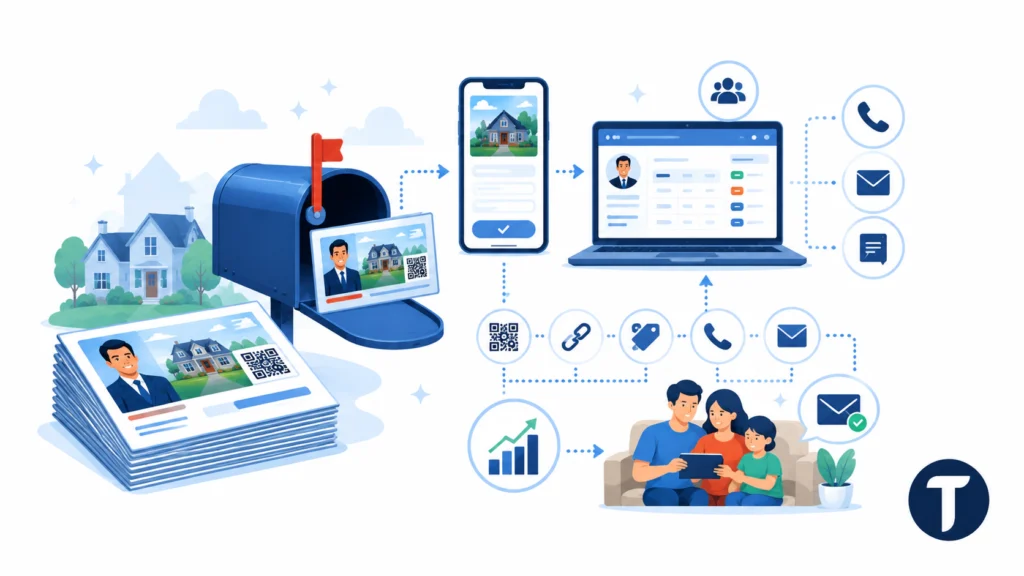
Direct mail marketing should not sit apart from digital marketing. The best direct mail strategies connect the mailbox to the CRM, landing page, phone call, and email marketing follow-up.
Use a QR code, short URL, or unique phone number on each postcard. Send prospects to one useful action, such as a home valuation request, open house page, seller checklist, or neighborhood market update.
A simple direct mail for real estate tracking stack can include:
- A QR code for each direct mail campaign
- A short URL for each mailing list segment
- A CRM tag for each mailed audience
- A phone number for high-intent listing calls
- A follow-up email marketing sequence after form fills
The Association of National Advertisers found that direct mail formats can produce strong returns in its Response Rate Report 2021, with letter-sized envelopes via the U.S. Post Office reaching 112% ROI in the study summary.
That connection is what makes direct mail for real estate easier to measure, compare, and improve over time.
Integrate direct mail with digital follow-up so the campaign has more than one chance to convert. A digital ad can support recall after the postcard arrives, and a CRM task can remind you to follow up with warm prospects.
6. Improve Response Rate with Useful Mailer Offers
Response rate depends on the list, message, timing, design, and offer. A pretty postcard cannot fix a weak audience or a vague call to action.
Start direct mail for real estate with useful offers, not generic slogans.
Strong real estate mailer ideas include:
- “Get a 60-second home valuation snapshot”
- “See what your home could list for this month”
- “Download the pre-listing repair checklist”
- “Book a 15-minute seller strategy call”
- “Get the latest open house traffic report for your area”
A useful offer gives the reader a reason to act now. It also protects your mailer from feeling like plain advertising.
Track direct mail for real estate response rate by campaign, not by memory. Use a unique QR code, URL, or phone number for each mailed postcard and record every lead generation source in your CRM.
Direct mail ROI looks clearer when you can connect a mail format, mailing list, and offer to listing appointments, referrals, and closed deals.
7. Send Postcards Consistently, Then Refine the Mailing List
One direct mail for real estate postcard rarely changes a brand. A steady mailed rhythm creates the feeling that you are active, visible, and committed to the area.
Use a 90-day plan to make direct mail for real estate practical:
- Month one: send postcards with a neighborhood market update.
- Month two: mail a recent listing story or just sold proof point.
- Month three: send a seller checklist with a clear home valuation offer.
- End of month three: review calls, scans, form fills, and listing appointments.
Then refine the direct mail for real estate mailing list. Remove poor-fit addresses, mark warm prospects, and separate homeowners, investors, absentee owners, and past clients where possible.
Postal data quality matters too. A Coding Accuracy Support System verified list, clean names, and correct addresses can reduce waste before anything is mailed.
Consistency is the part most real estate agents skip. Successful real estate campaigns keep showing up with value until local homeowners know the name and trust the message.
That rhythm helps real estate direct mail feel like local presence instead of a one-time pitch.
Best Practices for High-Converting Mailers
The best real estate direct mail campaigns do not need to feel complicated. They need to feel clear, useful, and easy to act on.
Use these direct mail for real estate best practices before sending direct mail:
- Keep one goal per mail piece.
- Use a headline tied to the local market.
- Match the template to your brand position.
- Put the offer above the fold on the postcard.
- Use personalized direct mail only where it adds trust.
- Test every door direct mail® for broad farm coverage when it fits the area.
- Consider dimensional mailers for premium prospects, but use them with a clear reason.
- Make your direct mail easy to scan in five seconds.
The right direct mail format depends on the goal. Postcards work well for awareness and repeated visibility. Letters can feel more personal. Brochures can explain services. Personalized mailers can support higher-value seller campaigns.
Your mail format should match the level of trust you are trying to build. A first touch needs clarity. A warm prospect may need proof, detail, and a stronger offer.
Strong direct mail for real estate does not need every format at once. It needs the right format for the audience, stage, and offer.
Follow-up questions
What Is Direct Mail for Real Estate?
Direct mail for real estate is a local marketing method that sends postcards, letters, brochures, or newsletters to a targeted group of homeowners, buyers, investors, or past clients. Direct mail for real estate works best when each piece supports the same local brand promise.
How Often Should Agents Send Real Estate Direct Mail?
Most agents get better brand recall from a steady schedule than from one isolated mailing. A practical rhythm is to mail often enough that the same audience sees your name, local proof, and offer repeatedly without feeling overwhelmed.
What Should a Real Estate Mailer Include?
A strong mailer should include one clear message, a local reason to care, recognizable branding, a simple offer, and a trackable call to action such as a QR code, short URL, or dedicated phone number.
How Do You Track Direct Mail Marketing Results?
Track direct mail marketing with campaign-specific QR codes, URLs, phone numbers, CRM tags, landing pages, and follow-up tasks. This connects each response to the mailing list, offer, and mail format that produced it.
Where this leaves you
Direct mail for real estate works best when you treat it as brand building, not a one-time lead blast. Choose one position, send useful mailed postcards, use the same real estate mailer system, track response rate and ROI, and keep showing up until local prospects remember your name.
When direct mail for real estate stays local, useful, and repeatable, it becomes a trust-building channel instead of a throwaway campaign. Real estate direct mail keeps working when each campaign strengthens recognition, trust, and the next reason to respond.