What Is the Best Roadmap for Securing Autonomous AI Coding Agents?
Table of Contents
AI coding agent security is no longer a niche AppSec concern. As teams use agents to write code, run commands, read repositories, and connect to tools, prompt injection can move from a chatbot problem into a production risk.
The bigger challenge is that these agents sit inside normal software workflows. That makes software supply chain security, access control, sandboxing, and monitoring part of the same roadmap.
What it means
The best roadmap for securing autonomous AI coding agents has three steps:
- Map The Agent’s Full Attack Surface: List what the agent can read, write, execute, install, access, and change.
- Add Architectural Controls: Use least privilege, sandboxing, output validation, dependency checks, and human approval for high-risk actions.
- Monitor And Govern Continuously: Log prompts, tool calls, file changes, credentials, approvals, and abnormal behavior so teams can respond quickly.
A secure AI coding agent is not just a safer model. It is a controlled system with limited permissions, tested guardrails, trusted dependencies, clear logs, and a working kill switch.
This AI coding agent security roadmap works because it treats the agent as part of the software delivery system, not as a separate productivity tool.
Why Traditional AppSec Breaks With AI Coding Agents
Traditional AppSec assumes humans make most decisions. A developer writes code, a reviewer checks it, CI runs tests, and security tools scan the result.
Autonomous agents change that flow. They can read files, edit code, run shell commands, install packages, call APIs, open pull requests, and sometimes deploy changes with limited human input.
That creates compound risk. A single permission may look harmless, but several permissions together can become dangerous. Read access plus internet access can leak secrets. Code execution plus package installation can trigger malware. Repository access plus write access can create persistent backdoors.
The risk is not only what the agent is asked to do. It is what the agent is technically able to do when exposed to hostile context.
Step 1: Map the Agent’s Full Attack Surface
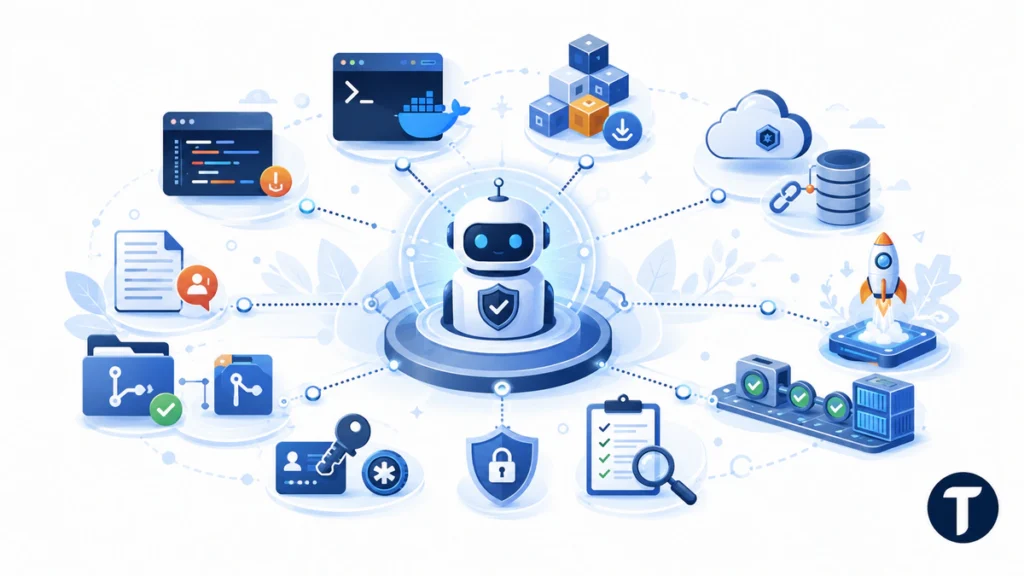
Start by listing every capability the agent has. Do not begin with the goal of the tool. Begin with its permissions.
A useful inventory should answer:
- Which repositories can the agent read or change?
- Can it execute commands, tests, scripts, or containers?
- Can it install dependencies from public registries?
- Which credentials, tokens, or environment variables can it access?
- Can it call external APIs or internal systems?
- Can it create branches, pull requests, releases, or deployments?
- Which logs show what it did and why?
This is where many teams discover the real gap. The agent was added as a productivity tool, but it now behaves like a privileged automation worker.
For AI coding agent security, this inventory should also show where prompt injection could enter the workflow, such as README files, issues, code comments, test data, or package metadata.
If your business is building internal copilots, coding assistants, or agents that can be steered by injected instructions, this inventory should happen before the agent is connected to sensitive repositories or production systems.
Step 2: Control Permissions Before You Trust Outputs
Least privilege matters more with agents because they can combine tools quickly. Give the agent only what it needs for the task, only for the time it needs it.
Use controls such as:
- Scoped Credentials: Short-lived tokens for one repository, project, or task.
- Capability Segregation: One agent can review code, another can run tests, and a separate approved workflow handles deployment.
- Human Gates: Require approval before dependency installation, production deploys, database writes, or secret changes.
- Network Limits: Block unnecessary outbound access during code execution.
- Repository Boundaries: Prevent broad organization-wide access by default.
The goal is not to slow every agent down. The goal is to make the safe path easier than the risky path.
Strong access control is one of the simplest AI coding agent security wins because it limits what an agent can damage even when it receives hostile instructions.
If an agent can make irreversible changes, it needs an approval gate. Convenience is not a security model.
Step 3: Sandbox Code Execution Properly
Agents that run code need isolation. A basic container can help, but it is not the whole answer. Container escapes, exposed mounts, broad network access, and shared credentials can still create risk.
A safer execution environment should include:
- Fresh ephemeral workspaces for each task.
- No default access to host secrets.
- Restricted filesystem mounts.
- Controlled network egress.
- Resource limits for CPU, memory, and runtime.
- Clean teardown after execution.
For higher-risk work, teams may use stronger isolation such as microVMs or hardened sandboxes. The important point is simple: generated code should be treated as untrusted until it has passed review and checks.
This is also where prompt injection becomes serious. A malicious README, issue, test fixture, or code comment can try to instruct the agent to ignore rules, reveal credentials, or modify unrelated files. The OWASP AI Agent Security Cheat Sheet is a useful reference for agent-specific controls, including tool access, memory, identity, and human oversight.
Prompt injection defense should be built into the sandbox design, not added after the agent already has access to files, tools, and credentials.
Step 4: Validate Code, Dependencies, Tool Calls, and Software Supply Chain Security
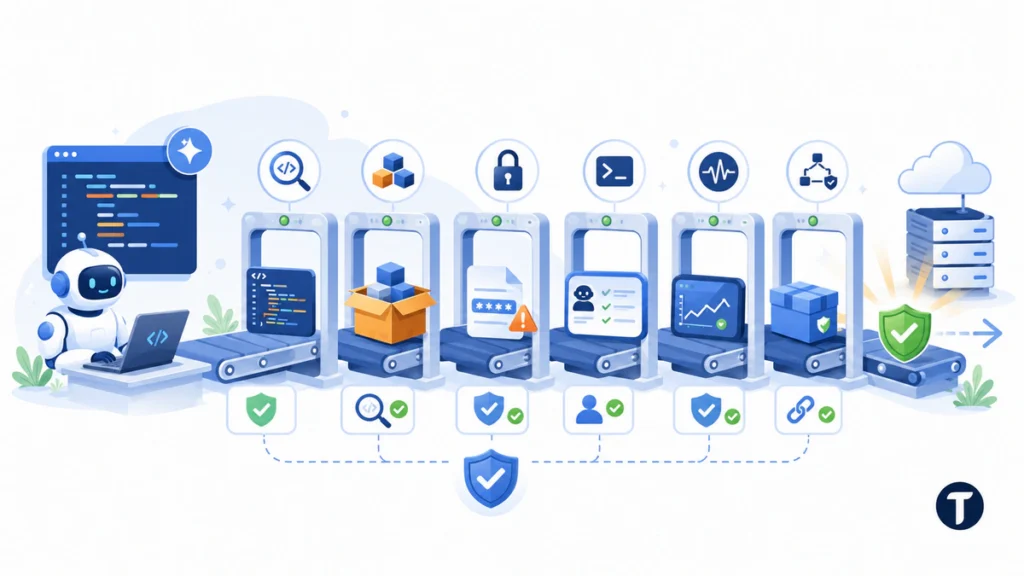
AI-generated code should go through the same security pipeline as human-written code, plus extra checks for agent behavior.
At minimum, use:
- Static Analysis: Scan for injection flaws, hardcoded credentials, unsafe deserialization, access control mistakes, and insecure defaults.
- Dependency Scanning: Check package names, versions, maintainers, release history, licenses, and known vulnerabilities.
- Secret Detection: Block keys, tokens, private URLs, and credentials before commits or pull requests are created.
- Runtime Monitoring: Watch what the code does when executed, not only what it looks like in a diff.
- Tool Call Review: Record which tools the agent used, which inputs it saw, and which outputs triggered its next action.
The supply chain issue deserves special attention. Agents may suggest plausible package names that do not exist. If attackers register those names, an automated install can become a malware delivery path.
Scanning tells you what is in the tree; provenance tells you where it came from. Published as part of the SLSA framework, the SLSA build levels describe increasing guarantees that an artifact was produced by the build system it claims, which is the control that matters when an agent can add a dependency without a human reading the diff.
This is why software supply chain security has to be part of agent validation. The agent should not be allowed to install, update, or execute dependencies until the package has been checked.
For teams validating high-risk agent workflows, professional penetration testing services can also help confirm whether controls around applications, APIs, cloud assets, and sensitive data hold up under realistic attack paths.
Every package install should be verified before execution, especially when the dependency was suggested by a model.
Step 5: Build AI Coding Agent Security Governance Like a Production System
Once agents touch real code, they need operational governance. Treat them like production automation, not experimental chatbots.
Your governance plan should cover:
- Agent owners and approved use cases.
- Allowed repositories, tools, and credentials.
- Logging requirements for prompts, tool calls, file changes, and approvals.
- Review rules for AI-generated code.
- Incident response steps for suspicious behavior.
- Periodic access reviews.
- A tested kill switch.
A kill switch should revoke agent credentials, stop running sessions, and block new executions in minutes. It should be tested before there is an incident.
The NIST AI RMF Playbook for the govern function is a useful governance reference because it frames AI risk around mapping, measuring, managing, and governing systems. That structure fits agent programs well because the risk comes from the whole workflow, not only the model.
Good governance also keeps prompt injection response, access reviews, and software supply chain security checks consistent across teams instead of leaving them to individual developers.
Common Mistakes To Avoid
The most common failures are not exotic. They are usually simple permission and process errors.
Avoid these mistakes:
- Giving agents permanent credentials.
- Letting agents install dependencies without checks.
- Running generated code on shared infrastructure.
- Treating prompt injection as only a chatbot issue.
- Allowing repository-wide access when task-level access would work.
- Reviewing final code while ignoring the agent’s tool calls.
- Logging file changes without the prompt context that caused them.
- Creating a kill switch that nobody has tested.
Weak prompt injection controls are especially risky when the agent can read untrusted project content and then act on it without human review.
Security teams should also track which code was AI-generated. If flawed generated code enters a repository and later becomes training or example material, the same weakness can spread through future workflows.
The takeaway
The best roadmap for securing autonomous AI coding agents is practical: map capabilities, limit permissions, isolate execution, validate outputs, and monitor behavior over time. AI coding agent security, prompt injection defense, and software supply chain security now belong in the same operating model because agents can read, act, install, and change software faster than traditional review processes were designed to handle.