Cybersecurity Skills for a Tech Career: How to Build a Strong Future in Security
Table of Contents
Introduction
Cybersecurity skills can help you build a stronger tech career because they teach you how to protect data, secure systems, investigate problems, and explain risk in a way businesses can act on.
That value keeps growing. The U.S. Bureau of Labor Statistics projects employment for information security analysts to grow 29% from 2024 to 2034, with a median annual wage of $124,910 in May 2024. CyberSeek also shows strong demand for cybersecurity-related roles across the job market.
Cybersecurity is not only one job title. It is a career skill layer that supports many areas of technology, including help desk, networking, cloud, software, compliance, incident response, and security management. If you understand how systems fail and how people use technology at work, you can become more valuable in almost any technical environment.
Quick Answer
To build a strong future in cybersecurity, start with the fundamentals: networking, operating systems, identity and access control, cloud security, vulnerability management, incident response, documentation, and communication.
Then connect those cybersecurity skills to a specific career path, such as security analyst, GRC, network security, cloud security, forensics, application security, or broader information security work. The strongest candidates do not only study concepts. They build hands-on projects, document their work, earn credentials with a clear goal, and learn how to explain risk in business terms.
Why Cybersecurity Skills Matter in Tech
Every modern company depends on connected systems. Employees use cloud apps, shared files, customer accounts, payment tools, mobile devices, remote access, and third-party platforms. Each one creates possible weak points.
A mistake as simple as a weak password, exposed file, unpatched system, or misconfigured cloud account can create real business damage.
Good cybersecurity skills help you spot risk before it becomes an incident.
That is why cybersecurity is useful even if your first job is not a pure security role. A help desk technician who understands phishing and account protection is more valuable. A network administrator who understands firewall rules and suspicious traffic is more valuable. A cloud support specialist who understands identity, logging, and storage permissions is more valuable.
For anyone building a tech career, information security knowledge can make routine technical work safer and more valuable.
Cybersecurity strengthens your ability to protect the systems people already depend on.
Start With How Systems Work
A strong cybersecurity foundation does not begin with advanced hacking. It begins with understanding how normal systems behave.
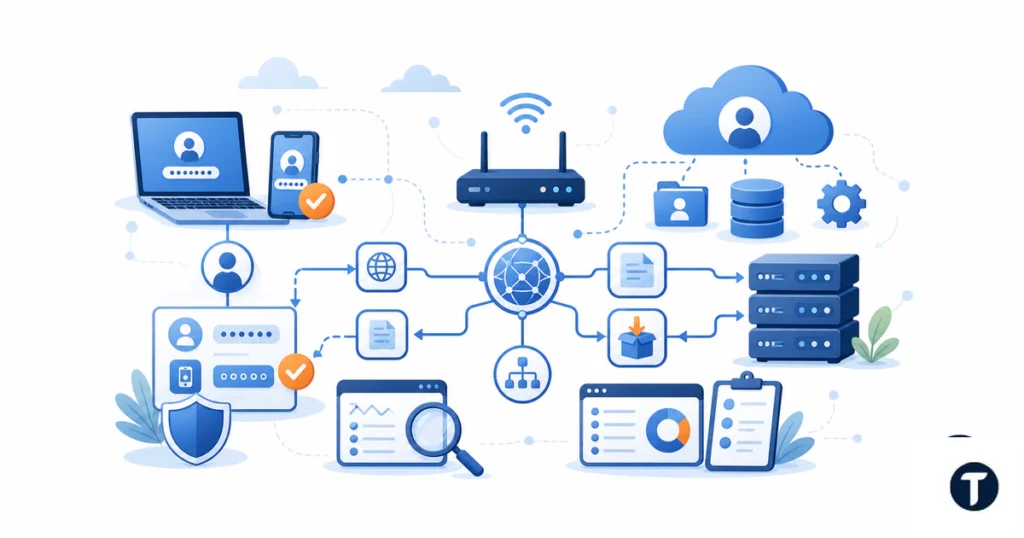
Before you can identify what is suspicious, you need to know what should happen during a normal login, file transfer, web request, software update, or cloud access request. This is where basic technical knowledge matters.
Important areas to learn include:
- Networking basics, including IP addresses, DNS, ports, routing, VPNs, and common protocols.
- Operating systems, especially Windows, Linux, macOS, and mobile device security settings.
- Identity and access control, including passwords, MFA, permissions, and least privilege.
- Cloud and SaaS security, especially how businesses manage users, storage, logs, and admin access.
- Information security basics, including data protection, acceptable use, privacy, and risk awareness.
- Vulnerability management, including scanning, ranking risk, assigning fixes, and tracking progress.
- Documentation and reporting, because security work must be clear enough for others to act on.
The best early goal is not to look impressive. It is to become useful. Learn enough to troubleshoot, ask better questions, explain what you found, and help a team reduce risk. These cybersecurity skills create the foundation for a stronger tech career over time.
Build a Strong Network Security Foundation
Network security teaches you how data moves. Once you understand traffic, firewalls, VPNs, logs, endpoints, and domains, cybersecurity becomes less mysterious.
Start by learning what normal activity looks like. A normal web request, for example, may involve DNS lookup, connection to a server, data transfer, and a response. A normal employee login may involve an identity provider, MFA challenge, device check, and session token.
Then learn what looks unusual. That could include repeated failed logins, connections to unknown domains, traffic from unexpected countries, blocked ports, or a device communicating at strange hours.
This mindset matters because many security alerts are not obvious at first. A security analyst often has to compare signals, remove noise, and decide what deserves action.
A simple network diagram can teach more than a stack of random tool tutorials. Map the devices, users, apps, and data flows in a small environment. Then ask where access is allowed, where logs are created, and where something could go wrong.
Learn Incident Response Judgment
Incident response is where cybersecurity feels real. Something happened, the business needs answers, and the security team has to act carefully.
A basic incident response process includes:
- Confirm what happened and what evidence supports it.
- Contain the issue without destroying useful logs.
- Remove the threat or fix the weak point.
- Recover systems in a controlled way.
- Document what happened and what should improve.
In practice, entry-level security work is often less about dramatic hacking and more about reading logs, checking accounts, documenting risk, and helping teams fix weak settings.
For example, a suspicious login alert may require you to check the user, location, device, time, MFA status, recent password changes, and related activity. You may need to decide whether to reset credentials, revoke sessions, escalate the case, or document it as a false positive.
This is where judgment matters. Good cybersecurity professionals stay calm, gather facts, avoid guessing, and communicate clearly.
Explore the Career Paths Cybersecurity Can Open
Cybersecurity includes many paths. Some are technical. Some are investigative. Some focus on risk, policy, and business process.
The NIST NICE Framework is useful because it gives employers, educators, and workers a shared language for cybersecurity roles, tasks, knowledge, and skills. CyberSeek’s Career Pathway tool can also help you compare common roles, credentials, salaries, skills, and transitions.
If you are still deciding where you fit, resources that explain how security roles protect business digital systems, data, and daily operations can help you connect learning goals to the actual work people do in security roles.
A strong tech career may start in support, networking, compliance, or cloud operations before moving deeper into information security. The key is to keep building cybersecurity skills that match the role you want next.
Use Certifications and Degrees With a Clear Goal
Credentials can help your cybersecurity career, but they work best when they support a specific plan.
A certification can prove a baseline, organize your study, and help you pass employer screening. A degree can support longer-term growth, especially for government, enterprise, analyst, information security, or management paths. Neither option replaces hands-on practice.
If you are weighing a graduate degree as part of that plan, this guide on how a cybersecurity master’s can advance your IT career can help you decide whether the credential matches your target role, experience level, and long-term goals.
Before spending money, ask:
- Does this credential appear in job posts I would apply for?
- Does it teach skills needed for the work?
- Can I pair it with a lab, portfolio, project, or volunteer example?
- Will it move me closer to a specific role, such as security analyst, GRC technician, or cloud security support?
For career changers with applied technical credits, the next step may not require starting over. An AAS graduate, for example, might consider an online BAAS in cybersecurity as one pathway for building on prior coursework while focusing on security-related roles such as IT security support, network security, or GRC.
The key is to connect education to evidence. Employers want to know not only what you studied, but what you can do with it. The right credential should strengthen your cybersecurity skills and make your tech career goals easier to explain.
Build Hands-On Experience Before You Feel Ready

Hands-on experience is the fastest way to make cybersecurity feel concrete. You do not need a corporate security operations center to start building proof of skill.
A small home lab or practice environment can show how you think. It can also give you useful stories for interviews.
Good beginner projects include:
- Set up a basic Linux server and harden login settings.
- Build a small network map for your home or lab devices.
- Review password and MFA settings for a test account.
- Read sample firewall logs and explain what each entry means.
- Write an incident report for a practice phishing email.
- Create a simple risk register for a small business tool stack.
- Build a cloud security checklist covering MFA, storage permissions, admin access, logs, and backups.
These projects show more than enthusiasm. They show that you can follow a process, document decisions, and explain risk clearly.
These projects also help turn cybersecurity skills into proof. Instead of only saying you understand security, you can show how you reviewed access, checked logs, mapped risk, or improved a small environment.
If you want ethical hacking experience, use legal practice labs and capture-the-flag exercises. Keep your work inside approved environments. Never test real systems without written permission.
Prepare for Changing Cyber Threats
Cyber threats keep changing because attackers follow money, attention, and weak points. Ransomware, phishing, credential theft, supply chain risk, and cloud misconfigurations continue to pressure security teams.
Artificial intelligence adds another layer. Security teams now need to think about automated attacks, data leakage, model misuse, prompt injection, and faster investigation workflows.
Still, the most valuable skills are the ones that survive tool changes. A firewall product may change, but the reason for filtering traffic does not. A dashboard may change, but the need to spot risky activity does not. An AI tool may summarize logs faster, but a person still needs to question the result and decide what action makes sense.
That is why communication, documentation, curiosity, and ethics belong beside technical skills. Cybersecurity affects real people, real money, and real trust.
Create a 90-Day Cybersecurity Career Plan
If you want a future in cybersecurity, do not wait until you feel fully ready. Build a focused plan and create proof of progress.
Use this 90-day roadmap:
- Choose one target role, such as security analyst, GRC technician, or cloud security support.
- Read 20 job descriptions and list repeated skills, tools, and certification names.
- Pick one course, book, or certification path that matches those patterns.
- Build three small projects that prove core skills.
- Write one-page notes for each project with the problem, steps, result, and lessons.
- Update your resume around proof, not buzzwords.
- Create a simple portfolio folder or page with your project summaries.
- Apply for roles while you keep learning.
By the end of 90 days, your goal should be clear: three documented projects, one role-targeted resume, a list of common job requirements, and a stronger understanding of where you fit.
This approach works because it connects learning to job evidence. It also keeps you from bouncing between random videos without building anything useful. A focused plan turns cybersecurity skills into visible progress for your tech career.
The Bottom Line on Cybersecurity Skills
Cybersecurity skills can help you build a stronger tech career because they make you useful in a world full of connected systems, sensitive data, cloud tools, and constant risk.
You can start with networking, operating systems, identity, cloud basics, vulnerability management, or incident response. From there, you can move into security analysis, GRC, forensics, cloud security, application security, or leadership.
The best path is not always the flashiest one. It is the path where your strengths, learning style, and proof of work match what employers need.
The future belongs to people who can protect technology while understanding how people use it.