How Can a Cybersecurity Master’s Advance Your IT Career?
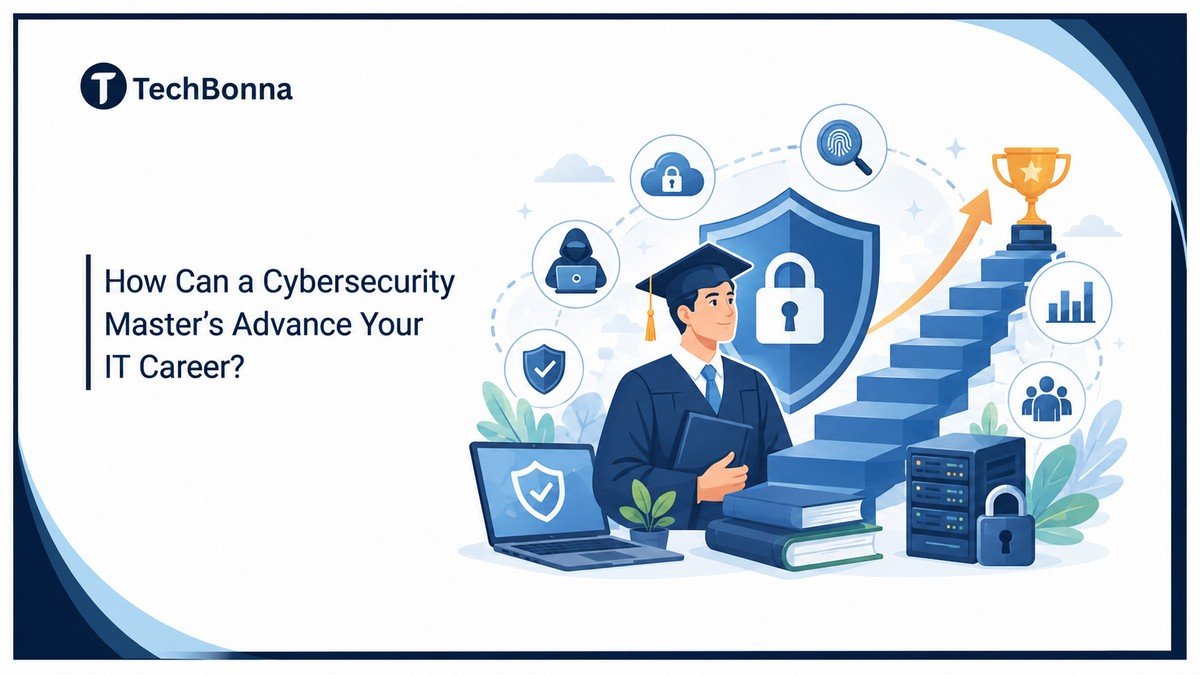
Table of Contents
A good IT career can start with support tickets, network admin, cloud operations, or software work. The question is: what helps you move from keeping systems running to protecting the business when risk becomes serious?
A cybersecurity master’s can help by giving you deeper technical knowledge, stronger security judgment, and a credential that shows you can handle more complex responsibilities. It will not replace experience, but it can make your next move clearer.
The short explanation
A cybersecurity master’s degree helps your IT career by building advanced security skills, strengthening your credentials, and preparing you for roles in security analysis, cloud security, digital forensics, risk management, and cybersecurity leadership. It can also improve your salary potential when combined with hands-on experience, certifications, and a clear career path.
It Builds Depth Beyond Everyday IT Support
Many IT roles teach you how systems behave when everything is working. Cybersecurity teaches you how systems fail, how attackers think, and how to reduce damage before a breach becomes a business crisis.
A strong degree in cybersecurity usually covers areas such as network security, cryptography, secure systems, governance, cyber risk, incident response, and digital forensics. Those topics help you understand why a control matters, not only how to configure it.
That difference is useful if you already work in infrastructure, help desk, cloud, software, or compliance. You can connect your current work experience to security decisions, then demonstrate to employers that you can take on more specialized duties.
The career jump often comes from moving from reactive IT work to proactive risk reduction.
Practical Skills Employers Can Recognize
- Analyzing logs and suspicious behavior
- Designing better access controls and security systems
- Understanding malware, keylogging, and data loss risks
- Working with policy, legal, ethical, and human factors
- Explaining security trade-offs to non-technical teams
Those skills matter because most businesses do not only need tool operators. They need cybersecurity professionals who can make sound decisions under pressure.
It Opens More Specialist Cybersecurity Roles

A master’s in cybersecurity can help you qualify for roles that expect deeper knowledge than an entry-level certification. It can also help when job adverts ask for a cybersecurity degree, advanced training, or a mix of technical and managerial ability.
Common next-step roles include security analyst, information security analyst, cybersecurity engineer, security engineer, security architect, penetration tester, digital forensics expert, SOC lead, and GRC analyst. Some professionals later move into security management or into chief information security officer roles.
If those job titles feel blurry, NICCS’s guide to the NICE Framework is a useful map, because it describes cybersecurity work in terms of named work roles and the skills each one expects. That makes it easier to check whether a course actually covers the role you want.
A master’s will not automatically place you in a senior role. Employers still care about projects, labs, work history, interviews, and how well you explain risk. However, the credential can help you get shortlisted for cybersecurity roles where graduate study is valued.
The best use of the degree is to pair it with evidence of practical work, such as labs, incident write-ups, cloud projects, and security documentation.
Where the Degree Can Fit
- If you are in IT support, it can help you pivot into security operations.
- If you are a network or systems admin, it can help you specialize in defense and architecture.
- If you are already in cybersecurity, it can support leadership, research, or advanced technical paths.
- If you work in compliance or risk, it can add technical credibility to your security advice.
It Can Improve Salary Potential, but Experience Still Matters
Cybersecurity can be a strong salary field because the work protects revenue, customer trust, and operational continuity. The U.S. Bureau of Labor Statistics reports that information security analysts had a median annual wage of $124,910 in May 2024, with employment projected to grow 29% from 2024 to 2034.
That does not mean every graduate earns a high salary immediately. Pay depends on your location, industry, existing IT background, clearance requirements, certifications, and ability to handle real security work.
Still, a cybersecurity master’s degree can make salary conversations easier when it supports a clear career move. For example, a systems administrator who adds cloud security projects and graduate study may have a stronger case for a security engineer role than someone relying on years of general IT work alone.
Think of the degree as a salary accelerator, not a salary guarantee. It works best when it helps you move into work with more risk ownership.
It Helps You Move from Technical Tasks to Security Leadership
Many IT professionals hit a point where technical skill alone is not enough. Senior cybersecurity jobs often involve budgets, policies, audits, board-level risk oversight, vendor selection, and incident communication.
Graduate study can help you practice that broader thinking. You may study legal and ethical issues, human behavior, economic factors, governance, and how security frameworks shape real decisions. That matters because security failures are rarely just technical failures.
The University of Tulsa page for its online M.S. in Cyber Security says the program includes both technical and leadership tracks, is 100% online, has no GRE requirement, and can be completed in as little as 20 months. That kind of structure can suit working professionals who want to keep earning while building a stronger security profile.
If you are comparing options, the University of Tulsa cyber security graduate degree is one example of a program designed around cyber defense, technical understanding, and leadership development.
Leadership growth is about learning to explain risk clearly, not just learning more acronyms.
It Gives Career Changers a More Structured Route
Some people come to cybersecurity from software, military service, audit, data, business operations, or general information technology. A master’s in cybersecurity can give career changers a structured path rather than forcing them to stitch together random courses.
The structure matters because cybersecurity is broad. Without a plan, it is easy to jump between ethical hacking videos, cloud labs, certification books, and job adverts without building a coherent story.
A graduate degree can help you build that story. It can show why you understand security fundamentals, where your strengths sit, and how your previous background supports the role you want.
For career changers, the goal is not to look like everyone else. It is to connect your past experience to a credible cybersecurity direction.
What to Do While Studying
- Build a small portfolio of security labs and write-ups.
- Map each course to one or two target job roles.
- Choose projects that match your intended path, such as cloud security, forensics, or governance.
- Use internships, volunteering, or internal projects to gain real evidence.
- Keep your LinkedIn and CV focused on outcomes, not only coursework.
Use the study period to create visible proof of skill, not just completed coursework.
It Can Strengthen Certification and Experience Paths
A certification can prove knowledge of a specific body of material. A master’s degree can demonstrate broader academic and strategic capabilities. They are not the same thing, and many strong cybersecurity careers use both.
For example, Security+, PenTest+, CISSP preparation, cloud vendor certifications, and practical labs can sit alongside graduate study. The right mix depends on whether you want hands-on technical work, management, audit, architecture, or incident response.
If you already have years of IT experience, a master’s may help you organize that experience into a stronger security narrative. If you have less experience, certifications and projects may be essential while you study.
The strongest profile usually combines education, proof of practice, and a clear role targeting.
How to Decide If a Cybersecurity Master’s Is Worth It
A cybersecurity master’s is worth considering if you know what career problem it solves. Do you need deeper technical confidence? A recognized credential? A route into leadership? A structured way to change careers? A stronger foundation for advanced security roles?
Before applying, compare programs on curriculum, flexibility, cost, career support, hands-on work, faculty experience, and whether the degree matches your target roles. Also, check whether you meet the recommended background requirements or need introductory courses first.
Ask yourself these questions:
- Which cybersecurity job do I want within two to three years?
- Will this program help me build evidence for that role?
- Can I study while keeping enough time for projects or work experience?
- Does the curriculum include the technical skills and leadership topics I need?
- Is the tuition realistic compared with my expected career path?
A degree in cybersecurity can be a smart investment when it supports a specific plan. It is weaker when it is used as a vague hope that a qualification alone will solve a career problem.
The best outcome comes when you treat the masters as part of a career system: study, projects, networking, certifications, and targeted applications all working together.
What this means in practice
A cybersecurity master’s can advance your IT career by giving you deeper knowledge, a stronger credential, and a clearer route into security work. It can support specialist roles, improve salary potential, and help you grow into leadership.
The degree is not a shortcut around experience. It is a way to make your experience more valuable. If you choose a program that fits your goals and keep building practical evidence as you study, it can become a strong step towards a better cybersecurity career.