How High-Frequency AI Models Outpace Live Broadcast Feeds In Modern eSports Analytics
Table of Contents
Real-time AI feels like a second set of eyes, except these eyes do not blink, cheer, or wait for a camera cut. In modern eSports analytics, that gap is hard to ignore because live matches now produce streams of structured data, not just action on a screen.
A broadcast may look instant to viewers, but High-Frequency AI can read machine-readable data before the audience sees the full scene. That speed turns player movement, utility use, timing, and match-state changes into predictive insight while the round is still unfolding.
Amazon IVS low-latency streaming documentation defines video latency as the delay between camera capture and the viewer’s screen. That is a separate pipeline from a structured match-data feed, so any claim that analytics arrives first should be measured against the specific data endpoint and broadcast path rather than assumed from the word “live.”
What it means
High-Frequency AI turns live match data into predictions faster than a human-facing broadcast can show or explain the same change. It does this by processing structured event data, updating match-state probabilities, and detecting tactical patterns in real time.
Low-latency inference can turn small signals, such as player position, utility use, economy state, and bomb control, into predictive insight before the broadcast catches up.
Why CS2 Turns eSports Analytics Into a Technical Test Bed
CS2 is a clean example because each round has a start, a middle, and an end. The game rewards tight choices, fast trades, and small timing wins.
CS2 is not just an esports game; it is a compressed decision machine. Counter-Strike 2 data includes player position, utility use, health, armor, weapons, bomb status, economy pressure, and map control.
A single opening kill can move win probability before a production team has time to explain the setup.
I like CS2 as a lens because the signals are sharp. One smoke, one late rotate, or one weak buy can change the shape of a round.
That makes CS2 a strong testing ground for eSports analytics, not just a popular title. It gives AI models a steady stream of structured events to process.
The Latency Gap Between the Broadcast and High-Frequency AI
A broadcast is built for people. It needs camera systems, broadcast overlays, voice, pacing, replay, and clean camera angles. It turns chaos into a story.
AI does not need that story first.
The broadcast tells viewers what happened; the data stream tells High-Frequency AI what changed. Low-latency inference can update from live match data as soon as the state moves. This matters because each millisecond can shrink the useful life of an insight.
Live broadcasts still feel close to the action, but they are media products. Real-time data streams are closer to the source.
This is one reason eSports analytics has moved beyond scoreboards. The best systems do not just report the round. They interpret the round while it is still forming.
What High-Frequency AI Models Do
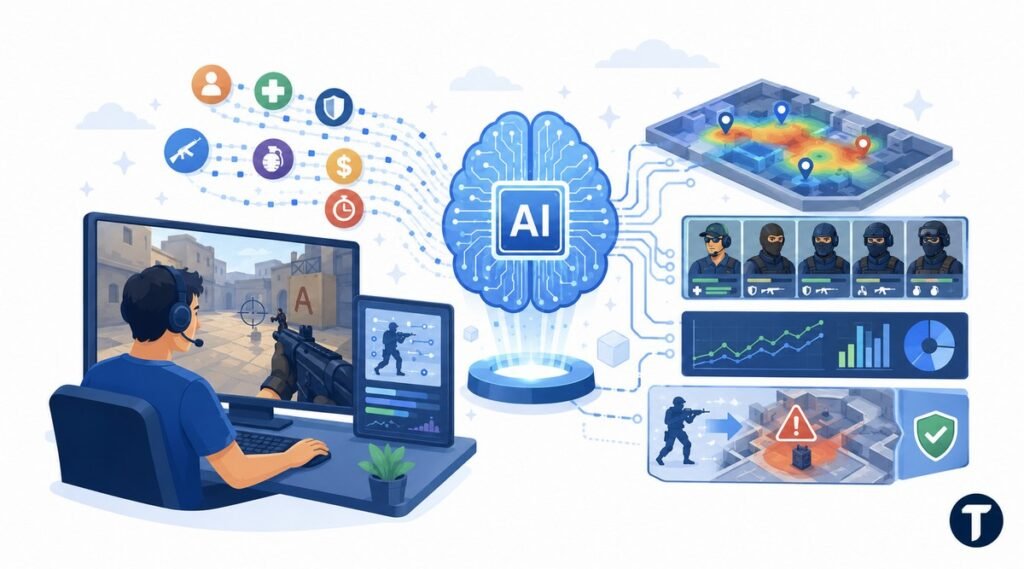
High-Frequency AI models read rapid streams of small events and refresh their view of the match again and again. Think of an algorithm taking many tiny snapshots of risk.
The model is not reading a scoreboard; it is rebuilding the match state. Each signal changes a map of control, danger, and future outcomes.
Common inputs include:
- Player coordinates and data points per player
- Health, armor, weapons, and utility
- Bomb location and round timer
- Economy state and previous round result
- Map control and in-game pressure
- Historical team performance and player performance
This is the core of real-time analytics. It turns raw game data into useful signals.
In CS2 analytics, those signals can reveal a site hit, a weak defense, or a likely save call before the broadcast gives viewers the full picture.
How High-Frequency AI Converts Events Into Predictive Signals
The pipeline starts with data ingestion. The system collects gameplay data from movement, kills, utility, economy, and objective control.
Next comes feature extraction. Raw events become labels such as mid control, utility deficit, late rotation, weak buy, or post-plant edge.
Then pattern recognition compares the present round with past states. Machine learning models and deep learning models can learn how small choices affect match outcomes.
The output is not magic; it is a chain of clean steps.
- Collect event data.
- Convert it into features.
- Compare it with past examples.
- Run inference.
- Send the result to a dashboard, overlay, or AI-powered match analysis tool.
If the CT side loses map space, burns utility, and rotates late, the model may flag a weak site before the camera moves there.
That is where High-Frequency AI gives eSports analytics its real power. It finds useful meaning inside fast, messy data.
Why AI Detects Momentum Before the Score Shows It
Momentum is not just a streak. It is a stack of small edges.
Human viewers see momentum when the score changes; AI sees it when the causes begin to form. Opening duel wins, better trade rate, cleaner utility, stronger performance metrics, and sharper post-plant spots all build pressure.
A sophisticated AI system can also spot reduced time-to-execute, weak economy loops, and repeated defensive guesses. That is why AI in eSports can feel ahead of the room. It does not wait for a chant, a scoreboard swing, or a desk segment.
This is where artificial intelligence starts to reshape sports analytics. It reads conditions before people name the trend.
For analysts, that is a major shift. eSports analytics no longer has to wait for visible proof. It can measure the pressure building underneath the action.
Real-Time Data Interfaces: Where Public Scoreboards Fit In
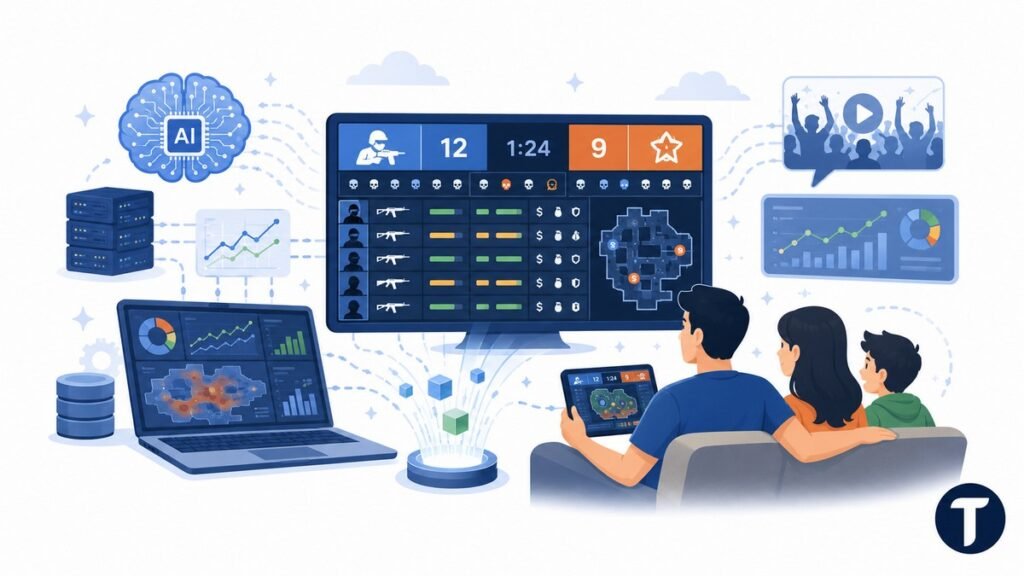
Advanced models work deeper than public pages, but public score tools show the same shift in the fan experience. People no longer want to wait for one feed. They want context across matches.
While advanced AI systems rely on deeper event streams and model-driven interpretation, public-facing tools such as a live CS2 scoreboard tracking ongoing matches show why structured match data has become useful for fans, analysts, and platforms tracking many events at once.
Scoreboards show the visible layer; High-Frequency AI interprets the hidden layer. Real-time statistics and real-time stats give the public a fast view. The model adds contextual judgment behind the scenes.
The viewing experience is moving from passive watching to data-aware tracking.
That shift matters for the wider eSports analytics market because it shows how valuable structured live match data has become.
Broadcast Still Matters for People
A broadcast gives a match a pulse. It gives us nerves, silence, surprise, and human stakes.
The broadcast gives people the feel of the match; AI gives systems a faster map of it. A broadcaster can explain fear in a clutch. A model can mark the risk before the player peeks.
Sports broadcasting still owns emotion, story, and audience engagement. AI is better at scale, speed, and signal. The best integration will not erase the human layer. It will augment it.
This mix can create richer fan experiences without turning eSports events into cold charts. The goal is more meaning, not less drama.
In that future, High-Frequency AI works behind the scenes while humans keep the match alive on screen.
Technical Challenges Behind High-Frequency AI in eSports Analytics
The hard part is not collecting more data. The hard part is knowing what the data means.
A model must avoid mistaking noise for signal. Data quality matters because small errors can mislead a fast system. Latency matters because stale insight has little value in a 40-second hit.
Context matters too. One lost duel can mean panic, bait, trade setup, or save logic. Model drift adds pressure because teams change habits, patches shift balance, and the esports industry keeps moving.
Explainability also matters. Analysts need to know why a prediction changed, not just see a number. Access to server data, public data, or sports video can change the whole result.
Different data needs also shape what a product can show to esports teams and fans. A public dashboard may only show match progress. A team tool may need deeper tactical context.
That is why eSports analytics depends on both speed and judgment.
Beyond CS2: What eSports Analytics Teaches Real-Time AI Systems
CS2 is the case study, but the same idea reaches beyond one esport.
Fast environments teach AI how to read change before people see the pattern. The same lesson appears in cybersecurity, fraud checks, logistics, finance, and autonomous systems.
Traditional sports face a related shift. Computer vision can track offside, shooting percentage, and movement inside a stadium. Sports media can combine video, telemetry, and models.
Games like Dota 2, Valorant, and titles like League of Legends add other forms of state, timing, and team pressure.
The future of esports will borrow from live sports, but it may also lead the way because every esports competition takes place inside software.
That makes eSports analytics a useful test case for any field where fast interpretation matters.
The Future Layer of AI-Generated Analysis
The next-gen playbook will blend human story with machine speed. AI-generated summaries can explain why a round changed. Natural language processing can create commentary for dashboards, coaches, and viewers.
The best future is AI-assisted, not AI-only. Model families and learning algorithms can support post-game analysis, personalization, and viewer engagement. Product teams can build viewer experiences where video, live data, and prediction sit side by side.
Using AI this way could revolutionize how teams review matches and how platforms serve millions of viewers. It is a transformative piece of digital transformation because it changes the meaning of live.
For me, this is the real promise of High-Frequency AI in eSports analytics: faster truth, not louder noise.
Conclusion: High-Frequency AI Changes What Live Means in eSports Analytics
Live no longer means only video in front of your eyes. It also means data interpreted as it happens.
CS2 shows this with force. Rounds are fast, structured, and full of signals. High-Frequency AI can read those signals before the broadcast has finished the story.
In modern eSports analytics, the fastest observer is no longer always the camera. It is the model reading the stream, detecting the pattern, and updating before the human view catches up.