Securing Intelligent Systems: How AI Is Reshaping Both Cyber Threats and Defenses
Table of Contents
Artificial intelligence in cybersecurity is now central to how security teams find attacks, investigate alerts, and protect systems. At the same time, AI cyber threats are giving attackers faster ways to create phishing, malware, reconnaissance, and social engineering campaigns.
That tension makes cybersecurity automation a strategic issue, not just a tooling choice. Organizations need AI-powered cybersecurity tools that improve threat detection without blind trust in models, data, or automated decisions.
The short explanation
Artificial intelligence in cybersecurity uses machine learning, generative AI, analytics, and automation to detect threats, prioritize risk, speed up response, and protect users, data, networks, cloud systems, and applications.
It also changes the threat landscape. Attackers can use AI to scale phishing, discover weaknesses, imitate trusted voices, and adapt malicious activity. The best defense combines AI-driven cybersecurity with human oversight, secure data practices, governance, and incident response.
How AI Cybersecurity Changes Threat Detection
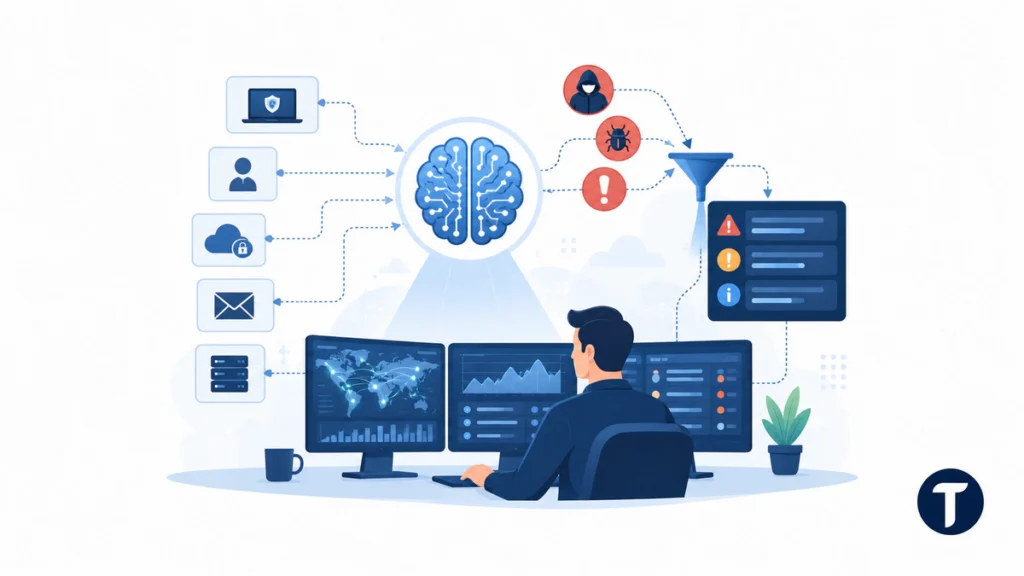
Traditional cybersecurity often depends on signatures, known indicators, rules, and analyst review. Those controls still matter, but they struggle when attackers change infrastructure, wording, timing, or behavior faster than rules can be updated.
AI in cybersecurity helps by learning patterns across endpoints, identity systems, cloud logs, email, network traffic, and applications. Instead of flagging only known malware, an AI security system can spot unusual access, suspicious data movement, impossible travel, abnormal logins, and activity that looks harmless in isolation but risky in context.
This is where AI threat detection is useful. It can reduce noise, group alerts, enrich threat intelligence, and highlight the events a security team should investigate first. The result is faster triage and better use of human judgment.
AI Cybersecurity Solutions and Security Operations Use Cases
Security operations teams face more alerts than people can reasonably review. A well-designed Artificial Intelligence in Cybersecurity solution can support analysts by summarizing incidents, ranking risk, recommending steps, and connecting events across tools.
The practical benefits of AI include faster detection, fewer repetitive tasks, better prioritization, and consistent response. For example, AI-powered cybersecurity tools can classify suspicious emails, correlate endpoint and identity events, summarize incidents, and suggest containment actions for ransomware, account takeover, or data loss.
Cybersecurity automation also helps with evidence gathering, ticket enrichment, policy checks, vulnerability prioritization, and compliance reporting. The key is to automate tasks that are repeatable, auditable, and reversible while keeping high-risk decisions under human control.
Generative AI Cyber Threats and Threat Intelligence
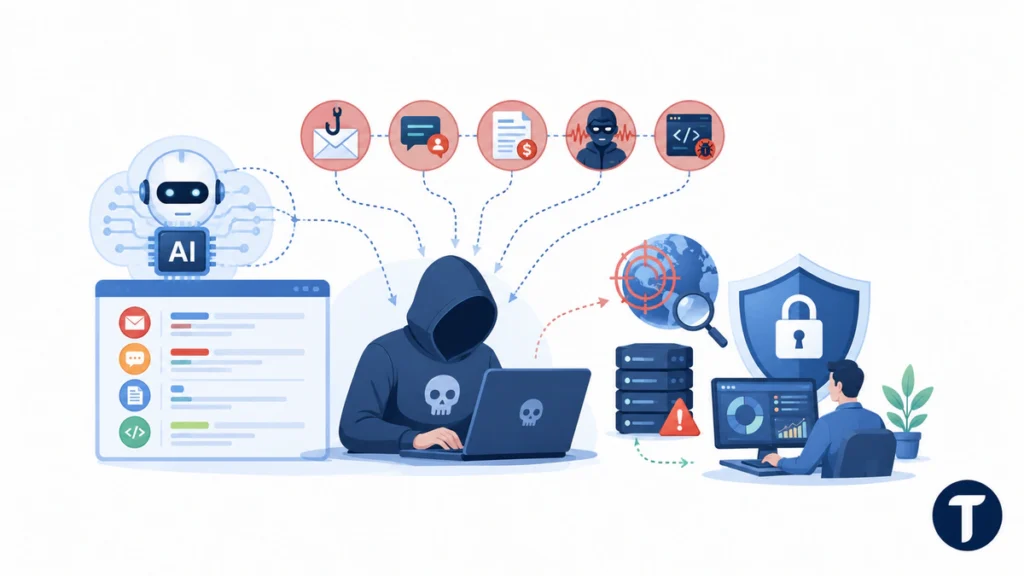
Attackers can use generative AI to produce convincing phishing emails, fake support messages, fraudulent invoices, malicious scripts, and deepfake audio or video. AI does not need to invent a new category of cyberattack to be dangerous. It can make familiar attacks cheaper, faster, and more personalized.
AI cyber threats also affect reconnaissance. Criminal groups can summarize leaked data, scan public systems, test password patterns, and tailor social engineering to a company, role, or recent business event. Even low-skill attackers can use AI to improve grammar, translate lures, or adapt payloads.
Security teams should treat this as an acceleration problem. Phishing, malware, fraud, credential theft, and vulnerability exploitation still need standard controls, but those controls must operate at the speed and scale of AI-assisted attacks.
For teams turning that pressure into a skills plan, AI cybersecurity certification courses can show which practical capabilities help analysts secure AI systems, test AI-powered applications, and respond to AI-assisted threats.
How AI Enhances Cybersecurity Across Security Tools
AI helps enhance cybersecurity when it is embedded into the security platform analysts already use. Instead of switching between dashboards, analysts can review endpoint events, cloud alerts, network signals, and data security findings in one investigation flow.
This is one reason AI cybersecurity tools are becoming common in security operations centers. They can translate telemetry into incident timelines, compare activity against threat intelligence, and recommend the next investigation step, such as credential abuse, lateral movement, or data exfiltration.
Advanced AI and machine learning are useful when traditional rules are too rigid. AI technologies can look for weak signals across data and AI systems, then show how one low-risk event may connect to a larger cyber threat intelligence pattern.
The Main Benefits of AI in Cybersecurity
The clearest benefits of AI in cybersecurity come from pattern recognition and prioritization. AI can process large volumes of telemetry, compare behavior with baselines, and flag activity that would be hard for analysts to see manually.
- Better threat detection across identity, endpoint, cloud, email, and network data.
- Faster incident response through alert grouping, enrichment, and suggested playbooks.
- Stronger phishing and fraud detection based on language, sender behavior, and context.
- More useful threat intelligence because AI can summarize patterns and connect related signals.
- Improved security operations when repetitive investigation steps are automated.
These gains matter most when AI is connected to clear processes. A model that detects unusual behavior is useful only if the organization knows who reviews the alert, what evidence is required, and when containment is allowed.
The Risks of AI Security and AI Models
AI security also creates risk. Models can make mistakes, produce false positives, miss quiet attacks, leak sensitive data through prompts, or rely on incomplete training data. If a security team treats AI output as final truth, it can respond too slowly, block legitimate users, or overlook a real compromise.
There are also security risks around AI systems themselves. Attackers may try prompt injection, data poisoning, model extraction, unsafe plugin access, or abuse of connected tools. Prompt injection can make a model ignore instructions. Data poisoning can weaken future outputs. Model extraction can expose how a system works. Excessive access can let an AI tool take actions that should require review.
This is why governance matters. ENISA research on artificial intelligence and cybersecurity highlights research needs around AI for cybersecurity and the security of AI. The same principle applies in business environments: protect the AI system, not only the systems it helps defend.
Security teams can also use the the cybersecurity challenges specific to AI systems to think through AI risk, while the OWASP Top 10 for Large Language Model Applications is useful for risks such as prompt injection, insecure output handling, data leakage, and unsafe integrations.
AI for Cybersecurity vs. Security for AI
A strong strategy should separate two related goals. AI for cybersecurity means using AI to improve detection, investigation, threat intelligence, and response. Security for AI means protecting the models, prompts, datasets, APIs, plugins, and connected systems the organization uses.
Both matter. A company may use AI to detect account takeover, but it must also prevent sensitive tickets, logs, source code, customer data, or credentials from leaking into an unsafe AI workflow. This is where policies, access control, logging, vendor review, and red team testing become part of the cybersecurity program.
Best-Fit Use Cases for AI-Powered Security
The strongest use cases for AI-powered security are narrow, measurable, and tied to a clear workflow. Email defense can use AI to detect business email compromise. Identity tools can flag unusual access. Cloud security tools can prioritize exposed workloads. Endpoint tools can separate suspicious behavior from normal maintenance.
Organizations can also use generative AI for analyst support. It can draft incident summaries, explain malware behavior, prepare executive updates, and help cybersecurity professionals query security data. These tasks improve overall security posture without handing full control to AI agents.
The wrong use case is one where the AI solution makes high-impact decisions without evidence, review, or rollback. AI-powered cybersecurity should increase confidence, not hide the reasoning behind a security measure.
Best Practices for AI in Cybersecurity
Organizations do not need to choose between manual security and full automation. The safer approach is layered adoption. Start with narrow use cases, measure results, and expand when controls are reliable.
- Define approved AI use cases for detection, investigation, reporting, and response.
- Keep humans responsible for high-impact containment, legal, privacy, and customer decisions.
- Protect prompts, logs, training data, and integrations as sensitive security assets.
- Test AI outputs against real incidents, red team exercises, and false positive scenarios.
- Monitor model drift, failed detections, and analyst overrides so performance can be improved.
Security leaders should map AI tools to existing controls. AI should improve endpoint detection, identity security, cloud monitoring, email defense, vulnerability management, and incident response rather than becoming a separate experiment with no owner.
Choosing an AI Cybersecurity Solution
A strong AI cybersecurity solution should explain what data it uses, how alerts are scored, how it integrates with existing security tools, and what actions it can take automatically. It should also show accuracy evidence, privacy controls, audit logs, and analyst workflow support.
Buyers should ask practical questions before they trust the tool:
- What data does the model process, store, or use for improvement?
- Can analysts see why an alert was scored as high risk?
- Which actions can be automated, and which actions need approval?
- Are prompts, outputs, model updates, and analyst overrides logged?
- How does the vendor prevent unsafe automation, data exposure, and model abuse?
The best fit is usually not the most autonomous product. It is the security solution that improves detection and response while giving the team enough visibility to trust, challenge, and tune the results.
AI-Based Cybersecurity Implementation Checklist
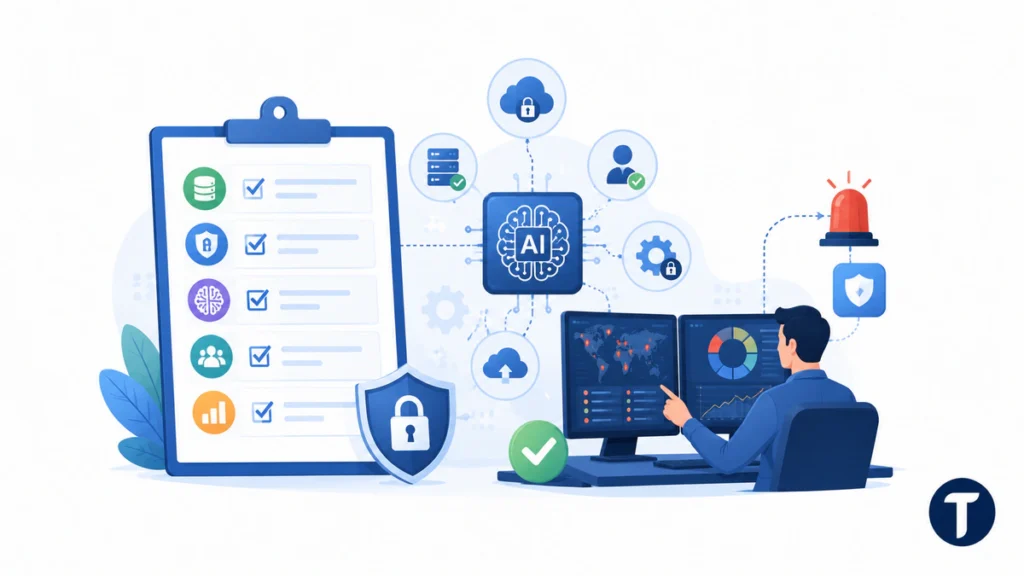
Before teams integrate AI into cybersecurity, they should document data sources, owners, permissions, and response limits. A practical checklist should cover:
- Data readiness: Confirm log quality, source coverage, data retention, and privacy requirements.
- Access control: Limit who can view data, approve actions, change prompts, or connect tools.
- AI security: Review prompts, training data, model access, plugins, APIs, and output handling.
- SOC workflow: Define who reviews alerts, when escalation happens, and how actions are reversed.
- Metrics: Track alert precision, time to triage, time to contain, false positives, and analyst override rates.
CISA’s Roadmap for AI also reinforces the need to promote beneficial AI use while managing security risks. If an AI cybersecurity solution cannot improve at least one operational metric, it may add complexity without improving defense.
The Future of AI and Cyber Defense
The future of cybersecurity will depend on how well teams manage speed, scale, and trust. Attackers will keep using AI to make phishing, fraud, reconnaissance, and malware development faster. Defenders will use AI to connect weak signals, prioritize alerts, and respond before incidents spread.
The strongest teams will not treat AI as a replacement for cybersecurity professionals. They will treat it as a force multiplier that needs guardrails: clear ownership, tested playbooks, secure integrations, explainable outputs, and human review for decisions that affect users, customers, legal exposure, or continuity.
In the age of AI, the goal is not to automate everything. The goal is to use artificial intelligence in cybersecurity where it strengthens evidence, reduces delay, and improves decision-making without creating blind spots. AI cyber threats will keep evolving, so cybersecurity automation must stay measurable, accountable, and secure by design.
AI in Cybersecurity FAQs
Is AI a Benefit or a Threat to Cybersecurity?
AI is both. It helps defenders detect patterns, automate repetitive work, and respond faster. It also helps attackers scale phishing, fraud, malware development, reconnaissance, and social engineering.
Can AI Replace Cybersecurity Professionals?
No. AI can assist cybersecurity professionals, but it cannot replace accountability, investigation, business context, legal judgment, or incident leadership. Human oversight remains essential.
How Is Generative AI Used in Cybersecurity?
Generative AI can summarize alerts, draft incident reports, explain suspicious activity, support threat hunting, and help analysts query complex security data. It must be controlled so sensitive data and automated actions are not exposed.
What Are the Biggest AI Cyber Threats?
The biggest AI cyber threats include more convincing phishing, deepfake fraud, faster reconnaissance, AI-assisted malware changes, credential attacks, and abuse of AI tools connected to sensitive business data.
What this means in practice
Artificial intelligence in cybersecurity is reshaping both defense and attack. AI cyber threats are making familiar risks faster and more convincing, while cybersecurity automation is helping security teams detect, prioritize, and respond with less delay. The winning approach is practical: use AI to strengthen detection and security operations, but govern it carefully so intelligent systems stay secure, explainable, and accountable.