
AI-Driven Reduced Workweek: Automation’s Impact by 2026
Introduction
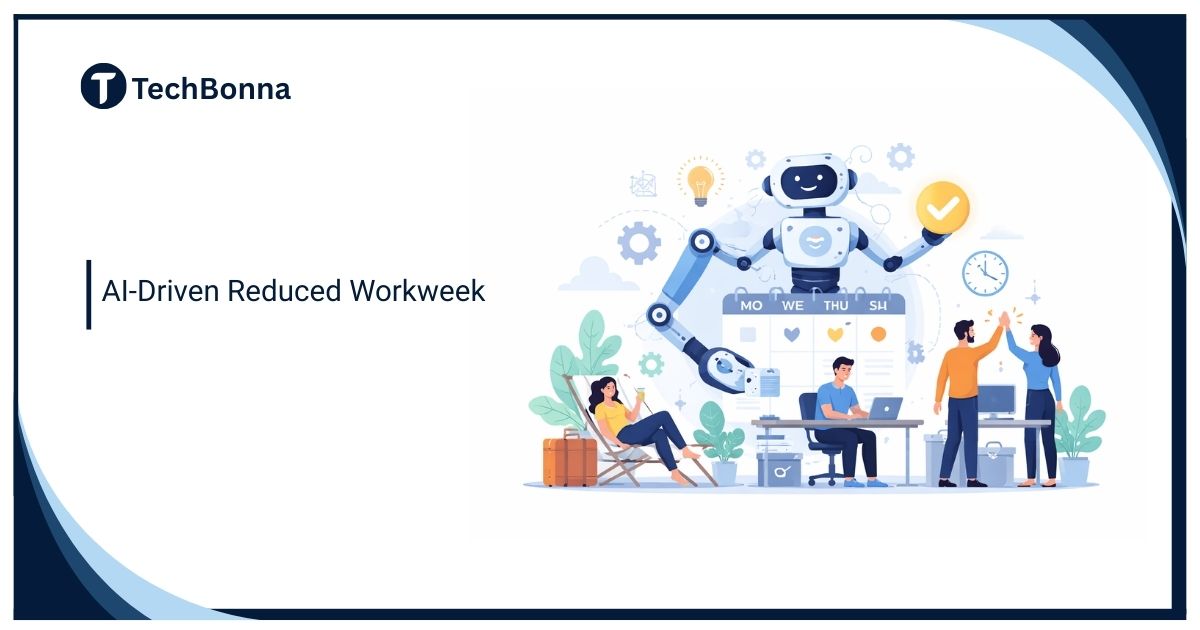
An AI-driven reduced workweek means working fewer hours without sacrificing output, quality, or accountability because artificial intelligence absorbs a meaningful share of routine, low-value, and coordination-heavy work. Instead of squeezing the same workload into fewer days through policy alone, organizations redesign how work gets done using automation.
The years 2026–2027 represent a tipping point. AI copilots, autonomous agents, and workflow automation have matured beyond experimentation. Companies are no longer asking whether AI can save time; they are deciding how to convert that saved time into sustainable productivity gains.
Automation changes the relationship between time and output. When AI handles scheduling, reporting, data processing, customer triage, and internal coordination, human effort shifts toward judgment, creativity, and decision-making allowing the same or higher output in fewer hours.
Quick Answers: AI-Driven Reduced Workweek Essentials
What it is
A reduced workweek enabled by AI automation, not by workload compression alone.
Who it’s for
Knowledge workers, service teams, and organizations with repeatable processes and digital workflows.
What changes
Working hours, task allocation, and how productivity is measured.
What doesn’t change
Expected output, accountability, performance standards, or customer experience.
What Is an AI-Driven Reduced Workweek?
An AI-driven reduced workweek is a work model where artificial intelligence replaces or accelerates enough operational work to allow employees to work fewer hours while maintaining or increasing results.
Core Principles
- Automation before time reduction
- Output-based performance measurement
- Role redesign, not role elimination
- Continuous optimization
How It Differs from Other Models
Traditional 4-day workweek
A policy shift that shortens time without necessarily changing how work is done.
Flexible work schedules
Adjusts when people work, not how much value is produced per hour.
AI-driven reduced workweek
Redesigns workflows so less human time is required to produce the same outcomes.
AI is the enabler because it removes friction, coordination costs, and repetitive work at scale something policy alone cannot do.
Why the AI-Driven Reduced Workweek Is Gaining Momentum
Burnout has become a structural risk. Many organizations discovered that longer hours no longer correlate with higher output, creating a productivity paradox.
At the same time, automation maturity has reached a point where:
- AI agents can execute multi-step tasks
- Copilots assist with analysis, writing, and coding
- RPA handles cross-system workflows
Talent retention has also become strategic. Companies offering sustainable workloads attract stronger candidates without inflating salaries. In competitive global markets, reduced workweeks supported by AI are becoming a differentiator rather than a perk.
The Productivity Mathematics Behind 40-to-32 Hour Compression
Successful reductions rely on replacing low-value work, not squeezing schedules.
How AI Replaces Low-Value Work
- Status reporting generated automatically
- Scheduling optimized algorithmically
- First-line customer inquiries handled by AI
- Data cleanup and reconciliation automated
Task-Level vs Role-Level Automation
Task-level automation removes friction inside roles. Role-level automation reshapes entire job designs, reducing the number of human handoffs required.
Output-Based Performance Models
Organizations that succeed measure:
- Revenue per employee
- Deliverables completed
- Customer satisfaction
- Cycle time reduction
Hours become an input, not the metric.
Core AI Technologies Enabling Reduced Workweeks
AI Copilots and Agentic AI
Assist professionals in writing, coding, analysis, and decision support cutting cognitive load and iteration time.
Robotic Process Automation (RPA)
Executes repeatable workflows across systems without human intervention.
Predictive Analytics
Forecasts demand, staffing needs, and bottlenecks before they occur.
Workflow Orchestration Tools
Coordinate tasks across teams and systems, reducing delays and rework.
AI-Driven Scheduling
Optimizes shifts, capacity, and workloads in real time.
Real-World AI-Driven Reduced Workweek Case Studies
Technology & AI-Native Companies
Firms like Convictional and Ask Bosco automated internal operations early, allowing teams to focus on strategy rather than execution logistics.
Marketing & Creative Organizations
Buffer and Game Lounge reduced working days by automating reporting, analytics, and content operations without lowering output.
Enterprise & Financial Services
Microsoft Japan demonstrated productivity gains exceeding 40% through process automation and meeting reduction.
Professional Services
Perpetual Guardian showed that outcome-based management could outperform traditional time-based models.
Public Sector Trials
Iceland’s public sector experiments confirmed long-term sustainability when productivity metrics were redesigned.
What Successful Companies Do Differently
They automate first, reduce hours second. Leadership participates rather than delegating change downward. Metrics are explicit, and communication is continuous. Trust replaces surveillance.
The Economic Case for AI-Driven Reduced Workweeks
Organizations calculate ROI by comparing:
- AI tooling and integration costs
- Reduced overtime and burnout costs
- Higher retention and lower hiring expenses
Revenue per employee often increases, making reduced hours economically rational rather than idealistic.
Industry-Specific AI-Driven Reduced Workweek Models
Technology & Software Development
AI accelerates coding, testing, and documentation.
Professional Services & Consulting
Automation handles research, reporting, and admin overhead.
Financial Services
AI manages compliance checks, reconciliation, and forecasting.
Healthcare
Scheduling, documentation, and triage automation reduce clinician load.
Manufacturing & Production
Predictive maintenance and planning reduce downtime.
Customer Support & 24/7 Operations
AI handles first response and routing, preserving human capacity.
When AI-Driven Reduced Workweeks Fail Lessons from Reality
Failures usually stem from reducing hours without redesigning work.
Common Failure Patterns
- Overestimating AI readiness
- Weak change management
- Poor productivity metrics
Success correlates strongly with leadership involvement and realistic automation timelines.
Legal, Regulatory, and Policy Considerations
United States
Wage laws focus on output neutrality and overtime compliance.
European Union
Experiments align with labor protections but require clear metrics.
United Kingdom
Large-scale trials show productivity stability when automation is present.
Asia-Pacific
Models vary, with strong emphasis on efficiency gains.
Compliance planning must precede rollout.
AI-Driven Reduced Workweek Implementation Roadmap (2026)
Readiness Audit
Identify automation opportunities and constraints.
Pilot Design
Select teams, metrics, and AI tools.
Optimization
Refine workflows and measurement models.
Scaled Rollout
Expand across functions.
Strategic Predictions for the AI-Driven Reduced Workweek Future
AI agents will act as digital coworkers. Talent markets will split between high-automation and low-automation firms. Measurement will focus on outcomes. Three-day workweeks will appear first in highly automated sectors, though inequality risks will grow.
Strategic Imperatives for Leaders
Leaders must redefine productivity, invest in AI infrastructure, redesign management roles, and align incentives with outcomes rather than presence.
Best Practices for Implementing AI-Driven Reduced Workweeks
Diagnostic Assessment
Audit tasks before changing schedules.
Stakeholder Alignment
Communicate expectations clearly.
AI Stack Design
Choose scalable, interoperable tools.
Pilot Governance
Define success criteria early.
Measurement
Track outputs, not hours.
Change Management
Address cultural resistance proactively.
Human Impact of AI-Driven Reduced Workweeks
Reduced hours improve mental health, engagement, and retention when career progression remains transparent. Meeting culture must evolve, and leaders must model the behavior they expect.
FAQs:
What is an AI-driven reduced workweek?
A work model where AI enables fewer hours without reducing output.
How much productivity gain is required?
Typically 20–30%, depending on industry.
Do employees earn the same salary?
Most successful models maintain pay.
Which AI tools enable reduced workweeks?
Copilots, RPA, analytics, and orchestration platforms.
How is customer support handled?
AI manages first contact; humans handle complexity.
Which industries succeed most?
Technology, services, finance, and support operations.
How long does implementation take?
Six to eighteen months.
What are the biggest risks?
Poor measurement and weak change management.
How does it affect promotions?
Progression shifts toward outcomes, not visibility.
Can employees choose five days?
Hybrid models are common during transition.
What about peak seasons?
AI scaling absorbs demand spikes.
How is productivity measured?
Output, quality, and cycle time.
How does remote work interact with it?
They reinforce each other.
How do global teams handle time zones?
AI coordination reduces dependency on overlap.
What evidence supports sustainability?
Long-term trials show stable or rising output.
How does it affect culture and retention?
Trust-based cultures see stronger retention.
Final Thoughts: AI-Driven Reduced Workweeks as a Competitive Advantage
The AI-driven reduced workweek is not a lifestyle perk. It is a structural shift in how organizations convert technology into productivity. Companies that act early will attract talent, improve margins, and adapt faster. Those that delay risk higher burnout, weaker retention, and declining competitiveness.
By 2026, the question will no longer be whether reduced workweeks are possible but whether companies are prepared to enable them.


One Comment