Why Are Businesses Switching to RFID Tracking Systems?
Table of Contents
A missing pallet, a lost laptop, or an incorrect stock count can slow down an entire business. When staff spend more time searching for items than serving customers, the problem is no longer just an inventory issue. It becomes an asset tracking, productivity, cost, and service issue.
This is why more businesses are looking at RFID tracking systems to improve inventory management and daily operations. RFID helps teams identify, count, and monitor stock or assets faster, giving them a clearer view of where important items are and how they move across the business.
What it means
Businesses are switching to RFID tracking systems to achieve faster stock counts, greater asset visibility, and fewer manual errors. RFID can scan multiple tagged items simultaneously, even when staff cannot see each item, providing teams with a more reliable view of stock, equipment, and movement across a site.
What RFID Tracking Means for a Business
RFID tracking uses radio frequency identification to identify items through a tag and a reader. The RFID tag is attached to a product, tool, case, file, or physical asset. The RFID reader receives the tag signal via an antenna and sends the data to the management software.
The main value is speed. A person does not need to scan every label individually. A handheld RFID scanner or fixed RFID readers can read many tags in seconds.
This is why RFID technology is becoming common in retail, healthcare, logistics, manufacturing, schools, and offices. The same basic tracking process can support inventory, asset tracking, check-in and check-out flows, and supply chain movement.
Healthcare deserves one extra check before deployment. The FDA’s guidance on RFID and medical devices covers the possibility of electromagnetic interference with equipment in the same space, which is a site-testing question rather than a reason to avoid the technology.
Businesses are not switching because RFID sounds modern. They are switching because manual tracking methods make growth harder. Clipboards, spreadsheets, barcode scans, and memory all break down when a business has more stock, more locations, more people, and more customer pressure.
Why Manual Inventory Work No Longer Fits
Many teams start with a spreadsheet because it feels cheap and flexible. That works for a small list. It becomes painful when the list changes every hour.
Manual stock work creates a delay between what actually happened and what the system records. That gap causes over-ordering, under-ordering, missed sales, lost items, and wasted labor.
Inventory management is about ordering, storing, using, and selling stock in a controlled way. RFID gives that process better inputs. Better inputs lead to better decisions.
Common manual problems include:
- Staff scanning one barcode at a time.
- Stock counts take hours or days.
- Items marked as available when they are missing.
- Equipment checked out with no clear owner.
- Warehouse teams are relying on memory.
- Slow audits due to records and reality not matching.
A barcode system can still be useful. The problem is that barcode labels need a direct line of sight. Staff needs to find the label, face it, and scan it. RFID tags can be read through packaging, containers, or from a short distance, depending on the tag, reader, and environment.
How RFID Asset Tracking Systems Work
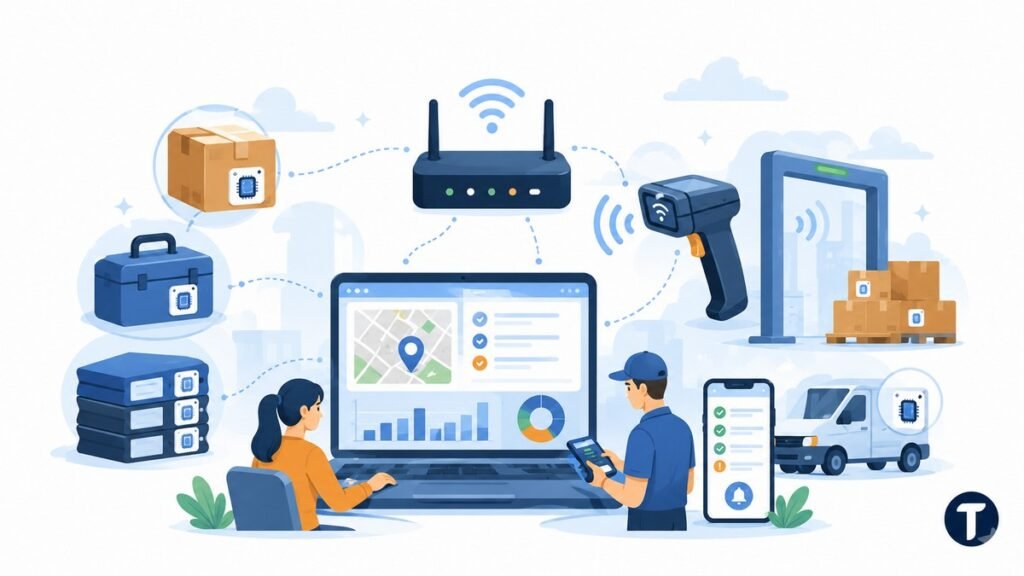
An RFID asset tracking system has three core parts: tags, readers, and software. The RFID tag stores a unique ID. The RFID reader detects that ID. The software connects the ID to an item record.
The system turns a physical asset into a digital record you can search, count, and update.
There are different types of RFID tags. Passive RFID tags do not have a power source. They wake up when a reader signal reaches them. Active RFID tags have a battery and can broadcast over a longer range. Semi-passive tags sit between those two options.
Passive RFID tags are common for stock, files, uniforms, tools, and lower-cost items. Active RFID tags suit higher-value assets, yard tracking, large sites, and equipment with longer read-range needs.
A typical RFID tracking system workflow looks like this:
- You attach the right RFID tag to each item.
- The RFID reader scans tagged items by shelf, doorway, room, van, or zone.
- The antenna receives the signal and sends the tag ID to the software.
- The asset tracking software updates the item record.
- Staff see location, status, count, movement, or exception alerts.
This can be done with handheld RFID devices, fixed RFID readers at key points, or a mix of both. The right setup depends on the site, asset value, read range, and process risk.
The Main Reasons Businesses Are Switching
RFID is not perfect for every use case, but it solves several common business problems at once. That is why the move is not limited to large warehouses.
Businesses switch when the cost of not knowing exceeds the cost of better tracking.
Faster Counts and Less Admin
RFID can automate parts of the count process. A team can scan a shelf, room, cage, or trolley without touching each item. That reduces labor and makes cycle counts less disruptive.
For retail teams, this can mean better shelf availability. For manufacturers, it can mean less time stopping production to find parts. For service teams, it can mean fewer missing tools and faster van checks.
Better Asset Visibility
Asset visibility matters when items move between people, places, and jobs. An RFID asset tracking solution can show whether an item is in storage, in use, in transit, overdue, or missing.
This matters for laptops, medical equipment, hire stock, safety equipment, event kit, IT assets, and high-value tools. The business gets a clearer view without having to ask staff to update records by hand each time something moves.
This is especially useful during an office relocation, when the business can use RFID records to verify that tagged equipment, furniture, and files reach the correct destination while a commercial mover coordinates the physical transfer.
More Accurate Inventory Tracking
Inventory accuracy improves when the system captures movements closer to the moment they occur. RFID inventory records can be updated during receiving, picking, packing, transfers, audits, and returns.
This does not remove every human task. It gives people fewer chances to enter the wrong number or skip a scan.
Stronger Supply Chain Control
RFID can support supply chain management by giving teams more details on where inventory items are and when they are moved. That is useful when stock crosses sites, vehicles, suppliers, or customer locations.
Real-time tracking is not always needed, but near-real-time data can still reduce guesswork. Managers can make faster decisions about shortages, delays, returns, and reordering.
RFID Versus Barcode Tracking
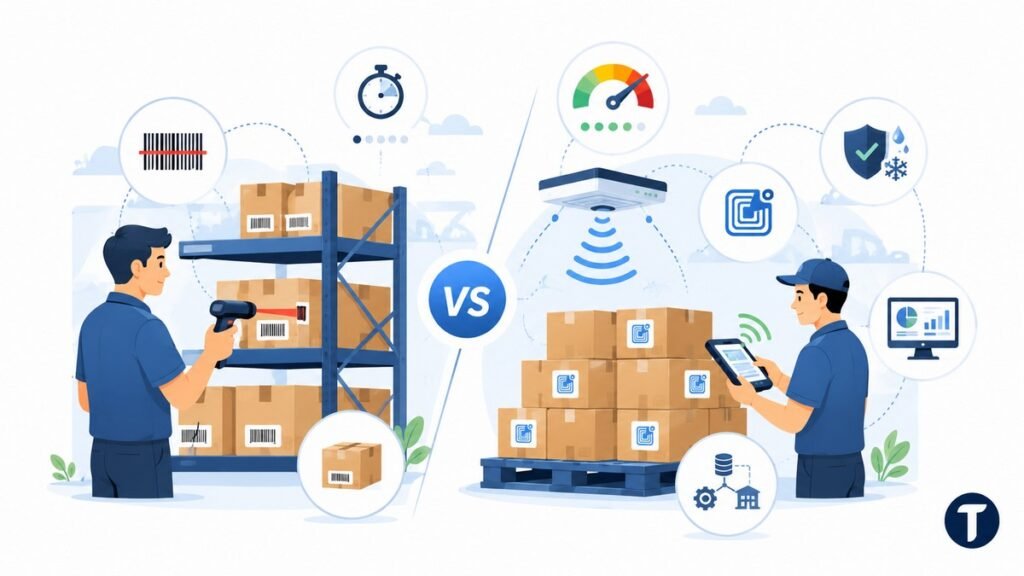
Barcodes are cheap, familiar, and easy to print. RFID labels and tags cost more, but they give more automation and speed.
The choice is not always barcode or RFID. Many businesses use both. Barcode works well for simple, low-cost, one-at-a-time scans. RFID works better when speed, volume, movement, or visibility matter more.
Key differences include:
- Line of sight: barcode needs visible labels. RFID can read tags without direct sight in many settings.
- Scan speed: barcode is usually one item at a time. RFID can read multiple tags simultaneously.
- Durability: RFID tags can be used in harsh environments, on metal surfaces, in cold rooms, or outdoors.
- Data flow: RFID systems can feed movement data into asset management or ERP tools.
- Cost: Barcode is cheaper to start. RFID can be more cost-effective when labor, loss, and errors are expensive.
The practical question is simple: where does your team lose time or trust in the current record? That answer usually shows whether RFID is worth testing.
What to Check Before Deploying RFID
RFID projects fail when businesses buy hardware before they map the process. The technology is only useful when it fits the way people work.
Start with the business problem, then select the right RFID tag, reader, and software.
Before deploying RFID, check:
- The items you need to track and their value.
- The read range you need.
- The site layout, including doors, shelves, rooms, vehicles, and zones.
- Material issues such as metal, liquids, cold, dust, or heat.
- Whether you need passive or active RFID tags.
- How RFID software will connect with current management systems.
- Who will maintain tags, readers, and item records.
- How staff will use the system on busy days.
Custom RFID may be needed for unusual assets or environments. UHF RFID is common for longer-range inventory and asset work, but the best frequency depends on the item, distance, and interference risk.
Interoperability is the reason that choice is safe to make. GS1’s EPC UHF Gen2 air interface standard defines how UHF tags and readers talk to each other, so tags and hardware from different suppliers can work in the same deployment instead of locking the site to one vendor.
A pilot is the safest route. Pick one process with a clear pain point. Measure count time, missing items, stock accuracy, and staff feedback before rolling the system across the business.
When Switching to RFID Makes Sense
RFID makes sense when a business has too much movement to manage manually. It also makes sense when losses, delays, or wrong records hurt the margin or service.
You do not need to track everything. You need to track the items that cause the most cost, risk, or delay when they go missing.
Strong use cases include:
- Warehouses with frequent stock movement.
- Retailers needing faster cycle counts.
- Healthcare teams managing shared equipment.
- Construction firms tracking tools and plant.
- Manufacturers tracking parts, work-in-progress, and finished goods.
- Offices tracking laptops, devices, keys, and access assets.
- Event and hire companies moving kit between locations.
The switch is less about the tag and more about trust. A good RFID asset tracking system gives staff confidence that the record matches the real world.
The takeaway
Businesses are switching to RFID tracking systems because manual tracking is too slow for modern stock and asset movement. RFID delivers faster counts, greater visibility, fewer errors, and stronger control over inventory and equipment.
The best results come from a focused rollout. Choose a clear problem, test the right tracking technologies, connect the data to your existing process, and train staff around the new workflow.
RFID works best when it removes friction from everyday work, not when it adds another system for people to babysit.