
AI-Driven Reduced Workweek: Automation’s Impact by 2026
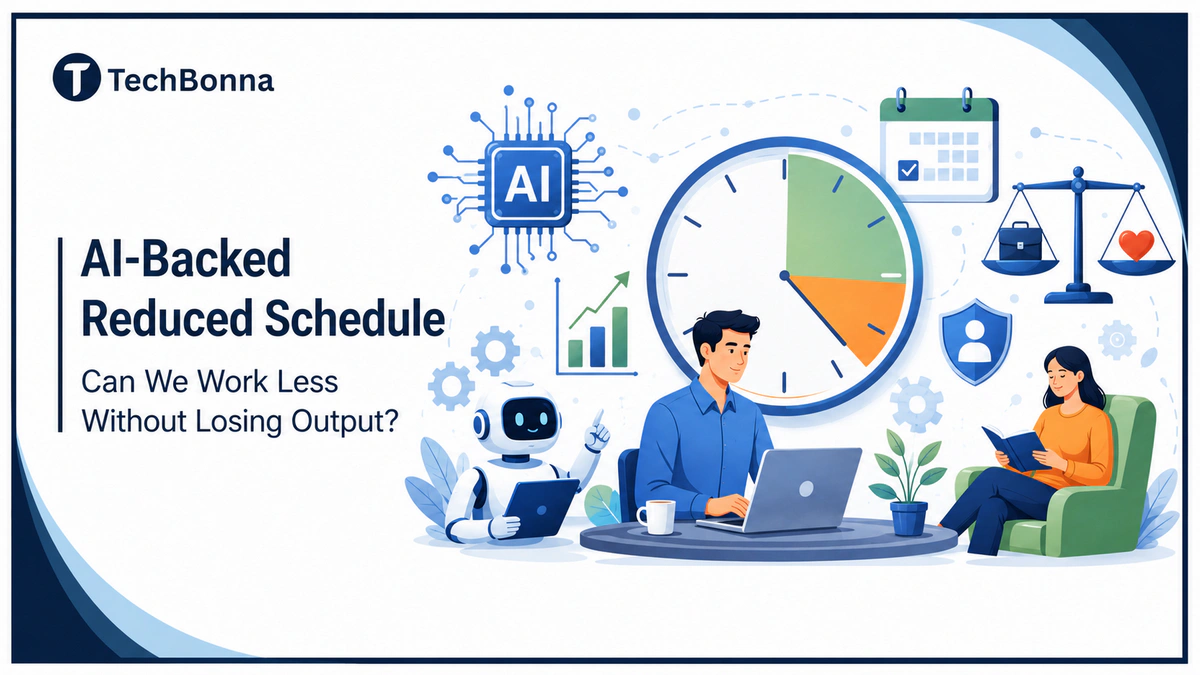
An AI-driven reduced workweek is moving from a workplace prediction to a practical operating question. Leaders want to know whether AI tools and workflow automation can remove enough routine work to support shorter hours without weakening service.
The answer depends on work design, not software alone. A credible plan must protect employee productivity, pay, quality, customer coverage, and human judgment while making any time savings visible.
What it means
An AI-driven reduced workweek is a shorter work schedule supported by AI tools, automation, and redesigned processes. It can help a team maintain output in fewer hours, but only when the company sets workload limits, protects pay, measures quality, and keeps people responsible for important decisions.
These systems can summarize information, draft routine documents, route approvals, improve scheduling, and surface exceptions. They cannot decide whether saved time becomes shorter hours, higher profit, more work, or fewer jobs.
What the Research Says About Shorter Workweeks
Shorter schedules work best when organizations redesign work before cutting hours. Removing low-value meetings, protecting focus time, clarifying handoffs, and limiting unnecessary reporting are often as important as any new technology.
The 4 Day Week Global research library brings together results from shorter-week pilots across different organizations. Its findings support structured testing, but they do not prove that every role, industry, or staffing model can move to the same reduced schedule.
A peer-reviewed study of four-day workweeks in Nature Human Behaviour also found improvements in worker well-being after organizations reduced working time without cutting pay. The study matters because participating companies reorganized work before the trial instead of treating the schedule change as an isolated perk.
That distinction is essential. A shorter workweek is not successful if employees compress the same overload into fewer days, work hidden overtime, or leave customers waiting. The evidence supports careful pilots with clear baselines, not a universal promise.
How AI Changes a Reduced Workweek
These tools change the calculation by reducing small delays that consume a normal work week. Common examples include first-pass summaries, meeting notes, document classification, basic data cleanup, internal search, schedule suggestions, and draft responses.
This is where the a shorter working week measured in controlled trials becomes a model to test rather than a prediction to repeat. A company can map repetitive tasks, choose low-risk use cases, and measure whether people can work fewer hours without shifting pressure elsewhere.
The best use cases assist a defined process instead of replacing an entire job. A support agent may receive a suggested ticket summary, but the agent still checks the facts and decides how to respond. A finance system may flag an unusual invoice, but an authorized person still approves the action.
Teams should answer four questions before using AI to justify reduced hours:
- Which tasks are repetitive, time-consuming, and safe to assist?
- Which decisions still require judgment, empathy, approval, or accountability?
- What output and quality measures will prove the change works?
- How will managers stop saved time from becoming extra assignments?
Where Workflow Automation Creates Time
The strongest automation opportunities are narrow, repeatable, and measurable. In operations, workflow automation can route routine approvals, reduce duplicate entry, match records, flag exceptions, and give managers cleaner information.
Useful opportunities often sit between teams rather than inside one job. A form may arrive by email, be copied into a spreadsheet, checked by a manager, and then re-entered into another system. Connecting those steps can save more time than asking each employee to type faster.
Protect the Boundary Between Assistance and Substitution
Drafting a summary is different from making a staffing decision. Prioritizing a support ticket is different from refusing service. Suggesting a schedule is different from deciding whose hours or pay should change.
Human review should increase with the potential impact of an error. Decisions involving employment, money, safety, legal rights, sensitive data, or customer access need documented owners and clear escalation paths.
Fix the Process Before Automating It
Automation can make a good process faster, but it can also make a bad process fail at scale. Teams should remove duplicate steps, define exceptions, clean data, and assign ownership before connecting systems.
A simple rule helps: if employees cannot explain how the process should work, the business is not ready to automate it.
Why Productivity Gains Do Not Guarantee Time Off

Technology creates options, but management decides who receives the benefit. Efficiency gains can become shorter schedules, faster delivery, higher margins, lower labor costs, more output, or job cuts.
That choice should be stated before a pilot begins. If the goal is a 32-hour schedule with no reduction in pay, employees need that commitment in writing. If the goal is only efficiency, leaders should not imply that a four-day week will follow.
Workload matters as much as scheduled time. A company has not created a reduced schedule if people answer messages on their day off, skip breaks, or regularly work late to meet unchanged targets. Hidden overtime can make a pilot look successful on paper while increasing burnout.
A fair reduced schedule shares the efficiency dividend instead of quietly raising expectations. That may mean time off, stable pay, more flexibility, better staffing, or an agreed combination of benefits.
Supporters of shorter schedules sometimes describe this as an AI productivity dividend. The case is strongest when AI productivity gains allow employees to work fewer hours without reducing pay. Critics note that a business may instead cut labor costs or justify cutting headcount.
Decide How to Share the Efficiency Dividend
A company should decide how verified savings will be shared. It can shorten the workweek, improve service, reinvest in training, or direct more savings toward corporate profits. None of those outcomes is automatic. The choice belongs in the pilot design so employees know what success is meant to deliver.
Shorter weeks can also take different forms. A team might test a 4-day workweek, staggered time off, or half days a week. The right structure is the one that protects coverage while allowing employees to work fewer hours.
What Could Go Wrong
A reduced-hours forecast has real limits. Some services need coverage every day. Some teams are already understaffed. Hourly employees can lose income if pay rules are poorly designed. Frontline roles may receive fewer benefits from generative AI than office-based roles.
Automated systems can also make mistakes, expose sensitive data, reproduce bias, or produce confident but incorrect answers. Employees may spend saved time checking weak output, which creates rework instead of efficiency.
The harder concern is displacement. Companies can use the same tools to reduce work hours or reduce headcount. If leadership treats every gain as a reason to employ fewer people, the result may be a layoff, fewer people working, or broader layoffs tied to artificial intelligence rather than more leisure time.
The debate over how to prevent AI-driven mass unemployment includes retraining, profit sharing, worker consultation, universal basic income, and clearer rules for automated decisions. These ideas can help more people benefit from AI, but each organization still needs a practical plan for redeployment, training, and accountability.
Good economic planning for an AI-powered economy should reward tools that keep people employed as well as those that cut costs. That wider future of work question sits beyond one company pilot, but it shapes whether technology creates shared time or greater insecurity.
How to Design a Fair Pilot
Start with workload mapping, not a software purchase. List the team’s recurring work, estimate the time involved, identify bottlenecks, and separate essential outcomes from habits that no longer add value.
Then classify each task as remove, simplify, automate, delegate, protect, or keep unchanged. This prevents the company from using expensive AI investments to automate work that should have been removed.
A useful pilot plan should define:
- The schedule, participating team, start date, and review period.
- Baseline output, quality, response time, overtime, and staffing levels.
- Pay rules, urgent coverage, customer expectations, and escalation paths.
- Approved tools, data restrictions, review points, and accountable owners.
- Conditions for pausing, adjusting, expanding, or ending the pilot.
Run the new process beside the old baseline long enough to capture normal demand and at least one busy period. A short trial during a quiet month can hide coverage and capacity problems.
Managers should review results with employees before expanding the model. Worker feedback can reveal hidden overtime, weak tools, unclear approvals, and tasks that performance dashboards miss.
Metrics to Track Before Reducing Hours
Speed alone is not enough. Teams need a balanced scorecard that shows whether work is becoming easier, safer, and more reliable rather than simply faster.
Track output, quality, service, workload, and employee experience together. Useful measures include:
- Completed work compared with the pre-pilot baseline.
- Error rates, rework, missed handoffs, and quality-review results.
- Customer response times, satisfaction, complaints, and coverage gaps.
- Overtime, after-hours messages, sick days, and unused leave.
- Employee productivity, focus time, burnout signals, and tool confidence.
- Model correction rates, exceptions, privacy incidents, and escalations.

Compare results by role and work type, not only at team level. An average improvement can hide that one group is carrying more customer coverage or correcting most of the automated output.
If quality falls or hidden overtime rises, the company has not proved a shorter schedule. It has only moved pressure into a less visible place.
Which Roles Are Easiest to Test
Roles with repeatable research, reporting, scheduling, documentation, analysis, and administrative tasks are easier to test first. These jobs often contain clear workflows where software can reduce preparation time without owning the final decision.
Physical, safety-critical, regulated, and live-service roles need different plans. A nurse, field technician, retail worker, or customer-support team may still need full weekly coverage even if some paperwork becomes faster.
Reduced hours do not always require every employee to take the same day off. Staggered schedules, shorter daily shifts, rotating coverage, or seasonal arrangements may protect service better than closing the business for one day.
In the U.S., employers must also consider wage rules, overtime treatment, exempt status, collective agreements, and industry-specific requirements. Legal and HR review should happen before schedules or pay change.
What the AI Workweek Outlook Looks Like in 2026

The most realistic outlook is mixed. Some organizations will use technology and process redesign to support 32-hour workweeks. Others will keep a 40-hour workweek and use efficiency gains to increase output. Some will choose remote-work flexibility, and some will cut headcount.
Different functions will change at different speeds. Sales, finance, support, software, operations, and care roles have different demand patterns, risks, and coverage needs. One company may run several schedule models at the same time, even when it uses AI extensively across the business.
AI will reshape work, but it will not produce one standard result. The future with AI depends on whether leaders use AI-powered systems to protect capacity, improve service, or simply demand more output. The impact of technology is more positive when the operating model keeps people employed and shares verified gains.
A credible forecast separates three decisions:
- Can AI reduce the human effort required for a task?
- Can the organization maintain quality and coverage with shorter hours?
- Will leadership share the benefit as time, pay, flexibility, staffing, or profit?
If all three answers support employees and customers, a reduced schedule is plausible. If the final answer is no, technology may change work without changing the schedule.
Things people ask
These answers separate what technology can support from what employers must decide through policy, staffing, and work design.
Will AI Create a Four-Day Workweek?
Technology may help some teams create a four-day work week, but it will not do so automatically. The company still has to redesign tasks, protect service coverage, define pay rules, and prevent hidden overtime.
What Is a 32-Hour Workweek?
A 32-hour schedule may use four eight-hour days, shorter daily hours, rotating shifts, or another agreed structure. The pay and coverage rules must be stated clearly.
Can AI Make Employees Work More Instead of Less?
Yes. If leaders use automation only to raise output targets, employees may receive more work instead of more time. A pilot should state whether the goal is reduced hours, efficiency, cost savings, or a defined combination.
Which Jobs Are Most Likely to Adapt to AI?
Jobs built around trust, physical presence, complex judgment, relationship management, safety, and accountability are likely to change rather than disappear. Technology may alter the task mix, but people remain essential where errors carry serious consequences.
Is AI Already Reducing Jobs?
Automation is reducing some tasks and may reduce some jobs, but results vary by company and industry. The more useful question is whether the organization plans to retrain people, improve service, reduce hours, or use savings mainly for cutting headcount.
Will Salaries Decrease with Reduced Hours?
Not necessarily. Many shorter-week pilots keep full pay while testing whether redesigned work can maintain results. A company should state its wage and overtime rules before the trial so hourly and salaried employees understand how income, benefits, and availability will be handled.
What Is the 30% Rule for AI?
The 30% rule is an informal planning idea, not a law. It suggests looking for tasks where assistance can safely remove about 30% of manual effort before redesigning a whole role. The purpose is to test specific work rather than assume a tool can replace a person.
Which Industries Benefit Most from Reduced-Work Pilots?
Knowledge-work teams in software, finance, marketing, professional services, and administration often have more repeatable digital tasks to test. Healthcare, retail, logistics, and other coverage-heavy industries can still benefit, but they may need staggered shifts and additional staffing.
Is an AI-Powered 3-Day Workweek Realistic?
A three-day schedule is possible for selected teams, but it is a more demanding target than a four-day model. A company would need substantial process improvement, dependable customer coverage, clear pay rules, and evidence that quality remains stable through busy periods.
The takeaway
An AI-driven reduced workweek is possible when evidence, worker input, and operating discipline come before hype. The strongest pilots use workflow automation to remove waste, measure employee productivity alongside quality and coverage, and turn verified gains into a fairer schedule for the people doing the work.






One Comment
Comments are closed.