
AI SaaS Product Classification Criteria: A Simple Guide
AI SaaS product classification criteria give businesses a practical way to compare tools that may look similar on a sales page but solve very different problems. Choosing an AI SaaS product becomes easier when the buyer starts with the workflow, data, users, and decision risk instead of a long feature list.
A clear SaaS evaluation checklist also helps teams compare automation, integrations, deployment, pricing, security, and vendor support. The goal is not to find the product with the most AI features. It is to find the product that fits the job, protects the organization, and delivers measurable value.
What it means
AI SaaS product classification criteria are the factors used to group and compare cloud software with built-in artificial intelligence. A practical classification should evaluate:
- Business function and intended outcome
- AI technology and model role
- Target user, team, or industry
- Automation and human oversight
- Data sources, sensitivity, and retention
- Deployment and customization options
- Integrations and workflow fit
- User experience and accessibility
- Pricing, support, and vendor stability
- Security, compliance, and AI governance
Use these criteria as a SaaS evaluation checklist before running a pilot, signing a contract, or replacing existing software.
What Is an AI SaaS Product?
An an independent security certification buyers can ask for is cloud-delivered software that uses artificial intelligence to analyze information, generate content, recommend actions, automate tasks, or support decisions. Users normally access the service through a browser, mobile app, integration, or API rather than installing and maintaining the entire system themselves.
The AI capability may use machine learning, natural language processing, computer vision, speech recognition, generative AI, forecasting, optimization, or a combination of methods. Some products place AI at the center of the experience. Others add AI to an established workflow such as accounting, customer support, recruiting, cybersecurity, design, or sales.
This difference matters. A basic chatbot added to a dashboard should not automatically be evaluated like a system that makes predictions from company data or triggers actions across business applications.
Why AI SaaS Product Classification Criteria Matter
The same product can look impressive in a demonstration and still be wrong for the organization. Clear AI SaaS product classification criteria help buyers separate marketing claims from operational fit.
AI SaaS product classification criteria make comparison fairer. A writing assistant, fraud detection platform, medical imaging system, and inventory forecasting tool may all use AI, but they have different data needs, risks, users, and success measures.
AI SaaS product classification criteria also strengthen risk review. The the robustness, security and safety principle encourages organizations to consider trustworthiness throughout the design, development, use, and evaluation of AI systems. Buyers can apply that idea by checking testing, monitoring, accountability, privacy, and human oversight before approval.
Buyers who want a recognised structure for that review can also look at ISO/IEC 42001, the international standard for AI management systems, which frames AI oversight as something an organisation establishes and maintains rather than approves once at purchase.
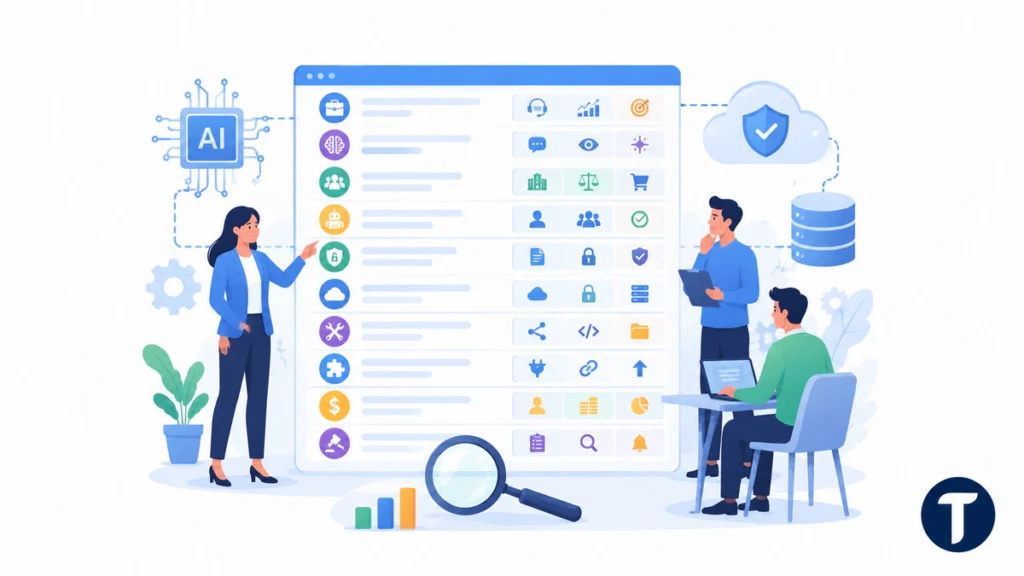
AI SaaS Product Classification Criteria at a Glance
| Classification Criterion | Main Question | Examples of Useful Labels | Buyer Decision Supported |
|---|---|---|---|
| Business Function | What job does the product perform? | Support, sales, finance, security, analytics | Use-case fit and expected value |
| AI Technology | What kind of intelligence is used? | NLP, computer vision, forecasting, generative AI | Capability and testing needs |
| User or Industry | Who is it designed for? | Horizontal, healthcare, legal, retail, developer | Workflow and compliance fit |
| Automation Level | How much can it do without approval? | Assistive, human-in-the-loop, autonomous | Oversight and accountability |
| Data Profile | What information does it use or create? | Public, internal, personal, regulated | Privacy and security controls |
| Deployment | Where does it run? | Multi-tenant cloud, private cloud, hybrid | Control, performance, and residency |
| Customization | How much can the system be adapted? | Configured, grounded, fine-tuned, custom | Setup time and maintenance |
| Integration | How does it connect to other tools? | API, webhook, native connector, file import | Workflow reliability |
| Commercial Model | How is usage charged and supported? | Per user, usage based, enterprise contract | Total cost and scalability |
| Governance | How are risks controlled over time? | Audit logs, reviews, testing, incident response | Compliance and long-term trust |
Use the table to create a product profile that business, IT, security, legal, finance, and end users can review together.
Classify the Business Function and Intended Outcome
Start with the problem. The strongest AI SaaS product classification criteria ask what work the tool improves before asking which model it uses.
Common business-function categories include:
- Customer support and service automation
- Sales forecasting and lead prioritization
- Marketing content and campaign optimization
- Finance, fraud detection, and expense review
- Human resources and workforce planning
- Cybersecurity monitoring and incident response
- Operations, inventory, and demand forecasting
- Research, analytics, and knowledge management
- Design, media, and software development
Then define the intended outcome. A support tool may aim to reduce response time, improve answer consistency, or route complex cases to the right agent. Those outcomes require different features and success metrics.
Avoid broad goals such as “use AI” or “increase productivity.” A useful product profile names the workflow, current problem, target user, expected improvement, and metric that will show whether the tool works.
Identify the AI Technology and Model Role
Next, use AI SaaS product classification criteria to identify what the AI actually does. The product may generate text, recognize objects, predict demand, detect anomalies, summarize documents, or recommend an action.
Useful technology labels include:
- Machine Learning: Finds patterns and makes predictions from data
- Natural Language Processing: Interprets, classifies, searches, or generates language
- Computer Vision: Analyzes images, video, or visual documents
- Generative AI: Produces text, images, audio, video, or code
- Optimization: Recommends efficient schedules, routes, prices, or resource allocation
- Anomaly Detection: Flags behavior or transactions that differ from expected patterns
Also identify the model’s role. Is AI the core engine, one feature inside a larger platform, or an optional assistant? This distinction affects testing, dependence, cost, and the impact of a model change.
Ask whether the vendor uses its own models, third-party models, or a mixture. Confirm which provider processes data and how model changes are communicated.
Match the Product to Its Users and Industry
Some AI tools are horizontal, meaning they can support many industries. Others are vertical products built around a specific sector, vocabulary, regulation, or workflow.
A horizontal AI SaaS product may work well for writing, meetings, search, project management, or general analytics. A vertical product may be more suitable when the workflow depends on specialized records, terminology, approvals, or regulatory controls.
Classify the intended users as well. A no-code interface for business teams is different from an API-first service for developers. An executive dashboard is different from a frontline tool used hundreds of times per day.
Check language, accessibility, device, technical, and approval needs. A powerful tool creates little value when users cannot understand or fit it into daily work.
Set the Automation and Human Oversight Level
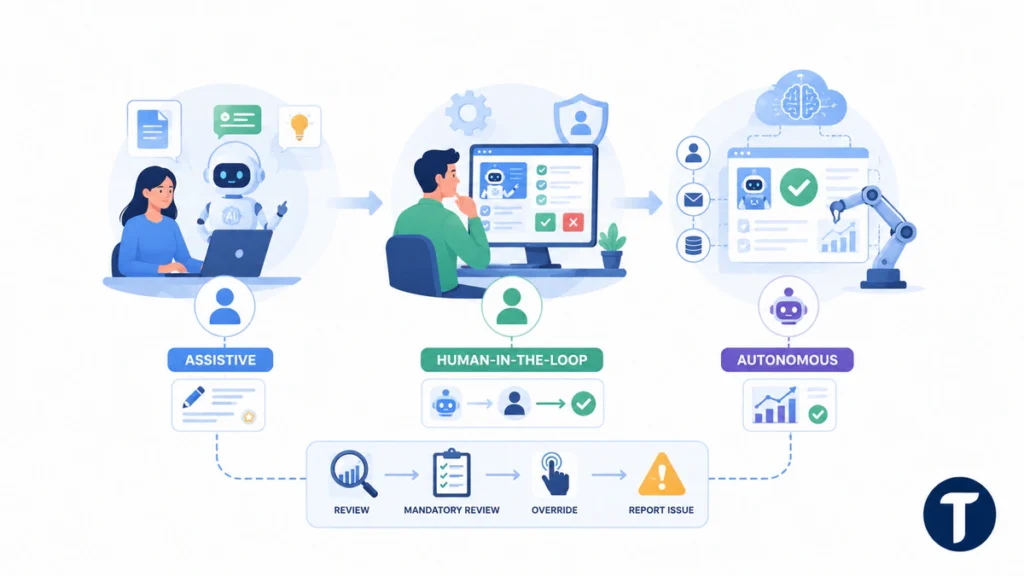
AI SaaS product classification criteria should define automation by decision authority, not by how futuristic the product sounds.
Three practical levels are:
- Assistive: The system provides drafts, summaries, alerts, or recommendations. A person decides what happens next.
- Human-in-the-Loop: The system completes part of the process, but defined actions require human review or approval.
- Autonomous: The system can trigger actions within approved rules, limits, or thresholds without reviewing every case first.
The correct level depends on possible harm. Drafting a meeting summary has a different risk profile from rejecting a payment, ranking a job applicant, changing a medical workflow, or blocking a customer account.
For every AI SaaS product, document who reviews outputs, when review is mandatory, who can override the system, and how users report errors. Human oversight must be an operating process, not a sentence in a policy.
Review Data, Deployment, and Customization

Data classification is one of the most important AI SaaS product classification criteria. Buyers should identify what information enters the system, what the product creates, where the data is stored, how long it is retained, and whether it is used to improve a vendor model.
Useful data labels include public, internal, confidential, personal, financial, health, payment, customer, employee, and regulated data. The product’s controls should match the most sensitive information in scope.
Deployment options may include multi-tenant cloud, a dedicated environment, private cloud, on-premises components, or a hybrid design. More control may increase cost and implementation work, but it can be necessary for strict security, data residency, or performance requirements.
Customization also needs clear labels. Products may support settings, templates, company-document retrieval, custom workflows, fine-tuning, private models, or extensions. More customization can improve fit, but it increases testing and maintenance.
Check Integrations and Workflow Fit
An AI tool rarely works alone. It may need data from a CRM, ERP, help desk, file repository, identity system, analytics platform, or internal database.
Classify integrations as native connectors, APIs, webhooks, browser extensions, plug-ins, file imports, or manual copy-and-paste steps. Native integration does not automatically mean reliable integration, so test permissions, data mapping, error handling, rate limits, and audit logs.
AI SaaS product classification criteria should reveal whether a tool reduces workflow friction or creates a second system employees must update. During a pilot, count the steps removed, added, or changed.
Integration review should also include exit planning. Confirm whether the organization can export prompts, records, configurations, outputs, and audit history if it changes vendors.
Compare User Experience, Pricing, and Vendor Support
User experience affects adoption, accuracy, and support costs. Classify the interface as chat-based, dashboard-based, embedded, mobile, no-code, low-code, developer-focused, or API-first.
Test the product with real users and representative tasks. A polished demonstration may hide confusing permissions, weak search, poor error messages, or difficult review steps.
Pricing may be per user, per workspace, per task, per token, per document, per API call, or based on an enterprise contract. Use a SaaS evaluation checklist that includes setup fees, usage overages, premium models, storage, integrations, support, training, security reviews, and contract exit costs.
For customer-facing or core workflows, check service commitments, incident communication, documentation, model-change notices, and access to support.
Evaluate Security, Compliance, and AI Governance

AI SaaS product classification criteria should cover identity controls, multifactor authentication, role-based access, encryption, logging, incident response, and data deletion. Verify claims with documentation, not a badge on a pricing page.
Compliance needs depend on the organization, data, jurisdiction, and use case. A vendor may support certain standards or contractual controls, but the buyer still owns how the AI SaaS product is configured and used.
Governance questions should include:
- Which uses are approved or prohibited?
- How are accuracy, bias, and harmful outputs tested?
- Can users understand when AI influenced an outcome?
- Who owns incidents and customer complaints?
- How often are models, prompts, and workflows reviewed?
- What happens when the vendor changes a model or feature?
Strong AI SaaS product classification criteria treat governance as an ongoing category. Approval at purchase does not replace monitoring after launch.
Compare Point Tools With All-in-One Platforms
Some AI products solve one narrow problem. Others combine writing, research, image generation, coding, search, analytics, and automation in one workspace.
Point tools may offer deeper features, stronger controls, or better workflow fit. Platforms may reduce subscription overlap, training time, and integration effort. The right choice depends on the organization’s priority.
TechBonna’s guide to whether an all-in-one AI platform can replace multiple software subscriptions helps buyers compare consolidation with specialist depth. Use the AI SaaS product classification criteria in this guide to test whether a broad platform is secure, integrated, measurable, and capable enough to replace the current stack.
Use a Step-by-Step SaaS Evaluation Checklist
Follow this process before purchasing or renewing an AI SaaS product:
- Define the workflow. Name the task, user, current problem, and desired outcome.
- Set the success metric. Choose measurable indicators such as time saved, error reduction, revenue impact, or service quality.
- Create the product profile. Apply the ten AI SaaS product classification criteria.
- Identify nonnegotiable controls. List data, security, compliance, integration, and human-review requirements.
- Shortlist comparable products. Do not compare tools that serve different functions or risk levels.
- Run a controlled pilot. Use real tasks and representative data within approved limits.
- Measure quality and failure. Track good outputs, errors, overrides, user confusion, and exceptions.
- Calculate total cost. Include usage, implementation, integration, support, training, and governance work.
- Review the vendor. Check stability, roadmap, contract terms, model dependencies, and exit options.
- Approve with conditions. Set owners, monitoring dates, usage rules, and a process for suspension or reassessment.
A SaaS evaluation checklist should end with a decision record. Document why the product was selected, what evidence supported the choice, which risks remain, and when the organization will review the decision again.
Avoid Common Classification Mistakes
The most common mistake is applying AI SaaS product classification criteria only to a headline feature. “AI assistant” says little about business function, data sensitivity, model role, or decision authority.
Other mistakes include:
- Comparing products that solve different problems
- Treating every AI feature as equally important
- Ignoring third-party model providers
- Assuming automation removes the need for ownership
- Evaluating price without usage and integration costs
- Accepting compliance claims without reviewing scope
- Skipping data export and vendor exit planning
- Running a pilot without success or failure metrics
- Approving a product without ongoing monitoring
A useful classification model stays simple, but it does not omit the categories that determine real-world risk and value.
Things people ask
What Are the Main AI SaaS Product Classification Criteria?
The main criteria are business function, AI technology, target user or industry, automation level, data profile, deployment, customization, integrations, user experience, pricing, vendor support, security, compliance, and governance.
How Is an AI SaaS Product Different From Traditional SaaS?
Traditional SaaS provides cloud software through a subscription or service model. An AI SaaS product also uses AI to generate, predict, classify, recommend, recognize, or automate. The AI component creates additional questions about data, testing, explainability, oversight, and model changes.
Should a Business Choose a Horizontal or Industry-Specific Tool?
Choose based on workflow and risk. Horizontal tools can be flexible and easier to deploy. Industry-specific tools may offer better terminology, integrations, controls, and regulatory fit. Test both against the same SaaS evaluation checklist.
Is a More Autonomous AI Product Always Better?
No. More autonomy can save time, but it also increases the importance of limits, monitoring, accountability, and recovery. High-impact decisions usually need stronger human review than low-risk administrative tasks.
How Often Should an AI SaaS Product Be Reclassified?
Review it after major model updates, pricing changes, integrations, incidents, workflow changes, or expansion into new data and users. An annual review is also practical for important systems.
The takeaway
Choosing AI software becomes easier when the decision starts with the job, not the hype. A structured profile helps teams compare products fairly, test real workflow fit, understand total cost, and identify risks before the system becomes difficult to replace.
Use AI SaaS product classification criteria to evaluate every AI SaaS product with the same SaaS evaluation checklist. That consistent approach helps the organization select tools that are useful, secure, governable, and capable of delivering measurable value over time.



One Comment
Comments are closed.