
8 Ways AR Try-On Is Making Online Glasses Shopping Feel Like the Real Thing
Table of Contents
Online glasses shopping used to feel like a guess. You could compare frame measurements, read reviews, and zoom in on product photos, but you still had to imagine how the pair would look on your face.
That is where virtual try-on glasses tools are changing the experience. With AR try-on, online glasses shopping now feels closer to standing in front of a mirror, checking shape, fit, color, and confidence before you buy.
Start with this
AR try-on makes online glasses shopping feel real by placing digital frames on your live camera view or uploaded photo, so you can preview size, color, bridge fit, face shape balance, and style before ordering. If you want to compare how digital frames are fitted to a face image, this kind of virtual try-on tool helps close the gap between browsing a product page and checking frames in a store mirror.
It does not replace a prescription, pupillary distance measurement, or a proper return policy. It does make the first buying decision easier because you can see how frames on your face might look in normal light, from different angles, and with several styles side by side.
1. AR Try-On Turns the Screen Into a Mirror
The biggest shift is simple: the screen stops acting like a catalog and starts acting like a mirror. Instead of looking at a model wearing a frame, you can see a digital version of that frame mapped onto your own face.
That visual feedback makes the product feel personal before the order is placed. It helps shoppers move from “I like this style” to “I can picture myself wearing this.”
Most virtual try-on tools use a camera, face-tracking software, and product images or 3D frame models. The tool identifies facial landmarks, places the eyewear over the eyes and nose, and adjusts the preview as you move.
This matters because glasses are not just a functional product. A frame can change how your face looks, how your eyes are framed, and how formal, sporty, creative, or minimal your style feels.
2. Frame Shape Becomes Easier to Judge
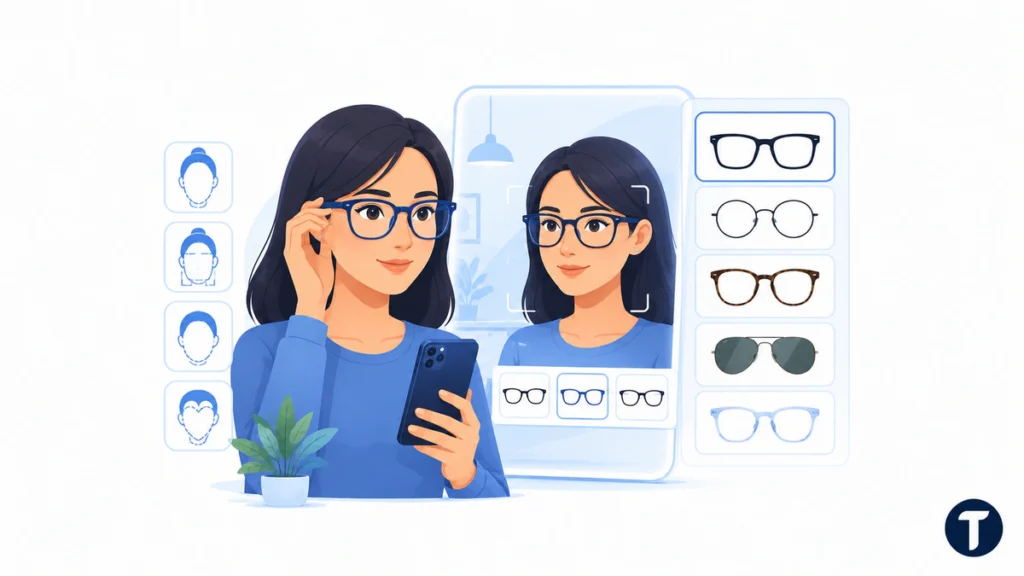
Frame shape is one of the hardest parts of buying eyeglasses online. A square frame, round frame, aviator shape, or thick acetate design can look completely different depending on face shape, eyebrow line, cheek width, and personal style.
AR try-on gives shoppers a faster way to compare those shapes. You can test a rounded style against a rectangular pair, switch between thin and bold rims, and see whether the frame sits too high, too wide, or too narrow.
The value is not perfection. The value is faster elimination. If a pair clearly does not suit your face, you can remove it from the shortlist before spending time on lens options, pricing, or checkout.
That helps with common style questions such as:
- Does this frame make my face look wider or narrower?
- Does the top rim follow my brow line naturally?
- Do round faces look better with more angular frames?
- Would oval faces suit this oversized shape?
- Does a heart-shaped face need a lighter lower rim?
3. Color and Finish Feel Less Risky
Color is another area where product photos can mislead shoppers. Black frames may feel too heavy on some faces. Clear frames may disappear against certain skin tones. Tortoise, blue, gray, or metal finishes can look subtle in one light and bold in another.
A virtual try-on preview helps shoppers compare color against their actual face, hair, and clothing. It can also make favorite frames easier to narrow down when several colors share the same shape.
Seeing color in context reduces the “will this look strange on me?” problem. That does not mean the preview will match every lighting condition, but it gives more information than a product thumbnail alone.
4. Fit Questions Become More Practical
AR try-on can help with appearance, but smart shoppers still need to check measurements. Frame width, lens height, bridge width, temple length, and pupillary distance all affect comfort and vision.
The American Academy of Ophthalmology’s guidance on choosing glasses covers the parts a camera preview cannot show, including lens type and prescription considerations, which is the half of the decision worth getting from a clinical source rather than a retailer.
The best virtual try-on experience combines visual preview with measurement information. That lets shoppers ask better questions before ordering instead of choosing only by style.
| Shopping Question | How AR Try-On Helps | What Still Needs Checking |
|---|---|---|
| Will this shape suit me? | Shows the frame on your face in real time | Personal taste and return policy |
| Is the frame too wide? | Gives a visual cue around cheek and temple width | Frame width and temple measurements |
| Does the color work? | Compares finish against your face and hair | Lighting differences and product photos |
| Will the lenses work for my prescription? | Helps you choose a frame shape | Lens type, prescription limits, and optical advice |
| Can I order with confidence? | Reduces uncertainty before checkout | Prescription accuracy, PD, shipping, and returns |
The most realistic result comes from using both the preview and the numbers. A frame can look great in a camera view but still feel uncomfortable if the measurements are wrong.
5. Augmented Reality in Retail Makes the Customer Experience More Interactive

Augmented reality in retail is not only a novelty. It gives retailers a way to turn a flat product page into a more interactive shopping moment, especially when the item depends on personal style.
For eyewear, AR in retail bridges the gap between online browsing and in-store comparison. A shopper can use AR technology to judge color, size, and confidence before asking harder questions about lenses, shipping, or returns.
AR Turns Product Pages Into Interactive Experiences
The best AR experience is simple, useful, and fast. If the feature is slow or confusing, it weakens the online shopping experience. If it feels easy, it can improve customer engagement and make the shopping process feel less risky.
This is why more retailers invest in AR. The future of AR in retail is not about replacing every store visit with virtual reality or VR. It is about using augmented reality, AR and VR concepts, and immersive product previews where they add practical value.
Good AR implementation can support personalized shopping, immersive shopping, and more engaging shopping without making the buyer work harder. It also helps an online store explain an AR product visually, which is often clearer than a long product description.
Eyewear Shows the Practical Value of AR
In eyewear, the benefits of AR are easy to understand: shoppers see the product on themselves. That role of augmented reality is especially useful when a retailer wants to offer AR applications that enhance the shopping experience and create better support for different face shapes, styles, and comfort needs.
AR is revolutionizing this part of digital shopping because it makes the buying experience more visual. The impact of augmented reality is strongest when AR features are tied to useful product data, not gimmicks. That is the difference between an engaging shopping experience and a distracting effect.
Using AR technology well means building for the full shopping behavior, from discovery to checkout. AR enables customers to compare products faster, while AR technology allows users to see scale, color, and style in context. This is how AR in online shopping can support online retail without removing the need for clear product information.
AR Works Best When It Is Built Into the Shopping Flow
For eyewear brands, augmented reality in e-commerce works best when the integration of AR is part of the product page, not a separate trick. An AR app can be helpful, but browser-based AR tools are often easier for shoppers who just want to test one or two styles quickly.
Retailers that incorporate AR should also test the implementation of AR on mobile, desktop, and slower connections. Implementing AR in retail is less about adding every possible feature and more about making the online buying experience feel steady, memorable, and useful.
AR overlays digital frames on a real face, so the experience for consumers feels more like physical shopping than traditional shopping online. That immersive AR layer can create interactive shopping experiences without turning the eyewear page into a full virtual reality and augmented reality demo.
Practical Shopping Details Still Matter
Practical details still matter. Some shoppers want vision insurance, insurance benefits, in-network pricing, reimbursement notes, free returns, and clear shipping before they select a brand. Others only need to know whether a rectangle shape will fit your face, what favorite glasses might look like, and whether they can compare glasses and sunglasses from anywhere without leaving home.
The tool also needs basic browser support. If JavaScript fails, the experience breaks. When everything works, shoppers can personalize the shortlist, compare frames online, judge what may look best, and move toward checkout with a clearer choice.
6. Shoppers Can Compare More Pairs in Less Time
In a store, trying on many frames can take time. Online, AR makes the selection process faster because you can move through several options without placing each physical pair on your face.
This speed is useful when a retailer offers hundreds of eyeglass and sunglass options. You can save a shortlist, compare similar shapes, test bold and conservative choices, and then focus on the pairs that feel most wearable.
AR try-on supports better comparison shopping because it keeps the decision visual. For retailers thinking beyond the try-on experience, TechBonna also explains how push advertising can scale affiliate and e-commerce campaigns once the product page is strong enough to convert returning shoppers. That is important for eyewear because shoppers often know what looks wrong before they can explain what looks right.
It also makes online shopping easier for people who do not enjoy busy stores, have limited time, or want to compare new frames at home before visiting an optical shop.
7. Confidence Improves Because the Experience Feels Interactive
Research on AR shopping supports what many shoppers already feel: interactive product experiences can influence buying confidence. A 2024 PLOS ONE study on AR online shopping and purchase intention found that AR shopping experiences can affect purchase intention through perceived usefulness and ease of use.
That finding is relevant to eyewear because virtual try-on tools make the product easier to understand. The shopper is not only reading about frame size or viewing static images. They are interacting with the product in a way that feels closer to real-world evaluation.
When the tool feels easy and useful, the buying decision feels less abstract. That is why AR try-on works best when the camera loads quickly, the frame tracks smoothly, and the product page still explains lens options, measurements, and return details clearly.
8. Returns May Feel Less Inevitable
No virtual try-on tool can promise that every pair will be perfect. Glasses still need to feel comfortable on the nose, ears, and temples. Prescription lenses also need to match the buyer’s vision needs.
Still, AR can reduce obvious mismatches. If a frame looks too small, too bold, too wide, or wrong for the shopper’s face shape, that pair can be removed before checkout.
That makes returns feel less like part of the plan and more like a backup. Shoppers still need a clear return policy, but they can place the order with more confidence than they would have from product photos alone.
What AR Try-On Still Cannot Do
AR try-on is useful, but it has limits. It should be treated as a decision aid, not a complete replacement for optical advice or product details.
The main limits include:
- Comfort cannot be felt through a screen. A preview cannot tell you whether the nose pads pinch or the temples feel tight.
- Scale may vary by camera and calibration. Some previews are better at style than exact sizing.
- Lens needs still matter. Strong prescriptions, progressive lenses, coatings, and sunglass tints may affect the best frame choice.
- Color can shift by lighting. Camera exposure, screen settings, and room light can change how a finish appears.
- PD and prescription details must be accurate. The visual preview does not replace proper measurement or a valid prescription.
The safest approach is to use AR try-on for style confidence, then confirm the technical details before buying.
How to Use Virtual Try-On Glasses Tools Well
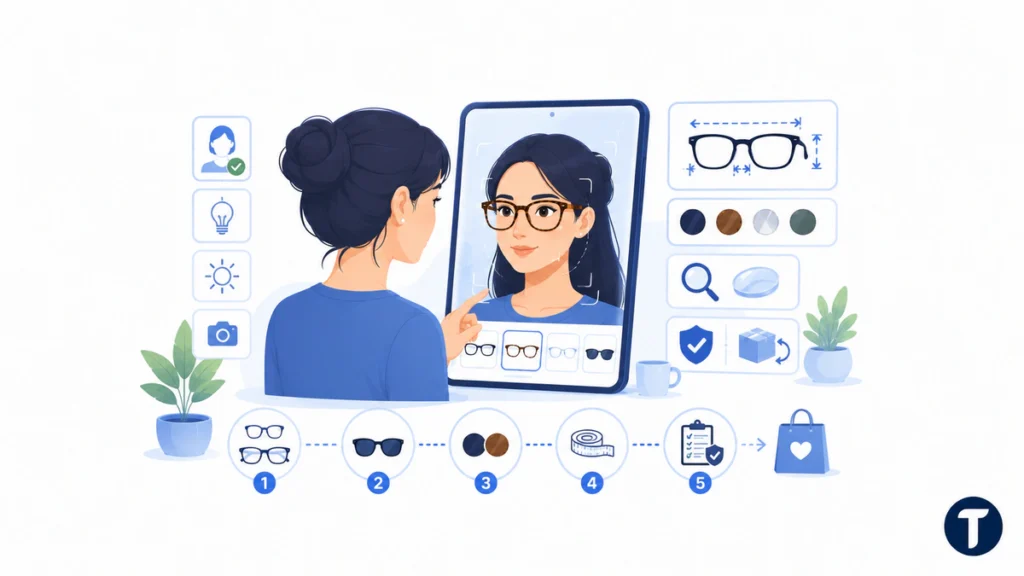
A better virtual try-on result starts with a better setup. Use a clear camera, face forward, remove hats or anything blocking your face, and stand in even light.
Then compare frames in a practical order:
- Start with shapes you already know you like.
- Try one bolder style to test your range.
- Compare at least two colors in the same frame.
- Check the measurements against a current pair that fits well.
- Review lens options, prescription requirements, and returns before checkout.
This turns AR from a fun feature into a useful shopping filter. It helps you find your perfect frame faster without pretending the preview can answer every optical question.
Worth knowing
Is There a Way to Virtually Try On Glasses?
Yes. Many eyewear retailers now offer virtual try-on glasses tools that use your camera or an uploaded photo to place frames on your face. Some tools work in a browser, while others use a mobile app.
How Accurate Is Virtual Try-On for Glasses?
Virtual try-on is usually helpful for judging style, color, and general proportions. It is less reliable for exact comfort, lens performance, and fine measurements, so shoppers should still check frame dimensions, prescription rules, and return options.
Do I Need an App to Try On Glasses Online?
Not always. Some eyewear sites let you use a virtual try-on tool directly in a browser. Other brands offer mobile apps with extra features, better face tracking, saved favorites, or additional frame previews.
Can AR Try-On Help Me Choose Frames for My Face Shape?
Yes. AR try-on can help you compare how round, square, oval, and browline frames balance your face. It is especially useful for seeing whether a frame feels too heavy, too narrow, or too wide.
Should I Still Visit an Eye Doctor Before Buying Glasses Online?
You should have a current prescription before ordering prescription eyewear. AR try-on can help with frame selection, but it does not replace an eye exam, prescription advice, or accurate pupillary distance measurement.
Making it your own
AR try-on is making online eyewear feel more personal, visual, and practical. It helps shoppers compare style, color, face shape, and frame fit before they commit to an order.
The best results come from combining the preview with real measurements, prescription details, clear product information, and a fair return policy. Used that way, virtual try-on glasses tools make online glasses shopping more confident, while AR try-on turns a flat product page into something much closer to the real mirror test.