Smart Payment Routing Explained: How AI Boosts Approval Rates

Table of Contents
Introduction
Smart payment routing matters most when checkout breaks at the worst moment and approval rates decide whether a good buyer completes the order.
A buyer has the card ready. Your offer makes sense. The page loads fast. Then the charge is declined, and the sale slips away.
Juniper Research, as reported by Yahoo Finance, expects the global merchant payment market to reach $100 trillion by 2030. That is a giant prize. It also means more card types, regions, banks, and risk checks between you and the money. For growing businesses, smart payment routing can make those payment paths cleaner and improve approval rates without adding more checkout friction.
Quick Answer: How Smart Payment Routing Improves Approval Rates
Smart payment routing is an AI-powered payment process that chooses the best processor, acquirer, or gateway for each transaction in real time.
It improves approval rates by matching payment data to the path most likely to approve the charge. It can also lower decline risk, reduce fraud friction, and recover soft failures through controlled retries.
In simple terms, smart payment routing helps a business:
- Send each transaction to the strongest available provider.
- Avoid slow or weak processing paths.
- Retry a soft decline through a cleaner route.
- Balance approval odds, fraud risk, and cost.
That keeps each transaction moving through a smoother payment flow and gives approval rates a better chance to rise over time.
What Is Intelligent Payment Routing?
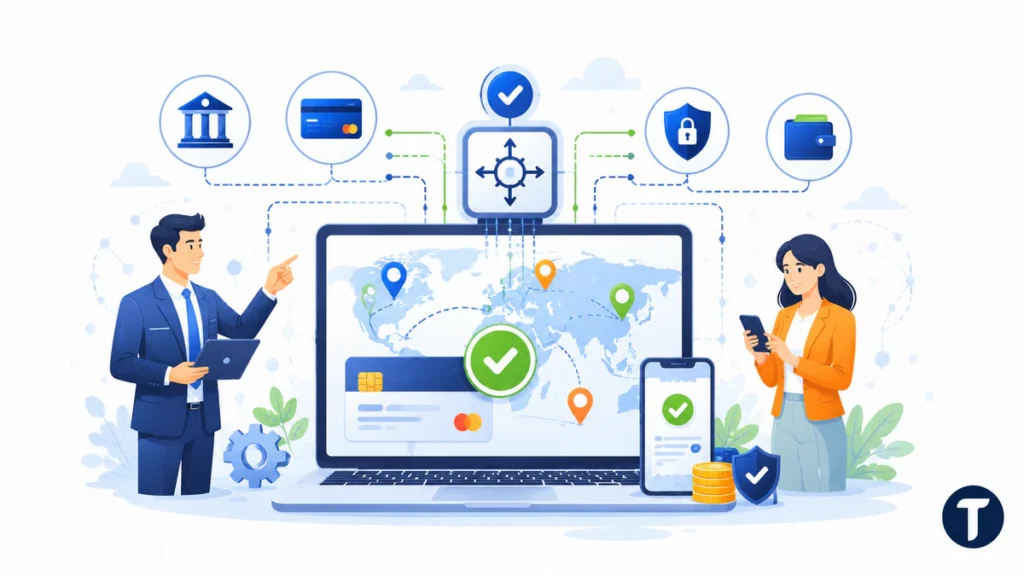
Intelligent payment routing is the control layer that decides where a transaction should go. In practice, it is one of the main systems behind smart payment routing.
Payment routing is the logic that matches a charge to the provider most likely to approve it at the right cost.
A payment gateway may connect your checkout to one provider. A stronger payment routing solution can work across multiple payment processors, multiple payment gateways, local acquirers, fraud tools, and wallets. This gives smart payment routing more paths to test and compare.
I like to think of it as a traffic director. It does not change the buyer’s intent. It changes the route behind the screen.
A basic setup may send every US card to one payment processor. A smarter one checks issuer country, card network, amount, currency, device risk, time, payment method, and past success rates. Then the payment routing engine picks the path. One transaction may need a local acquirer. Another transaction may need stronger risk screening.
For a closer look at how this works behind the scenes, Solidgate describes smart payment routing as a strategy that directs each transaction to the provider most likely to approve it. Combined with access to the shifting mix of U.S. noncash payment methods, this approach helps businesses improve authorization rates and create a more reliable payment experience, rather than simply expanding the number of payment options available.
How Routing Works and Why Fixed Paths Fall Short
Static routing uses fixed paths. It may say, “Send Visa to Provider A and Mastercard to Provider B.”
Static routing is easy to set up, but it can miss the best path for a live transaction.
Dynamic routing works in a different way. It checks live and past data before the first request goes out. That matters when one issuer favors a local acquirer, another provider has high latency, or one corridor shows weak results.
This is where payment routing work becomes revenue work. A business does not need more rules for the sake of rules. It needs sharper decisions. Smart payment routing makes those decisions easier to test because each route can be judged by cost, risk, and approval rates.
The Routing Data Behind Each Transaction
Every transaction carries clues.
Good routing logic reads those clues before the bank makes a call.
The system may review payment information such as card BIN, location, currency, amount, device history, fraud score, and customer record. It can also compare each payment method against local results.
Then the routing decision sends the request to the suitable payment gateway, the appropriate payment network, or the optimal payment processor. If the first path is weak for that profile, the routing system should know before the customer sees an error.
When smart payment routing reads those signals well, approval rates can improve because fewer valid transactions are sent down weak paths.
What Happens After a Decline
A decline is not always the end.
A soft decline needs a different response than a hard decline.
Visa says some soft declines can be retried after a fair waiting period, while hard declines, such as lost or stolen card messages, should not be retried. That guidance matters because a failed payment can be a recoverable event or a clear stop sign.
A transaction can be refused for low funds, expired details, issuer caution, or network trouble. Smart retry uses the decline code, issuer behavior, and customer history to decide the next move. If the payment fails for a temporary reason, the platform may try again later or send the request through another provider. If it is a hard decline, the system should stop and ask the buyer for a new card.
Smart payment routing supports this recovery step by choosing the next path with care. That can protect approval rates without turning every decline into a risky retry loop.
Payment Orchestration, Routing Rules, and Routing Decision Quality
Payment orchestration gives teams one place to manage providers, fraud tools, reporting, tokens, and routing rules.
Payment orchestration is useful only when the routing logic is clean enough to trust.
I have seen teams add another provider and expect magic. More choice can help, but messy routing options can add cost, noise, and support work.
Strong payment orchestration platforms let teams test paths without hardcoding every change. They also make it easier to use tokenization and smart controls across providers, so stored cards do not get trapped in one vault.
The routing setup should answer five questions:
- Which corridor has the lowest approval rate?
- Which provider wins by issuer, region, and card type?
- Which payment method needs local support?
- Which decline code deserves another attempt?
- Which path protects margin as well as trust?
This is also where smart routing and cascading need balance. Cascading can save a transaction after a soft decline. Predictive intelligent routing tries to choose the best first path, so there is less need for a second attempt.
For many businesses, smart payment routing works best when orchestration, routing rules, and provider data all support the same goal: better approval rates with fewer wasted attempts.
Benefits of Smart Payment Routing for Revenue and Cost

The upside shows up in the numbers that leaders care about: accepted orders, fewer avoidable declines, lower fees, better renewals, and stronger approval rates.
A smart routing system turns a hidden checkout leak into a measurable growth lever.
Solidgate reports that merchants can see up to 7% revenue uplift from intelligent routing and up to 10% lower processing costs when traffic moves through better paths. Results will vary, but the pattern is clear. A better first route can protect more sales.
That is the core value of smart payment routing. It gives a business a better way to improve approval rates while also watching processing costs.
Higher Approval Rates and Fewer False Declines
False declines hurt because the buyer did nothing wrong.
Each good transaction that gets blocked is lost trust, not just lost revenue.
A travel buyer may use a US card abroad. A loyal subscriber may renew from a new device. A large order may look risky but still be valid. AI can compare those signals with past outcomes and find a provider with stronger acceptance for that case.
That is how routing transactions can lift approval without loosening fraud checks. It separates odd-looking behavior from true risk.
Smart payment routing is especially useful here because false declines often come from poor path matching, not buyer problems. Better matching can raise approval rates while still keeping fraud controls in place.
Lower Cost Without Chasing the Cheapest Path
Cost control should not mean sending every request to the cheapest provider.
The cheapest failed route is still expensive.
A smart model compares fee, approval odds, and delay. It may choose a local acquirer to cut cross-border friction. It may avoid a slow provider during a spike. It may keep high-risk orders on a path with stronger screening.
That mix can improve payment performance without treating cost as the only score. Smart payment routing supports this balance because the best route is not always the cheapest one. It is the one that protects approval rates, customer trust, and margin together.
Implementing Smart Payment Routing Without Adding Checkout Risk
Implementation should start with a map of what is happening now.
Before optimizing payment paths, measure where good buyers fall out.
Review 60 to 90 days of data. Segment each transaction by issuer country, card brand, amount, currency, first purchase, renewal, decline code, provider, and device. Then compare approval by corridor.
A practical launch can look like this:
- Audit the current payment stack and provider coverage.
- Add one backup provider before adding five.
- Build routing strategies for the highest-volume corridors first.
- Test each rule on a small traffic share.
- Watch fraud, fee, and approval rate changes together.
- Roll back any rule that adds friction or support tickets.
This step also helps when payment failures cluster in one market. Markets under Strong Customer Authentication rules may need 3D Secure 2 and clear exemption logic. Alternative payment methods may matter more than cards in some regions.
The specification itself is worth going to directly. EMVCo’s own description of EMV 3-D Secure is the cleanest explanation of what the extra data is for: giving the issuer enough context to authenticate the cardholder without stopping the checkout. Exemption logic only makes sense once that exchange is understood.
The point is not to route payments through every vendor you can find. The point is to optimize payment processing for the buyer, the bank, and the business while improving business operational efficiency. Smart payment routing should make checkout safer and cleaner, not harder to manage.
When the rollout is measured well, teams can see whether approval rates improve before they expand the setup to more regions, products, or payment methods.
Building a Smart Payment Routing Strategy for the Future of Payment Growth
This strategy should grow with the business.
The next stage of payment growth depends on cleaner data, stronger routing, and fewer blind handoffs.
Start with one painful corridor. Build a payment routing strategy around it. Measure the first attempt, the retry result, the cost per accepted order, and the customer impact.
Use a provider mix that fits the market. Payment service providers differ by region, latency, authentication support, wallet coverage, and issuer trust. A single global provider may be fine at the start, but growth can expose weak spots.
The best routing strategies keep humans in control. Treat each transaction as a clue, not just a record. Make routing part of the payment strategy, not a side task. AI can score patterns. Your team still sets guardrails for risk, cost, brand trust, and customer care.
In short, it dynamically directs payment transactions only within limits your team can defend. AI should move traffic with rules you can explain.
A strong smart payment routing strategy gives those rules a clear business purpose. It should improve approval rates, protect good buyers, and keep each payment path easy to review.
Final Thoughts: Give Good Buyers a Better Path
A better checkout is not only about the button, page speed, or offer.
It is also about the road the charge takes after the buyer clicks.
Smart payment routing gives each valid buyer a better chance to complete the sale and helps approval rates move in the right direction.
It cannot fix weak fraud settings, poor data, or a confusing checkout. It can make a strong system sharper.
Every recovered transaction is a buyer who did not have to try again. Smart payment routing gives that buyer a cleaner path, protects trust, and keeps payment growth out of the developer backlog. For any team watching approval rates closely, that cleaner path can turn hidden checkout loss into measurable revenue.