Growth Navigate Startup Tools: The Complete 2026 Founder’s Guide to Scaling Smart
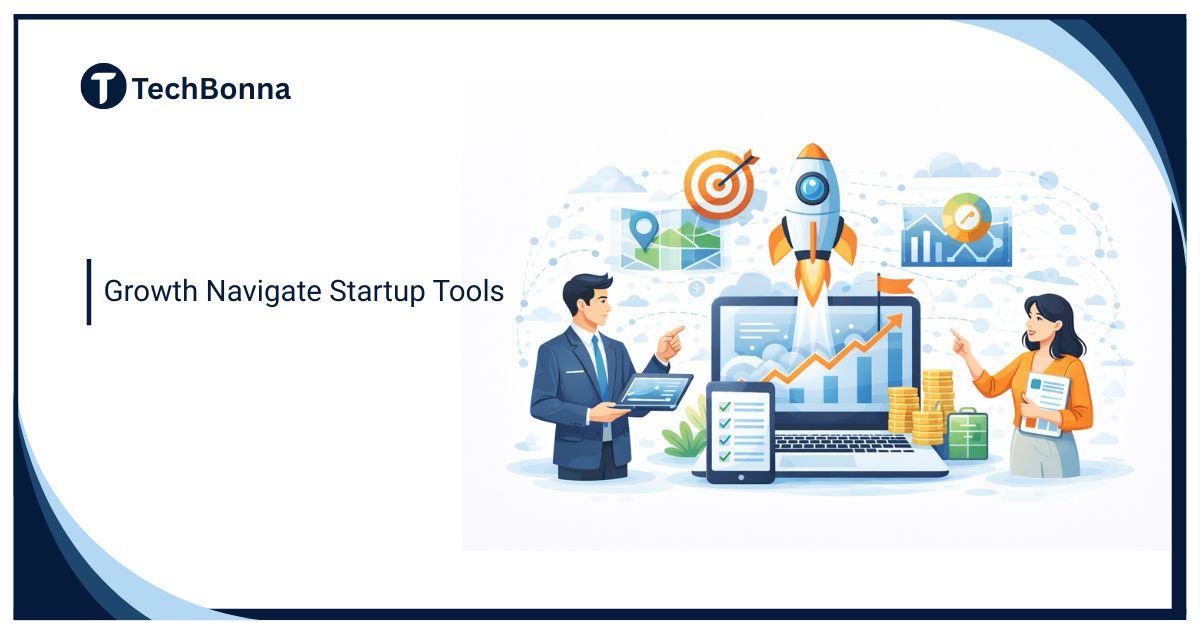
Building a startup in 2026 is not just about having a great product. It is about making disciplined decisions across strategy, funding, marketing, operations, and analytics without drowning in tools. Growth navigate startup tools are not random apps you install when something breaks. They form a structured system that helps founders move from idea to scale with clarity, measurable progress, and controlled risk. This guide breaks down how to design that system properly, avoid tool chaos, and build a stack that actually supports revenue growth instead of distracting your team.
What Are Growth Navigate Startup Tools?
Clear Definition in Simple Terms
Growth navigate startup tools are the structured combination of platforms, systems, and software that help founders:
- Plan growth intentionally
- Track performance with real data
- Manage teams and operations
- Control cash flow
- Support funding decisions
What “growth navigate” means in practice:
- Growth expanding revenue, users, market share, and operational capacity
- Navigate choosing the right direction using structured data and strategy
The difference between growth tools vs navigation tools:
- Growth tools focus on acquisition and expansion (marketing automation, CRM, sales systems).
- Navigation tools focus on clarity and direction (analytics dashboards, KPI systems, financial forecasting).
Why structure matters:
Without structure, tools become noise. With structure, tools become a growth engine.
Growth Navigate vs Random Tool Adoption
Many startups install tools reactively:
- “We need a CRM.”
- “Let’s try three marketing platforms.”
- “Someone recommended this AI tool.”
That creates tool overload.
A strategic stack:
- Has one tool per function.
- Integrates systems for clean data flow.
- Matches the company’s stage.
Random adoption leads to:
- Duplicate subscriptions
- Fragmented data
- Wasted time switching platforms
Who Needs Growth Navigate Startup Tools?
Pre-seed founders
- Need clarity on roadmap and burn rate.
Bootstrapped startups
- Must optimize costs and revenue tracking carefully.
Funded startups
- Require structured KPI reporting for investors.
Scale-ups
- Need automation and decision intelligence to avoid operational chaos.
If you are building a startup, you need structure, not more apps.
Why Startups Fail Without a Structured Growth System
Tool chaos is real. Here’s what usually happens:
Tool Chaos
Too many platforms. No integration. Confused teams.
Data Silos
Marketing data in one system. Sales in another. Finance in spreadsheets. No unified dashboard.
Misaligned Funding
Raising money without disciplined financial modeling.
Founder Burnout
Manually checking metrics across 8 dashboards daily.
Poor KPI Visibility
No clear view of:
- CAC
- LTV
- Burn rate
- Conversion trends
Without a structured system, growth becomes guesswork.
The 5 Pillars of Growth Navigate Startup Tools
1. Strategy & Roadmap Tools
- OKR systems
- Roadmap planners
- Growth modeling frameworks
2. Financial & Funding Tools
- Forecasting software
- Budget tracking
- Burn rate calculators
3. Marketing & Customer Acquisition Tools
- SEO platforms
- Paid ads managers
- Email automation systems
4. Operations & Productivity Tools
- Project management
- Team collaboration
- Workflow automation
5. Analytics & Decision Intelligence Tools
- KPI dashboards
- Funnel tracking
- Cohort analysis
Together, these pillars create a disciplined growth structure.
Core Categories of Growth Navigate Startup Tools
Strategy & Planning Tools
Founders need clarity before scale.
Use:
- Roadmap templates
- OKR systems
- Growth frameworks
These tools align teams around measurable goals.
Financial Planning & Cash Flow Systems
Cash flow determines survival.
Essential systems:
- Forecasting software
- Budget management tools
- Burn rate calculators
Track runway monthly, not quarterly.
Funding Readiness Tools
Before raising capital, your numbers must be clean.
Use:
- Pitch deck software
- Cap table management systems
- Investor CRM platforms
Investors expect organized data and structured reporting.
Marketing & Growth Hacking Tools
Acquisition drives revenue.
Key categories:
- SEO tools
- Paid advertising platforms
- Email automation systems
- Social growth tools
Choose based on stage not trends.
Analytics & KPI Tracking Tools
Every startup needs a centralized dashboard.
Track:
- Funnel conversion
- Cohort behavior
- Revenue growth
- Customer acquisition cost
Without clean data, strategy fails.
Automation & AI Tools
Automation saves time.
Examples:
- AI marketing assistants
- AI analytics copilots
- Workflow automation tools
But automate only after your processes are stable.
Collaboration & Communication Tools
Teams scale faster with structure.
Use:
- Project management systems
- Internal documentation platforms
- Async communication tools
Strong communication reduces execution friction.
Top Growth Navigate Startup Tools by Stage
Pre-Seed Stage (Idea to MVP)
Focus on:
- Lean validation tools
- Roadmap planning
- Basic financial tracking
Keep costs minimal.
Early Revenue Stage
Add:
- CRM systems
- Marketing automation
- KPI dashboards
Now revenue tracking becomes critical.
Scaling Stage
Integrate:
- Advanced analytics
- Automation workflows
- Hiring & HR systems
Operational efficiency matters more than experimentation.
Post-Funding Expansion Stage
Invest in:
- Financial intelligence systems
- Multi-channel analytics
- Enterprise-grade integrations
Investor reporting becomes structured and frequent.
Growth Navigate Funding Explained (Integrated with Tools)
Step 1: Build Financial Discipline
Before funding:
- Track burn rate weekly
- Model revenue scenarios
- Control operating costs
Step 2: Choose the Right Funding Model
Options include:
- Bootstrapping
- Angel investment
- Venture capital
- Revenue-based financing
Each requires different financial documentation.
Step 3: Use Tools to Support Your Funding Story
Prepare:
- KPI dashboards
- Investor reporting systems
- Forecast models
Data builds trust.
Core Frameworks Behind Smart Growth Decisions
The Ansoff Matrix Growth Strategies
Helps evaluate:
- Market penetration
- Market development
- Product development
- Diversification
The Five Stages of Small Business Growth
From existence to maturity — tools must evolve at each stage.
The Lean Startup Feedback Loop
Build → Measure → Learn.
Tools should support this cycle.
Growth Roadmap Framework
Quarterly goals aligned with metrics.
North Star Metric Framework
Identify one core metric that reflects long-term value.
How to Choose the Right Growth Navigate Startup Tools
Evaluate tools based on:
Scalability
Will it support your next growth stage?
Integration Capability
Does it connect with your existing systems?
Ease of Use
Adoption matters more than features.
Pricing Model
Match costs with revenue stage.
Automation Capabilities
Reduces repetitive work.
Data Security & Compliance
Protect customer data.
API & Ecosystem Support
Future-proof your stack.
Free vs Paid Growth Navigate Startup Tools — What Should You Start With?
When Free Tools Are Enough
- Pre-revenue stage
- MVP testing
- Small team operations
When Paid Tools Are Necessary
- Growing revenue
- Larger teams
- Investor reporting
Hybrid Model Strategy
Combine:
- Free analytics
- Paid CRM
- Scalable automation
ROI Calculation Framework
Measure:
- Time saved
- Revenue impact
- Error reduction
If ROI > subscription cost, upgrade.
Common Challenges When Navigating Startup Growth
- Leadership strain
- Complexity overload
- Operational bottlenecks
- Funding misalignment
- Tool stack fragmentation
- Over-automation too early
Balance discipline with flexibility.
Growth Navigate Startup Tools in the Age of AI
AI-Driven Analytics
Predict churn and revenue trends.
Predictive Financial Modeling
Simulate runway scenarios instantly.
AI Marketing Automation
Segment customers automatically.
AI for Customer Retention
Personalized engagement flows.
Founder AI Assistants
Summarize metrics and highlight anomalies.
AI should enhance decision-making, not replace strategic thinking.
How to Build a Growth Navigate Tool Stack (Step-by-Step Blueprint)
Step 1: Define Your Growth Goal
Revenue target? User acquisition? Expansion?
Step 2: Map Required Functions
Marketing, sales, finance, operations.
Step 3: Select 1 Tool Per Function
Avoid duplication.
Step 4: Integrate & Automate
Connect systems through APIs.
Step 5: Review Quarterly
Remove unused tools. Optimize costs.
Real-World Startup Tool Stack Example
SaaS Startup Example
- CRM + analytics dashboard
- Subscription billing system
- Marketing automation
- AI retention tracking
E-commerce Startup Example
- Inventory system
- Paid ads platform
- Conversion tracking
- Revenue analytics dashboard
B2B Service Startup Example
- Project management
- Proposal tracking
- Financial forecasting
- Client communication system
Each stack depends on the business model.
Metrics Every Founder Must Track Using Growth Navigate Startup Tools
High-priority metrics:
- CAC (Customer Acquisition Cost)
- LTV (Lifetime Value)
- Burn rate
- Runway
- MRR (Monthly Recurring Revenue)
- Conversion rate
- Retention rate
If you do not track these weekly, growth is blind.
Future Trends in Growth Navigate Startup Tools 2026–2030
AI-First Startups
Analytics embedded in every workflow.
No-Code & Low-Code Growth Systems
Founders build systems without developers.
Unified Founder Dashboards
One dashboard for finance, marketing, and operations.
Embedded Financial Intelligence
Real-time burn tracking inside operational tools.
Predictive Scaling Algorithms
Systems that suggest hiring or expansion timing.
The future is structured, integrated, and data-driven.
FAQ — Growth Navigate Startup Tools
What are growth navigate startup tools?
Structured systems that help startups plan, measure, and scale efficiently.
Why do startups need growth to navigate startup tools?
To avoid chaos, manage revenue growth, and align strategy with execution.
Which tools are best for early-stage startups?
Simple financial tracking, basic CRM, and lean analytics dashboards.
Are free growth navigate startup tools enough?
For early validation, yes. For scaling, usually no.
How many tools should a startup use initially?
One per core function. Avoid duplication.
How often should a startup review its tools?
Quarterly.
Can growth navigate startup tools improve team collaboration?
Yes, structured communication reduces operational friction.
How do growth navigate tools support funding?
Clean metrics and dashboards strengthen investor confidence.
What metrics should I track using these tools?
CAC, LTV, burn rate, runway, MRR, retention.
Are AI tools necessary for startup growth in 2026?
Not mandatory but increasingly valuable for analytics and automation.