Business Vertical Classification Categories: Complete Guide to Industry Segmentation
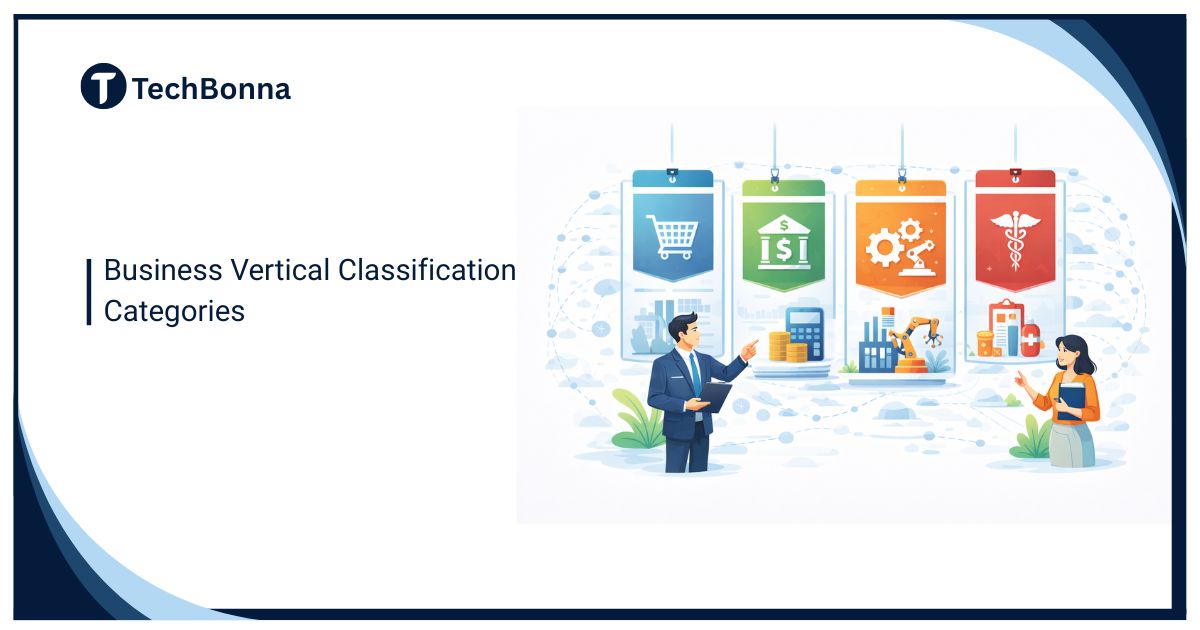
Business vertical classification categories define how economic activity is grouped, analyzed, regulated, and invested in. For founders, analysts, marketers, and investors, understanding vertical structure is not academic; it shapes positioning, valuation, compliance, and long-term growth strategy.
This guide explains vertical classification from fundamentals to modern digital complexity, with practical examples and strategic insights.
What Are Business Vertical Classification Categories?
Simple Definition
Business vertical classification categories are structured systems that group companies based on the primary products, services, and markets they serve. These categories organize economic activity into sectors, industries, and specialized verticals, enabling analysis, regulation, benchmarking, investment decisions, and strategic positioning.
Business Vertical vs Industry vs Sector
Clear terminology prevents strategic confusion.
Sector
The broadest economic grouping. Examples include Technology, Healthcare, Energy, and Financial Services. Sectors represent high-level economic domains.
Industry
A narrower grouping within a sector. For example, within Technology: Software, Hardware, Semiconductors.
Vertical
A focused market category within an industry that serves a specific customer type or use case. Example: Healthcare SaaS within Software.
Sub-vertical
Further specialization inside a vertical. Example: Telemedicine platforms within Healthcare SaaS.
Market Niche
A tightly defined segment with unique needs. Example: Telemedicine platforms for rural cardiology clinics.
Hierarchy Example:
Sector → Industry → Vertical → Sub-vertical → Niche
The narrower the classification, the more targeted the strategy.
Vertical Markets vs Horizontal Markets
Definition
Vertical market: A business serving a specific industry with tailored solutions.
Horizontal market: A business serving multiple industries with broad solutions.
Examples
- Vertical: Construction project management software
- Horizontal: General accounting software used across industries
Comparison Table
| Criteria | Vertical Market | Horizontal Market |
| Target Audience | Specific industry | Multiple industries |
| Customization | High | Moderate |
| Sales Cycle | Often longer | Typically shorter |
| Competitive Space | Narrow but deep | Broad but competitive |
| Pricing Power | Strong (specialization premium) | Volume-based |
Vertical positioning increases authority. Horizontal positioning increases scale.
Why Business Vertical Classification Categories Matter
Market Analysis and Competitive Benchmarking
Classification allows meaningful comparison. A fintech startup should benchmark against fintech, not generic tech companies. Accurate categorization enables performance ratios, growth tracking, and realistic valuation expectations.
Mini example:
A B2B cybersecurity firm comparing itself to consumer software companies will misjudge acquisition cost and retention benchmarks.
Strategic Positioning and Differentiation
Your vertical determines messaging. A CRM for law firms speaks differently than a CRM for e-commerce brands.
Clarity in vertical positioning improves:
- Brand authority
- Sales alignment
- Product roadmap focus
Regulatory and Compliance Reporting
Certain verticals operate under strict oversight (finance, healthcare, energy). Classification determines:
- Reporting requirements
- Data handling standards
- Licensing obligations
Misclassification can trigger compliance risks.
Investor Communication and Valuation
Investors evaluate companies relative to vertical peers. Multiples differ dramatically between industries.
Example:
- SaaS companies: often revenue multiple driven
- Manufacturing firms: asset and margin driven
Your vertical defines your valuation logic.
Digital Marketing and Targeted Growth
Vertical clarity improves:
- Keyword targeting
- Paid ad segmentation
- Content authority
- Industry backlink acquisition
Broad positioning dilutes SEO strength.
Startup Market Entry Strategy
Choosing the wrong vertical can stretch early resources.
Example:
A logistics software startup entering enterprise freight before mastering regional trucking operations risks operational overload.
Focused vertical entry reduces burn rate.
The Evolution of Industry Classification Systems
Traditional Industrial Era Classification
Early systems focused on manufacturing output—steel, textiles, machinery. The economy was production-centered and geographically bound.
Modern Globalized Economies
Service industries expanded:
- Finance
- IT
- Consulting
- Telecommunications
Global supply chains blurred geographic boundaries.
Digital Economy and Platform-Based Verticals
Platforms introduced hybrid models:
- Marketplace businesses
- On-demand services
- Subscription ecosystems
Companies now span multiple economic functions simultaneously.
The Shift Toward Data-Driven Classification
Modern classification relies on:
- Revenue source analysis
- Customer segmentation
- Activity-based reporting
- Algorithmic industry tagging
Data precision matters more than physical output.
Major Global Business Classification Frameworks
NAICS (North American Industry Classification System)
North American Industry Classification System
Purpose: Standardize business activity reporting in North America
Structure: 2–6 digit hierarchical codes
Who Uses It: Government agencies, analysts, economists
Widely used in the United States for statistical reporting.
SIC (Standard Industrial Classification)
Standard Industrial Classification
Historical relevance: Predecessor to NAICS
Where still used: Legacy datasets, some regulatory filings
Less granular than modern systems.
GICS (Global Industry Classification Standard)
Global Industry Classification Standard
Investor use: Stock classification
Stock market relevance: Used by major indices and asset managers
ICB (Industry Classification Benchmark)
Industry Classification Benchmark
Global investment analysis: Alternative to GICS
Used by international exchanges and fund managers.
Comparison Table of Major Systems
| System | Region | Purpose | Structure | Best For |
| NAICS | North America | Economic reporting | 2–6 digit hierarchy | Government data |
| SIC | US (legacy) | Industrial grouping | 4-digit codes | Historical comparison |
| GICS | Global | Investment classification | 4-tier structure | Equity analysis |
| ICB | Global | Financial markets | 4-level hierarchy | Portfolio management |
Core Business Vertical Classification Categories in Modern Markets
Below are major verticals with structural insights.
Technology
Definition: Development and distribution of digital and hardware solutions.
Revenue model: Subscription, licensing, usage-based
Target market: Enterprises, SMBs, consumers
Regulatory impact: Data privacy laws
Emerging trends: AI integration, cloud expansion
Healthcare
Definition: Medical services, pharmaceuticals, biotech
Revenue model: Insurance reimbursement, service fees
Target market: Patients, providers
Regulatory impact: Strict compliance requirements
Emerging trends: Telehealth, precision medicine
Finance
Definition: Banking, insurance, fintech
Revenue model: Interest spread, transaction fees
Target market: Individuals, corporations
Regulatory impact: Heavy oversight
Emerging trends: Embedded finance
Retail & E-commerce
Definition: Sale of goods online and offline
Revenue model: Direct sales, marketplace commission
Target market: Consumers
Regulatory impact: Consumer protection laws
Emerging trends: Omnichannel retail
Manufacturing
Production of physical goods.
Asset-intensive.
Increasing automation and robotics adoption.
Energy & Utilities
Power generation, oil & gas, renewables.
Transition toward sustainable sources.
Real Estate
Property development, leasing, REIT models.
Highly sensitive to interest rates.
Education
Institutions, EdTech platforms.
Shift toward hybrid learning models.
Media & Entertainment
Content production, streaming, advertising-supported platforms.
Transportation & Logistics
Freight, warehousing, last-mile delivery.
Driven by supply chain digitization.
Hierarchical Structure of Business Vertical Classification
Sector → Industry → Sub-Industry → Vertical → Niche
This layered model helps:
- Analysts compare performance
- Regulators monitor activity
- Businesses define strategy
Multi-Vertical Organizations
Large corporations often operate across verticals. Clear revenue segmentation improves investor transparency.
Conglomerates and Cross-Industry Models
Conglomerates diversify risk by spreading operations across unrelated verticals.
Hybrid and Converging Verticals
Example: Fintech combines finance and technology.
Convergence challenges traditional classification.
How to Determine the Right Vertical for Your Business
Step-by-Step Checklist
Define Core Value Proposition
What problem do you solve?
Identify Primary Customer Segment
Who pays you?
Analyze Revenue Model
Subscription? Transactional? Asset-based?
Study Competitor Classification
How are similar firms categorized?
Regulatory & Geographic Considerations
Where do compliance obligations fall?
Long-Term Scalability Alignment
Can this vertical sustain growth?
Misalignment here creates strategic drift.
Business Vertical Classification in B2B vs B2C Contexts
B2B Vertical Dynamics
Longer sales cycles, relationship-driven, compliance-heavy.
B2C Vertical Dynamics
Higher volume, brand-driven, price sensitive.
Marketplace & Platform Verticals
Two-sided markets serving suppliers and consumers simultaneously.
Benefits of Clear Vertical Classification
Targeted Marketing
Improved audience precision.
Product Development Alignment
Roadmaps tied to industry needs.
Improved Strategic Partnerships
Easier ecosystem integration.
Investment & Funding Appeal
Clear comparables improve valuation.
Brand Authority and Industry Positioning
Specialization builds trust.
Improved SEO & Digital Visibility
Industry-specific keywords increase ranking potential.
Challenges in Business Vertical Classification
Industry Convergence
Technology blends sectors.
Rapid Technological Innovation
New categories emerge quickly.
Global Regulatory Differences
Cross-border activity complicates classification.
Multi-Vertical Operations
Revenue segmentation becomes complex.
Misclassification Risks
Incorrect coding can distort reporting.
Solution approach: Regular strategic review and revenue source auditing.
Vertical Classification and Digital Marketing Strategy
Keyword Mapping by Vertical
Align search terms with industry language.
Content Strategy by Industry Category
Publish niche-specific insights.
Paid Advertising Segmentation
Target campaigns by industry filters.
Account-Based Marketing (ABM)
Focus on high-value vertical accounts.
Local vs Global Vertical SEO
Adapt to regional compliance and search patterns.
How Investors and Analysts Use Vertical Classification
Portfolio Allocation
Sector balancing reduces exposure.
Risk Diversification
Different industries react differently to macro trends.
Industry Benchmarking
Performance measured against vertical peers.
Growth Forecasting
Macro trends impact vertical growth rates differently.
Emerging Trends in Business Vertical Classification Categories
AI-Driven Categorization Systems
Machine learning improves classification accuracy.
Sustainability-Focused Industry Models
Green economy vertical expansion.
Cross-Border Economic Integration
Global classification harmonization efforts.
Platform and Ecosystem Verticals
Network-based economic models.
Increased Industry Dynamism
Categories evolve faster than traditional frameworks.
The Future of Business Vertical Classification Categories
Future systems will rely more on revenue composition, ecosystem mapping, and digital activity tracking rather than static labels. Hybrid models will dominate. Precision will replace broad categorization.
Businesses that understand classification strategically will communicate more clearly to regulators, investors, and markets.
Frequently Asked Questions
What is a business vertical?
A business vertical is a specific market segment within an industry that focuses on serving a defined customer group with tailored products or services. It represents a narrower specialization inside a broader industry category.
How is a vertical different from a sector?
A sector is a broad economic category such as Technology or Healthcare. A vertical is a focused segment within an industry that targets a specific customer type or use case.
What are the main industry classification systems?
Major systems include NAICS, SIC, GICS, and ICB. These frameworks organize businesses into structured categories for reporting, regulation, and investment analysis.
How do startups choose their vertical?
Startups analyze their core value proposition, primary customer, revenue model, regulatory environment, and competitive landscape before selecting the vertical that aligns with long-term scalability.
Can a company operate in multiple verticals?
Yes. Large firms and conglomerates often generate revenue across multiple verticals. Accurate revenue segmentation ensures clarity in reporting and investor communication.
Why does vertical classification matter for SEO?
Clear vertical identification improves keyword targeting, content authority, backlink relevance, and audience precision, increasing organic search visibility within a defined industry niche.
Conclusion: Strategic Power of Business Vertical Classification Categories
Business vertical classification categories shape how companies are analyzed, regulated, marketed, and valued. Clear categorization strengthens strategic clarity, improves investor communication, and sharpens competitive positioning.
In modern markets defined by convergence and rapid change, classification is no longer administrative, it is strategic infrastructure.
Understanding your vertical is understanding your economic identity.