
What Does an Ethernet Cable Look Like? A Simple Guide
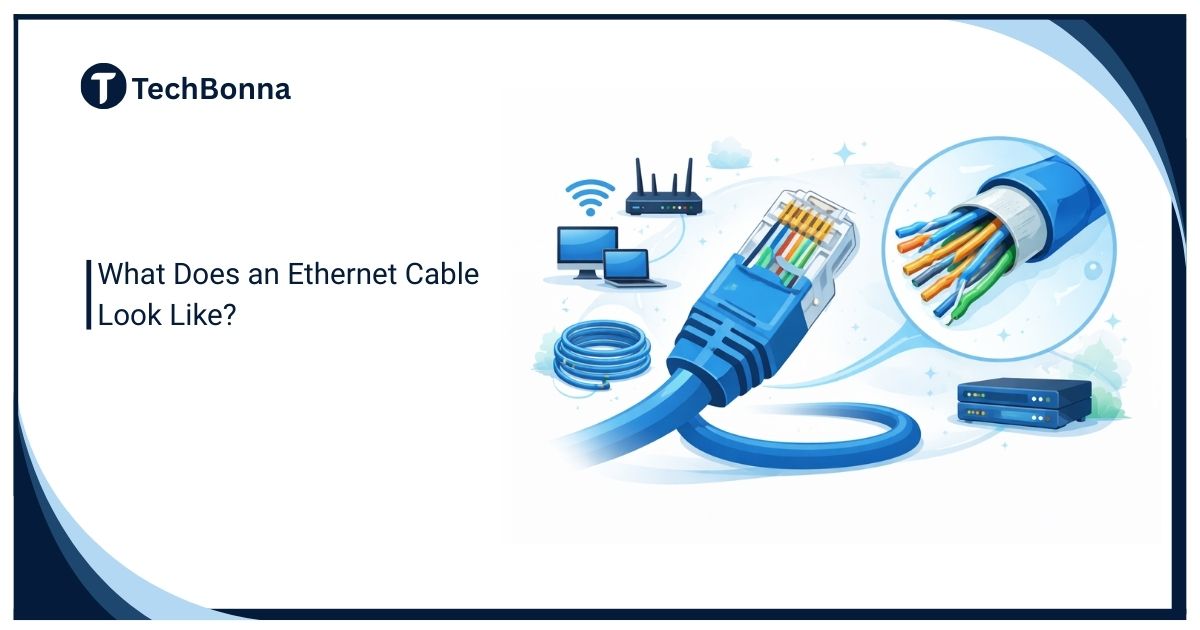
Table of Contents
What does an Ethernet cable look like when it is mixed in with phone cords, charging cables, and other wires? The easiest clue is the RJ45 connector: a wide, usually clear plastic plug with a locking clip and eight visible metal contacts.
This guide explains how to recognize an Ethernet cable, compare common Ethernet cable types, read the markings on the jacket, and choose the right cable for a router, computer, smart TV, game console, or home office.
In brief
What does an Ethernet cable look like? It usually looks like a round or flat network cable with a clear or semi-clear RJ45 connector on both ends. The plug is wider than an old telephone plug, has a flexible locking clip on top, and contains eight gold-colored contacts arranged in a row.
To identify one quickly, check for these features:
- A wide rectangular plug on each end
- Eight visible metal contacts inside the plug
- A small plastic locking clip
- A cable jacket marked Cat5e, Cat6, Cat6a, Cat7, or Cat8
- A plug that fits a LAN or Ethernet port on a router, switch, computer, TV, or console
What the RJ45 Connector Looks Like
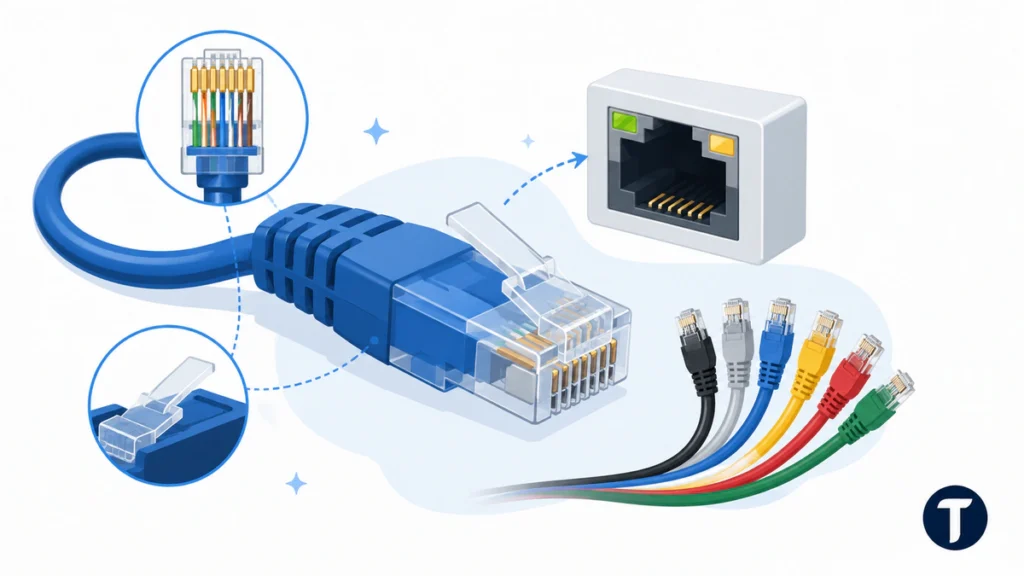
The connector is the fastest way to recognize an Ethernet cable. Most home and office patch cables use an eight-position modular plug commonly called an RJ45 connector. It resembles a larger telephone plug, but it is wider and has more contact points.
Look closely at the clear plastic tip. You should see eight narrow metal contacts across the front. A flexible tab sits on top and clicks into the matching port. Some cables also have a rubber or molded boot behind the plug to protect the tab from snapping.
The outside jacket may be blue, black, gray, white, yellow, red, green, or another color. Color is normally used for organization and does not tell you the cable’s speed. The Ethernet overview from NETGEAR provides a useful consumer explanation of how the cable connects devices to a local network.
Once you can identify the plug, TechBonna’s Ethernet cable color order guide explains T568A, T568B, wire sequencing, testing, and Power over Ethernet safety for readers who need to terminate or repair a cable.
Ethernet Cable Versus Similar Cables
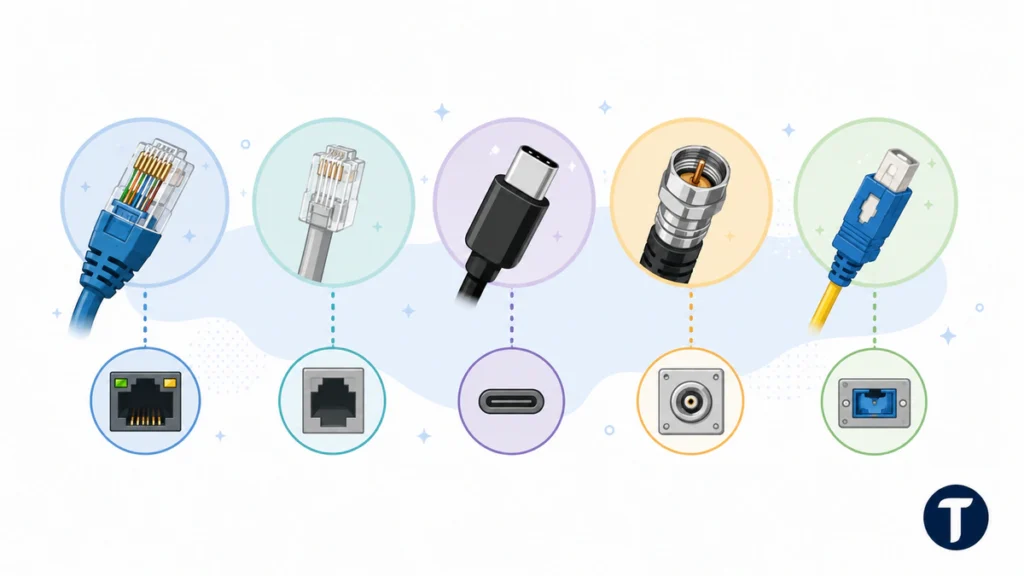
Ethernet cables are often confused with telephone, USB-C, coaxial, and fiber cables. The plug shape is more reliable than the cable color or thickness when you are sorting an unlabeled box of wires.
The IEEE 802.3 Ethernet standard covers the wider Ethernet technology family, while the everyday copper patch cable most people recognize uses twisted pairs and modular connectors.
Fluke Networks’ guide to twisted-pair cabling explains that the twists and differing twist rates help reduce crosstalk between conductors. It also notes that excessive untwisting at an RJ45 connector can worsen interference, which is why a cable’s internal pair arrangement matters even when the outer jacket looks normal.
| Cable Type | What the Connector Looks Like | Common Use |
|---|---|---|
| Ethernet | Wide clear plug, locking clip, eight contacts | Routers, switches, desktops, TVs, consoles, network wall jacks |
| Telephone | Narrow clear plug with fewer contacts | Landline phones and some older DSL connections |
| USB-C | Small rounded metal plug with no locking clip | Charging, displays, storage, phones, and laptops |
| Coaxial | Round metal connector that screws or pushes into place | Cable internet gateways, television, and antennas |
| Fiber | Small specialized connector attached to a thin cable | Fiber internet links and network backbones |
Never force a connector into a port. An RJ45 connector should slide into a matching Ethernet or LAN port and lock with a click. If the plug is too narrow, round, or metal, it is a different cable type.
How to Tell If a Cable Is Ethernet
Start with the plug, then confirm the markings printed along the jacket. This order prevents you from relying on color, thickness, or packaging claims alone.
Use this identification process:
- Inspect the plug. Look for a wide, clear or semi-clear rectangular connector.
- Count the contacts. A typical Ethernet plug has eight visible metal contacts.
- Find the locking clip. The small tab holds the plug securely inside the port.
- Check the jacket. Look for Cat5e, Cat6, Cat6a, Cat7, Cat8, UTP, STP, or similar markings.
- Compare the port. Match the plug with a LAN or Ethernet jack on a router, computer, switch, TV, or console.
- Inspect both ends. A normal patch cable has the same style of modular plug on both ends.
- Test it when needed. A basic cable tester can reveal broken, crossed, reversed, or missing conductors.
A cable can still be Ethernet even if it is flat, unusually thin, heavily shielded, or fitted with protective boots. The RJ45 connector and printed category are stronger clues than the cable’s shape.
What Is Inside an Ethernet Cable?
Most copper Ethernet cables contain four twisted pairs, for a total of eight insulated conductors. The pairs are twisted at different rates to help control interference and crosstalk while data moves through the cable.
The individual wires sit inside an outer jacket that protects them from bending, abrasion, and normal handling. Shielded cables add foil or braided protection around some or all of the pairs. Unshielded twisted pair, commonly labeled UTP, is widely used in homes and offices where interference is not unusually high.
Patch cables also differ by conductor construction. Stranded conductors are flexible and work well for short device connections. Solid conductors are more common in permanent runs inside walls or between a patch panel and wall jack. The connector, cable, and termination hardware should be designed to work together.
Do not assume that seeing eight wires means a cable is correctly built. Poor termination, excessive untwisting, damaged conductors, or low-quality connectors can cause slower negotiated speeds, packet loss, or an unreliable link.
Common Ethernet Cable Types and Their Appearance
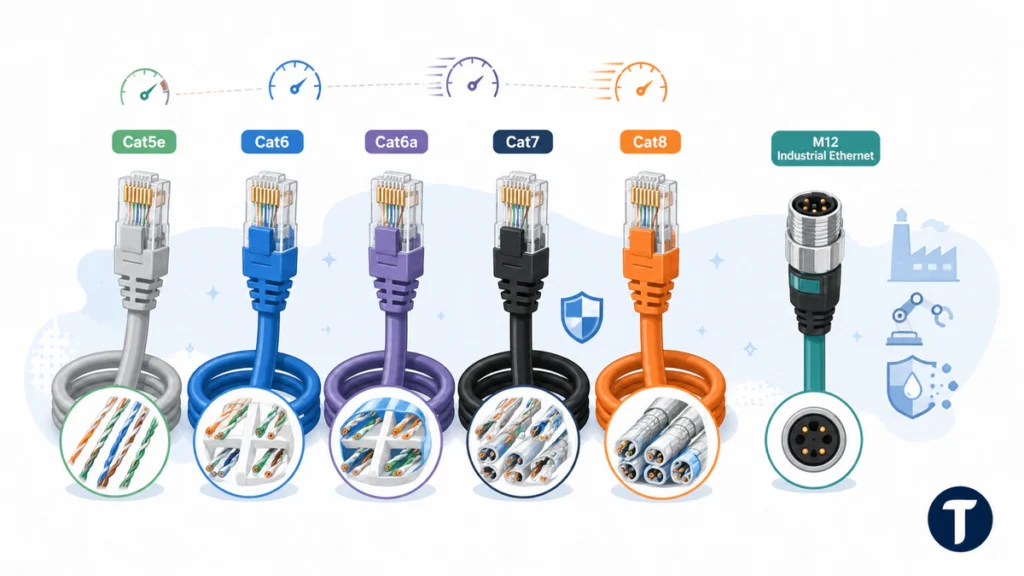
Ethernet cable types can look very similar from the outside. The printed category is usually more useful than jacket color, although higher-performance cables may be thicker, stiffer, or more heavily shielded.
Cat5e
Cat5e cables are often slim and flexible. They remain common for home and office Gigabit Ethernet connections. The jacket should clearly show Cat5e or Category 5e rather than only Cat5, which is an older category.
Cat6
Cat6 is a practical choice for many modern homes, desks, gaming setups, smart TVs, and small offices. It may be slightly thicker than Cat5e and may include an internal separator that helps keep the twisted pairs apart.
Cat6 supports Gigabit Ethernet over standard channel lengths and can support 10 Gigabit Ethernet over shorter runs when the equipment and installation meet the required conditions.
Cat6a
Cat6a is commonly thicker and less flexible because it is designed for stronger crosstalk control. It supports 10 Gigabit Ethernet over a full 100-meter channel when properly installed, making it useful for longer high-speed runs and structured cabling.
Cat7 and Cat8
Cat7 and Cat8 cables are usually thick, shielded, and more expensive. Cat8 is intended for short, very high-speed links in specialized environments such as data centers. Most home users gain little from buying Cat8 for a television, console, or standard router.
Category labels alone do not guarantee quality. Check the manufacturer, conductor material, connector construction, certification claims, length, shielding, and intended installation environment before paying for a higher number.
M12 Industrial Ethernet
M12 Ethernet cables look different because they use small round locking connectors designed for industrial equipment. They may appear in factories, vehicles, outdoor systems, and places exposed to vibration, dust, or moisture.
An M12 connector is not the standard clear RJ45 connector used on most home patch cables. Confirm the device port and pin configuration before buying one.
Where Ethernet Cables Plug In
Ethernet cables connect to rectangular ports commonly labeled Ethernet, LAN, network, or with a network symbol. These ports may appear on:
- Routers and modem-router gateways
- Network switches
- Desktop computers and laptop docks
- Smart TVs and streaming boxes
- Game consoles
- Network-attached storage devices
- Printers and security cameras
- Wireless access points and mesh units
- Wall plates in wired homes and offices
A matching port usually has a notch for the locking clip. Many devices also place one or two indicator lights beside the port. A steady or blinking light can show that a physical link exists and data is moving, although the exact light behavior depends on the equipment.
Some thin laptops and tablets do not include a built-in Ethernet port. They may need a compatible USB-to-Ethernet adapter or docking station.
How to Choose the Right Ethernet Cable
The best cable is not automatically the category with the highest number. Choose one that matches the device ports, expected speed, distance, and installation path.
For most short home connections, a reputable Cat6 patch cable is a sensible default. Consider Cat6a when you are installing longer structured runs, preparing for 10 Gigabit Ethernet, or working in a busier network environment.
Before buying, check:
- Port speed: A Cat8 cable will not turn a 1 Gbps router port into a faster port.
- Length: Buy enough cable to route it safely without leaving a large coil or pulling the connector tight.
- Jacket rating: Use indoor, outdoor, riser, or plenum-rated cable where the location requires it.
- Shielding: Shielded cable can help in electrically noisy areas but must be installed and grounded correctly.
- Conductor material: Prefer properly specified copper cable from a reputable manufacturer, especially for permanent wiring or Power over Ethernet.
- Cable shape: Round cable is a reliable general choice. Flat cable can be convenient in tight spaces but should not be crushed under furniture or used as a substitute for properly rated in-wall cable.
- Connector protection: A molded boot can protect the locking clip in frequently handled setups.
Avoid buying solely from claims such as “gaming cable,” “ultra-fast,” or “future-proof.” The category, construction, test certification, and compatibility matter more than marketing language.
Why Use Ethernet Instead of WiFi?
Ethernet provides a direct wired path between the device and the router or switch. That can reduce radio interference and make performance more consistent for desktop computers, workstations, video calls, online gaming, smart TVs, and large file transfers.
A wired connection is not automatically faster in every setup. Speed is limited by the slowest part of the path, including the device port, router or switch port, cable quality, local network traffic, and internet plan. Ethernet also cannot repair an outage from the internet service provider.
Still, testing with a known-good cable is a useful troubleshooting step. If Ethernet works while WiFi does not, the internet service may be active and the problem may be limited to wireless coverage, interference, router settings, or the device’s WiFi connection.
Common Mistakes to Avoid
Many cable problems come from identification or buying errors rather than the Ethernet standard itself.
Avoid these mistakes:
- Confusing a narrow telephone plug with an RJ45 connector
- Assuming cable color determines speed
- Buying Cat8 for ordinary home equipment that cannot use it
- Running an indoor cable outdoors or through an unsuitable building space
- Choosing a cable that is too short and placing tension on the plug
- Hiding a cable where chairs, doors, pets, or furniture can damage it
- Using a damaged locking clip that lets the connector slip out
- Trusting the jacket label without checking the seller and cable construction
- Making a custom cable without testing all eight conductors
Replace a cable if the plug is cracked, the clip is broken, the jacket is cut, copper is exposed, or the connection drops when the cable is moved.
Follow-up questions
What Color Is an Ethernet Cable?
Ethernet cables can be blue, black, gray, white, yellow, red, green, or almost any other color. The outside color is usually for organization. Read the jacket and inspect the RJ45 connector to identify the cable.
Is an Ethernet Cable the Same as a Phone Cable?
No. An Ethernet plug is wider and normally has eight contacts. A phone plug is narrower and usually has fewer contacts. They may look similar from a distance, but they fit different ports.
What Does an Ethernet Cable Look Like for a TV?
It looks like a standard Ethernet patch cable with an RJ45 connector on each end. One end plugs into the TV’s LAN or Ethernet port, and the other connects to a router, gateway, switch, or network wall jack.
Do All Ethernet Cables Have Eight Wires?
Modern copper Ethernet cables commonly contain four twisted pairs, or eight conductors. Specialized Ethernet systems may use different media or connectors, so identify the application before cutting or replacing a cable.
Is Cat6 or Cat8 Better for Home Internet?
Cat6 is the better value for most home connections. Cat8 supports specialized short-distance high-speed links, but ordinary routers, consoles, televisions, and computers usually cannot benefit from its maximum capability.
Can an Ethernet Cable Improve Internet Speed?
It can improve the speed and stability between a device and local network equipment when WiFi is the bottleneck. It cannot increase the maximum speed of the internet plan or make slow device ports operate faster.
Where this leaves you
What does an Ethernet cable look like? Look for a wide clear plug, eight contacts, a locking clip, and category markings along the jacket. Once you recognize the RJ45 connector and understand the main Ethernet cable types, you can separate network cables from phone and charging cords, choose a suitable cable, and build a more reliable wired connection without overspending.


One Comment
Comments are closed.