AI Transformation Is a Problem of Governance in 2026
Introduction
Over the last few years, companies have rushed to embed artificial intelligence into everything: customer service, underwriting, diagnostics, logistics, hiring, forecasting, fraud detection. The budgets are real. The pilots are impressive. The executive presentations look polished. And yet, a large percentage of AI initiatives either stall after proof-of-concept, fail to scale across the enterprise, or create new categories of risk that leadership did not anticipate.
The recurring pattern is this: organizations assume AI transformation is a technology challenge. They focus on models, infrastructure, data science hires, and cloud capacity. But in practice, AI transformation is a problem of governance. The real friction emerges around accountability, risk ownership, regulatory exposure, ethical boundaries, escalation protocols, and decision rights.
When AI systems begin influencing high-impact decisions—who gets approved for credit, which patient receives a diagnostic flag, how insurance premiums are priced, which job candidates are shortlisted—the issue is no longer technical optimization. It becomes a question of power and responsibility. Who decides? Who monitors? Who intervenes? Who answers when something goes wrong?
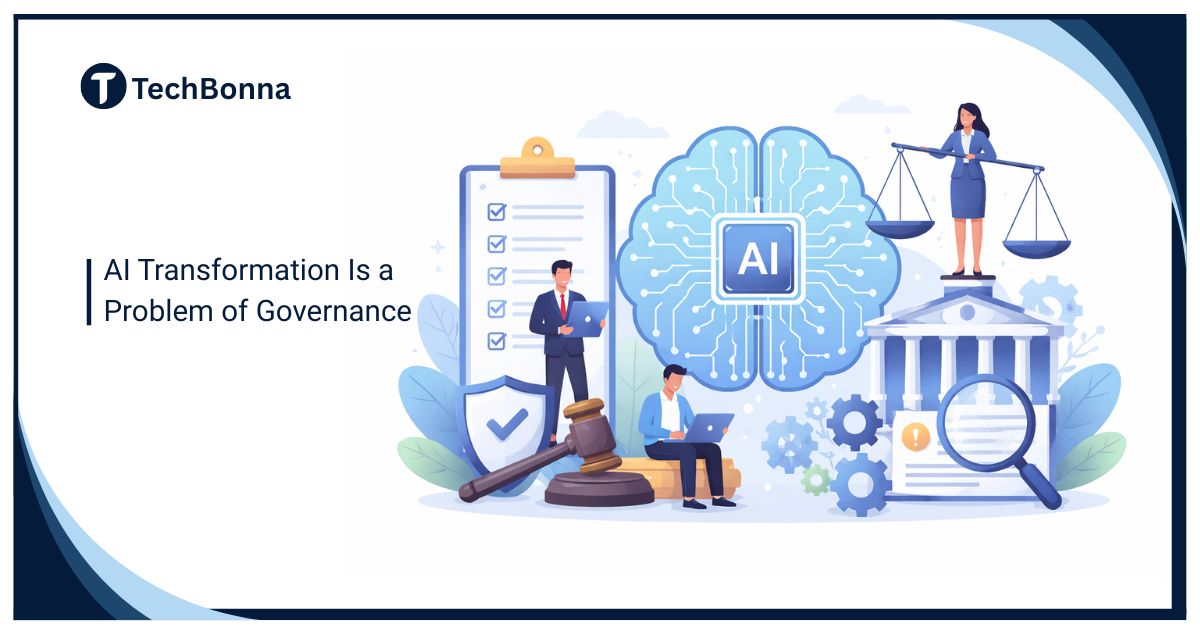
AI transformation fails not because organizations lack algorithms, but because they lack governance structures that can handle algorithmic authority at scale.
The companies that succeed in the AI era understand something fundamental: AI changes how decisions are made. Governance determines whether those decisions create value or liability.
What Does AI Transformation Is a Problem of Governance Really Mean?
Governance vs Management vs Technology
To understand the governance problem, we need clarity on terms.
- Technology builds the system.
- Management operates the system.
- Governance defines the authority, accountability, and oversight surrounding the system.
Governance is about rules, structure, and responsibility. It defines who is empowered to act and who is accountable for consequences.
In the AI era, governance must answer questions such as:
- Who approves the use of AI in high-risk contexts?
- Who sets acceptable error thresholds?
- Who signs off on deployment?
- Who reviews model drift?
- Who owns the consequences of harm?
Without clear answers, AI becomes an unmanaged force inside the organization.
Decision Rights in the AI Era
AI reshapes decision rights. Traditionally, decisions were made by human managers with defined reporting lines. Now, decisions may be partially or fully automated.
Consider:
- An AI model flags a transaction as fraudulent.
- A recruitment algorithm ranks candidates.
- A predictive model adjusts pricing dynamically.
If a wrong decision occurs, accountability can become blurred across data teams, product managers, compliance officers, and business leaders. Governance must clarify decision rights before a crisis forces clarity.
Who Owns AI Risk?
AI risk is multidimensional:
- Legal liability
- Regulatory non-compliance
- Bias and discrimination
- Reputational damage
- Operational instability
- Financial exposure
In many organizations, AI risk is diffused. IT assumes legal will manage compliance. Legal assumes product owns deployment. Product assumes data science owns model integrity.
Governance resolves this fragmentation by explicitly assigning ownership.
Why AI Changes the Power Structure of Organizations
AI introduces a subtle but powerful shift: algorithms influence outcomes that were previously human-controlled. Data teams gain strategic influence. Model outputs shape executive decisions. Predictive analytics influence capital allocation.
Governance must manage this shift in power deliberately. Otherwise, authority drifts without accountability.
Why AI Transformation Has Become a Governance Crisis in 2026
Scale and Autonomy of AI Systems
AI systems today operate at scale and with increasing autonomy. A flawed rule in a traditional process might affect dozens of decisions. A flawed model can affect millions in minutes.
Autonomous decision loops—where systems act without immediate human validation—raise the stakes further. Governance frameworks must evolve accordingly.
Regulatory Pressure (EU AI Act, Global Shifts)
Regulatory environments have matured rapidly. High-risk AI systems are now subject to documentation, risk assessment, transparency requirements, and ongoing monitoring obligations.
Organizations that treat compliance as an afterthought face severe financial and reputational consequences.
Shadow AI Proliferation
Employees often adopt generative AI tools independently to increase productivity. Sensitive company data may be shared externally without formal review. Governance gaps create invisible exposure.
Shadow AI is rarely malicious. It is often a symptom of slow internal approval processes.
Data Fragmentation Across Enterprises
AI depends on data integrity. Yet most enterprises operate with siloed, inconsistent datasets. Fragmented governance leads to inconsistent model performance and regulatory vulnerability.
Misaligned Executive Incentives
Innovation teams are rewarded for speed and market impact. Risk and compliance teams are rewarded for control and stability. Without aligned incentives, governance becomes adversarial instead of strategic.
The Governance Gaps Killing AI Strategies
No Clear Ownership of AI Strategy
Many organizations appoint AI leads without granting enterprise authority. Strategy becomes fragmented across departments.
Weak Board-Level Oversight
Boards often receive limited AI reporting. Oversight becomes reactive—only after incidents occur.
Inconsistent Data Governance Standards
Different business units apply different data quality and retention standards, increasing systemic risk.
Lack of Model Accountability
Models are deployed without clear retraining schedules, performance thresholds, or escalation protocols.
Poor Risk Escalation Processes
When anomalies arise, organizations struggle to determine who must act and how quickly.
Ethical Principles Without Enforcement
Public AI principles often lack operational metrics. Without enforcement mechanisms, they remain aspirational.
AI Treated as IT Instead of Enterprise Risk
AI influences revenue, brand trust, regulatory compliance, and investor confidence. Treating it solely as a technical function underestimates its reach.
What Makes AI Governance Different from Traditional IT Governance?
AI Systems Learn and Evolve
Unlike static IT systems, AI models adapt. Governance must address model drift, retraining cycles, and evolving risk profiles.
Unpredictability and Emergent Behavior
AI systems may produce outputs that were not explicitly programmed. Governance frameworks must anticipate uncertainty.
Ethical Risk Beyond Cybersecurity
Traditional IT governance focused heavily on data protection. AI governance must address fairness, bias, explainability, and societal impact.
Continuous Monitoring vs Static Controls
Periodic audits are insufficient. AI systems require real-time oversight and dynamic risk management.
The Core Pillars of Effective AI Governance
1. Data Governance and Sovereignty
Clear policies must define data ownership, access rights, cross-border transfers, and quality standards. Data flaws directly translate into model flaws.
2. Model Governance and Lifecycle Oversight
Organizations need structured lifecycle management covering:
- Validation
- Documentation
- Testing
- Deployment
- Monitoring
- Retirement
3. Risk and Compliance Architecture
AI risk should be embedded into enterprise risk management, not isolated in technical teams.
4. Human-in-the-Loop Oversight
For high-risk systems, human review thresholds must be defined clearly.
5. Transparency and Explainability
Stakeholders—including regulators and customers—must be able to understand how outcomes are generated.
6. Performance & Outcome Accountability
AI systems should have measurable KPIs tied to business objectives and risk tolerance.
The AI Governance Maturity Model
1 – Ad Hoc AI Usage
Uncoordinated experimentation. No structured oversight.
2 – Controlled Experiments
Pilot programs with limited documentation.
3 – Structured Governance Framework
Formal policies and designated ownership.
4 – Enterprise AI Operating Model
Standardized governance integrated across departments.
5 – Governance as Strategic Advantage
Governance becomes a trust signal and competitive differentiator.
The Role of the Board and Executive Leadership
Boards must define AI risk appetite, demand structured reporting, and ensure alignment between innovation and compliance.
Executives must:
- Assign clear AI ownership.
- Integrate AI oversight into strategic planning.
- Balance speed with responsibility.
Governance shifts the leadership conversation from “Can we deploy this?” to “Should we deploy this?”
Linking AI Governance to Business Results
Strong governance produces measurable benefits:
- Reduced legal exposure
- Lower reputational volatility
- Improved investor confidence
- Higher customer trust
- More stable model performance
Governance does not block innovation. It enables sustainable innovation.
What Happens When AI Transformation Lacks Governance?
Without governance, organizations face:
- Regulatory penalties
- Public backlash
- Biased outcomes
- Financial loss
- Strategic paralysis
AI amplifies both success and failure. Governance determines which one scales.
Step-by-Step Roadmap to Build an AI Governance Framework
- Define AI vision and risk appetite.
- Assign executive-level accountability.
- Map AI use cases and categorize risk.
- Implement structured data and model governance.
- Translate ethical principles into enforceable policy.
- Build monitoring dashboards and escalation protocols.
- Conduct recurring audits and framework updates.
Governance is not a one-time project. It is an ongoing capability.
Conclusion: Governance Is the Real Competitive Advantage in the AI Era
The defining question of 2026 is no longer whether organizations will use AI. They will. The real question is whether they will govern it effectively.
AI transformation is a problem of governance because it reshapes decision-making authority, redistributes risk, and amplifies impact at scale. Technology enables power. Governance controls it.
Organizations that treat governance as a strategic capability not a compliance burden will build resilient, trusted, and scalable AI systems. In the AI era, the strongest competitive advantage will not be smarter algorithms. It will be stronger governance.