
How Can Proxies Reduce Geographic Bias in Web Data?
Table of Contents
Geographic bias can make web data look more complete, neutral, or universal than it really is, while geographical bias can also hide which regions a dataset underrepresents. When a team collects results from one city, one country, or one IP address, the system built from that data may miss prices, search results, product availability, regulations, language signals, and customer experiences seen elsewhere.
A careful proxy provider strategy helps teams compare those differences instead of guessing. By collecting web data from several locations, researchers can test proxy security, access patterns, search visibility, and regional content before using the results for business decisions. This turns a vague concern into a technical guide for repeatable verification.
What it means
Proxies reduce geographic bias in web data by letting researchers collect the same page, search result, or platform response from multiple regions. Instead of relying on one location, a team can compare how content changes by country, state, city, language, IP address, and network type.
This helps reveal location-based pricing, regional indexing, ad targeting, product availability, search result variation, blocked pages, and local compliance differences. The strongest setup uses clean locations, repeatable collection rules, transparent proxy logs, and human review so the team can separate true regional differences from bot blocks, bad routing, or data collection errors.
Why Geographic Bias Changes Web Data
Geographic bias happens when data overrepresents some places and underrepresents others. In mapping work, this is often discussed as spatial bias because some places become easier to see than others. Imperial College London gives a useful explanation of what geographic bias means in research, especially when evidence is easier to find from high-income countries than from low-income countries or remote areas.
The same problem appears on the web because websites do not show every visitor the same version of reality. A single-location crawl may show one set of prices, one language, one legal banner, one content library, or one search result page. That does not mean the same data is visible from other regions.
Search engines, marketplaces, travel platforms, streaming services, and local directories often use geography as a ranking or access signal. A query from New York can return different search results than the same query from Dallas, Toronto, Berlin, or Manila. A data team that ignores that difference can train a model on a narrow slice of the market.
This creates a research gap. The dataset may look large, but its mapping is uneven, and a data repository may still fragment when regional samples are missing. It may describe urban users better than rural users, high-income markets better than emerging markets, or English-language pages better than multilingual search behavior.
Where Proxies Fit in Bias Testing
A proxy sits between the data collection tool and the destination website. The Internet Engineering Task Force describes this intermediary role in the HTTP Semantics section on proxies. In practical web research, the proxy changes the outward network path, which can change the IP address, location signal, and sometimes the content returned by the site.
This is also where a proxy provider can support cleaner regional testing. The goal is not to hide poor data collection practices. The goal is to collect comparable results from planned locations so analysts can see when geography changes the answer.
For a simpler provider-selection view, TechBonna also has a proxy provider checklist that explains how to compare IP quality, documentation, proxy security, pricing, and support before choosing infrastructure.
A good proxy setup lets a team test the same page from several locations, rotate IPs without breaking the study design, and verify whether a result appears because of geography or because one request was blocked. It also helps with ad verification, SEO checks, product monitoring, fraud research, and market analysis where location can change visibility.
How to Design a Multi-Location Collection Test
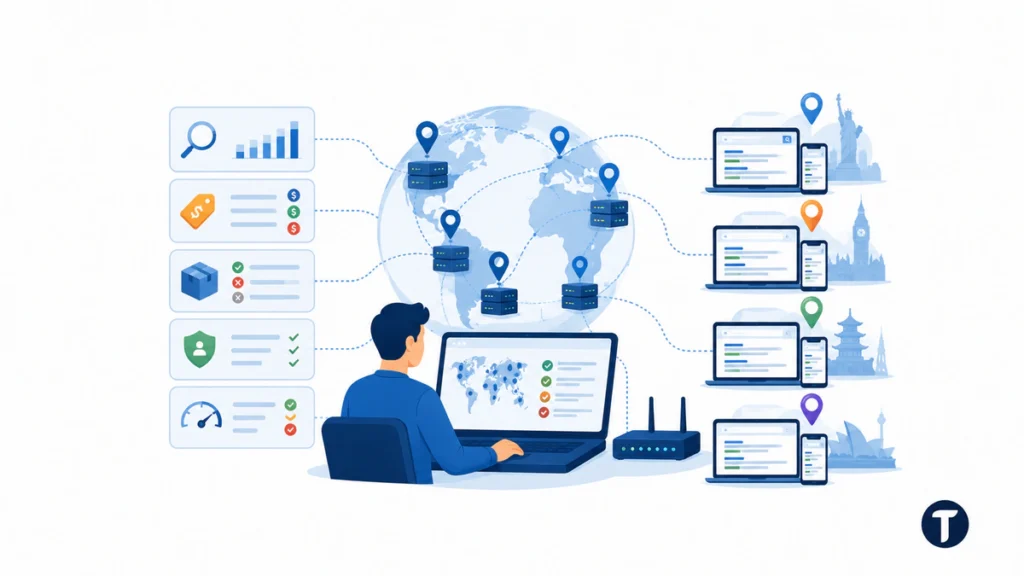
Reducing bias starts with study design, not with buying the largest proxy pool. A team should define the locations, timing, content type, and validation rules before collecting data. Otherwise, the proxy network can add noise instead of improving reliability.
Start with one clear question. For example, “Do users in different states see different delivery prices?” is easier to test than “Does the website vary by location?” Then choose the minimum set of locations needed to answer that question.
| Test Area | What to Compare | Why It Matters |
|---|---|---|
| Search Visibility | Rankings, snippets, local packs, ads, and language | Shows whether search results change by geography |
| Pricing | Product price, shipping fees, currency, and discounts | Reveals regional price differences and offers |
| Availability | Stock status, delivery area, blocked pages, and content access | Finds gaps that a single-location crawl would miss |
| Compliance | Consent banners, terms, privacy notices, and age gates | Checks whether legal experiences vary by region |
| Quality Control | Status codes, redirects, CAPTCHAs, and success rate | Separates real regional differences from collection errors |
Use repeatable rules for time of day, user agent, device type, cookies, language headers, and session length. If those inputs change randomly, the team may blame geography for a difference caused by browser settings or session history.
What Proxy Types Help Reduce Location Bias?
Different proxy types solve different problems. Residential proxies can help when a site responds differently to consumer network traffic. Datacenter proxies can work for faster, lower-cost checks where the site does not treat hosting networks differently. ISP proxies can help when a workflow needs a stable IP address for a longer session.
Mobile proxies may be useful when the research question involves mobile-only content, carrier routing, or app-like behavior. SOCKS5 can fit some technical workflows, while HTTP proxies are often simpler for web pages and API-style collection.
The best proxy type is the one that matches the bias you are trying to measure. If the study is about local search results, location accuracy matters more than raw bandwidth. If the study is about product pages at scale, success rate, rotation, and proxy pool health may matter more.
Free proxies usually do not belong in serious web data work. They can be unstable, slow, reused by unknown users, or risky for sensitive workflows. A reliable proxy service should offer documentation, authentication, usage controls, and enough transparency to explain where requests are coming from.
How Proxies Improve Model and Dataset Quality
Machine learning algorithms are only as balanced as the data that feeds them. If a dataset contains mostly results from high-income countries, one language group, or one city, an algorithm may learn patterns that fail elsewhere. That problem can affect pricing systems, recommendation tools, SEO tools, risk scoring, and market intelligence dashboards.
Collection geography is only one part of that. NIST research on identifying and managing bias in AI separates statistical bias in the data from the human and systemic decisions that shaped which data existed to collect. Multi-location proxy sampling addresses the first honestly; it does not settle the second, and reports should say so.
Proxies help by making geographic coverage visible. Analysts can label data by collection location, compare regional outputs, and quantify how much the answer changes across countries or cities. This creates a stronger foundation for evaluation because geography becomes a tested variable rather than an implicit assumption.
For example, a travel company might collect hotel listings from five countries to verify whether offers, fees, and availability match. A retail team might compare local delivery promises. An SEO team might collect search results from target markets to assess local visibility instead of relying on its office location.
That does not remove every skew. It does make the issue easier to detect, document, and reduce before the data reaches reporting or automation.
How to Keep Proxy Research Compliant and Reliable

Responsible proxy usage starts with purpose, permission, and restraint. Teams should read website terms, avoid sensitive personal data, respect robots and rate limits where applicable, and collect only what the business needs. Proxy infrastructure should not be used to bypass security controls, overload websites, or disguise abusive behavior.
Compliance also depends on recordkeeping. Keep a log of the location tested, proxy type, time, target URL, status code, redirect path, and collection result. If a result looks unusual, analysts should be able to replay the test or compare it against another location.
Proxy security matters as well. Credentials should be stored securely, access should be limited to approved users, and API keys should not sit inside shared scripts or spreadsheets. Teams should also monitor bandwidth, errors, and suspicious traffic patterns so a technical issue does not corrupt the dataset.
Data availability should be reviewed honestly. If a region produces fewer results because pages are unavailable, blocked, or not indexed, that absence is part of the finding. Do not fill gaps with assumptions just to make a table look complete.
Common Mistakes That Reintroduce Bias
Proxies can reduce location skew, but a weak process can bring it back. The most common mistake is using many IPs while testing only one country, one language, or one type of network. That creates the appearance of variety without real geographic coverage.
Another mistake is mixing residential proxies, datacenter proxies, and mobile proxies in the same test without labeling them. If one group gets blocked more often, the results may reflect proxy type rather than geography.
Teams also create problems when they rotate too aggressively. Constant rotation can break sessions, trigger bot defenses, or make a site return fallback content. For some tests, static residential proxies or sticky sessions produce cleaner data than rapid rotation.
- Do not compare locations unless browser, language, and cookie settings are controlled.
- Do not treat a CAPTCHA or block page as normal content.
- Do not combine fresh and cached results without labeling them.
- Do not average regional results before checking outliers.
- Do not use a single success rate to judge every location.
The safest workflow is to run a small pilot, inspect the outputs manually, then scale only after the team knows what normal regional variation looks like.
Related questions
Can Proxies Remove Geographic Bias Completely?
No. Proxies can reduce geographic bias by improving coverage and making location differences measurable, but they cannot remove every source of location skew. Website personalization, language, device type, cookies, time, and account history can still affect results.
Are Residential Proxies Better for Location Testing?
Residential proxies are often useful when a site treats consumer network traffic differently from datacenter traffic. They are not automatically better for every use case. The right choice depends on the target site, study design, location needs, proxy security requirements, and budget.
How Many Locations Should a Web Data Test Use?
Use enough locations to answer the research question. A local SEO test may need city-level coverage. A pricing study may need the main markets where customers buy. A global model audit may need a broader sample that includes high-income, middle-income, and low-income countries.
Can Proxies Help with SEO Research?
Yes. Proxies can help SEO teams compare regional search results, local packs, ads, snippets, and competitor visibility. The team should still control device, language, and search settings so the SEO test measures geography rather than unrelated variables.
What Is the Biggest Risk in Proxy-Based Data Collection?
The biggest risk is mistaking technical artifacts for real regional differences. Blocks, redirects, cached pages, bad IP reputation, and inconsistent sessions can all distort web data. Verification steps are essential.
The takeaway
Proxies reduce regional distortion when they are used as part of a clear research method. Define the locations, control the collection settings, label every dataset, and verify unusual results before using them in a model, report, or dashboard.
The real value is not just access to more IPs. It is better evidence. When teams combine geographic bias testing, balanced web data, and a reliable proxy provider strategy, they can make decisions from a broader and more honest view of the web.